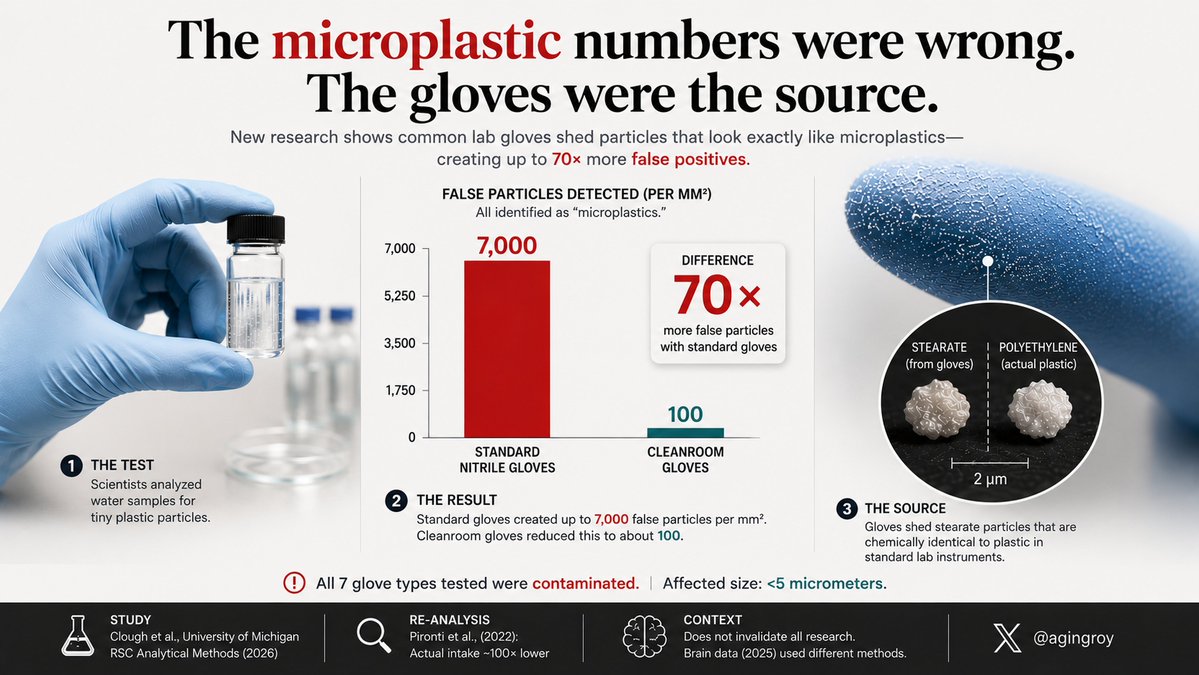
7,000 false positives per square millimeter. The culprit was the lab gloves.
University of Michigan researchers just upended a core assumption in microplastics science. Latex and nitrile gloves, worn by the scientists doing the measuring, shed stearate particles that look chemically identical to polyethylene. Standard infrared and Raman instruments can't tell them apart. The gloves were counting as plastic.
Seven glove types tested. All contaminated. The cheapest fix: switch to cleanroom gloves, which dropped false positives to around 100 per mm² vs. 7,000.
The "credit card per week" headline (5 grams, WWF/Newcastle 2019) has separate problems. A 2022 re-analysis found severe methodological errors in the original estimate. Actual measured intake is likely 100x lower.
None of this means microplastics are harmless. Last month's data on brain accumulation still stands. But the numbers driving the panic may have been measuring the scientists, not the environment.
Science catching its own errors is exactly how it's supposed to work.
People will look you dead in the eye and tell you that correlation implies causation here without disaggregating the numbers to see if that makes any sense.
One concept I wish more people were aware of is the Tocqueville Effect.
Named for Alexis de Tocqueville, this concept describes the curious phenomenon by which people become more frustrated as problems are resolved:
As life gets better, people think it's getting worse!🧵
wait this graph is crazy
BART installed anti-fare-hopping gates and the amount of station maintenance and cleanup they had to do went to basically zero
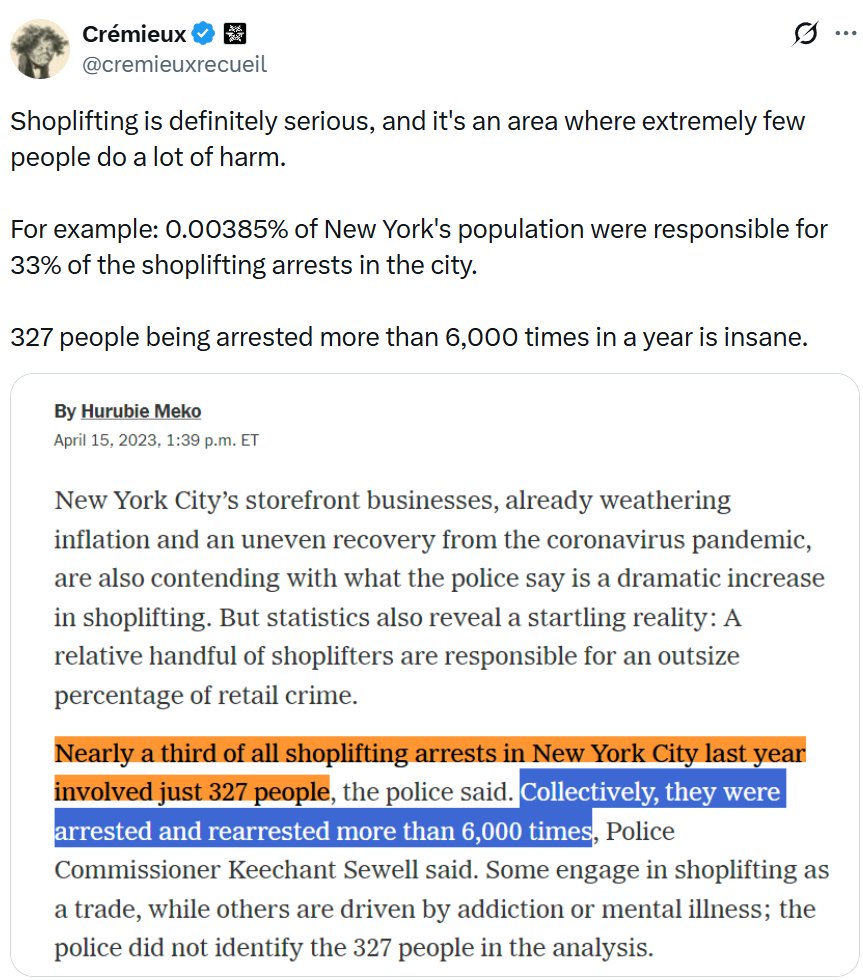
strong evidence that the poor condition of public transit is fairly easy to fix + caused by a very small group of people
Yield curve inversion looks like it's become a less useful economic indicator than it used to be.
Since it inverted in April 2022, the economy seems to have been fine. That's a long time for nothing to happen!
@davidasinclair Yeah, between this the blueberries, the 10,000 steps drinking açai and a little bit of pomegranate, red light therapy, hyperbaric, oxygen chamber, hydrogen water breath work Pilates Roomba smiling 12 times a day gonna start reversing my age I should be -20 in a couple of weeks
I’m sharing my slide deck on the demographic future of humanity,
🔗 Slides: https://t.co/geZQFXwN8h
prepared for the keynote address I will give tomorrow to the 7th EBRD and CEPR Research Symposium on “The Economics of Demographic Change”:
🔗 Symposium: https://t.co/L9Hn1fKA8A
Here are a few key ideas I’ll be discussing tomorrow, some of which even economists tracking population trends may not fully appreciate:
1️⃣ Fertility is falling everywhere: rich and poor countries alike, booming and stagnating economies, secular and religious societies. The decline is happening far faster than anyone anticipated, even me, ten years ago!
2️⃣ For example, Colombia’s fertility rate is 1.06, Iran’s is 1.44, and Turkey’s is 1.48, all of which are below the U.S.
3️⃣ The decline accelerated around 2014, well before the COVID pandemic.
4️⃣ As a result, humanity’s fertility is likely already below the replacement rate.
5️⃣ Many assume the replacement rate is 2.1 children per woman. That’s true for rich, advanced economies. But not for emerging economies, where selective abortion and higher young female mortality push the replacement rate higher. Thus, for humanity, the replacement rate is closer to 2.2.
6️⃣ The 2024 UN World Population Prospects are riddled with data and forecasts that, frankly, make little sense to my coauthor Patrick Norrick (at @AEI) and me.
7️⃣ Most of the differences in economic growth among advanced economies over the past 35 years can be attributed to demographic factors. Once adjusted for this, Japan’s economic performance is roughly on par with the U.S. (See my paper with Gustavo Ventura, @King_ofSweden, and Wen Yao, The Wealth of Working Nations):
🔗https://t.co/lm2iigVk7E
There are many other ideas (I could talk about this for hours!), but here’s the punchline: the world’s fertility crisis is worse than you thought, even after considering you already thought it was bad.
@ArendJanKamp Heffingen in de derde kolom zijn de helft van de tweede kolom (naar boven afgerond), uitgezonderd van Vietnam en Japan die er 'onterecht' één procentpunt bovenop krijgen?