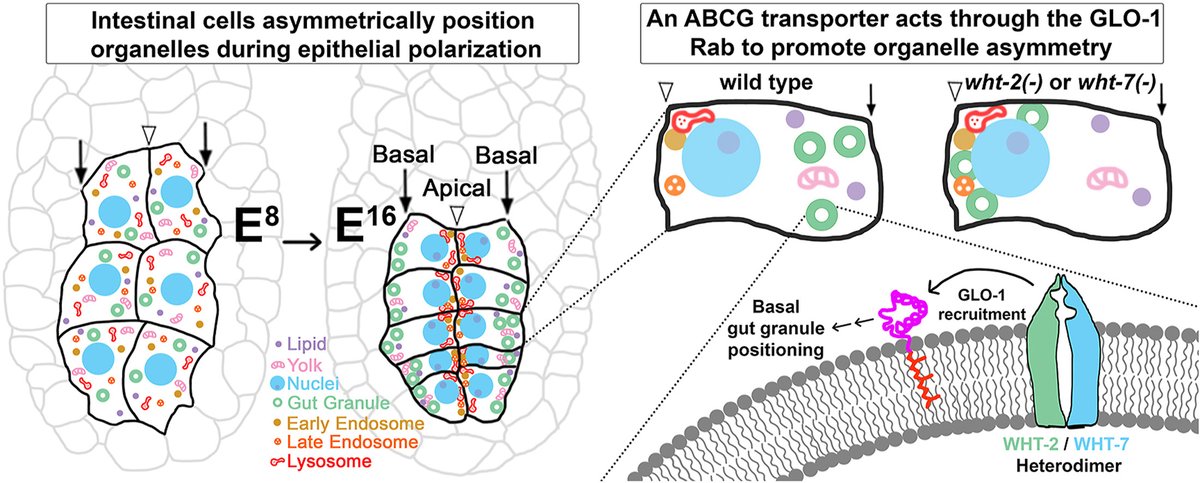
Hi all, our work from Greg Hermann's lab on embryonic organelle asymmetry in C. elegans is up @Dev_Bio_Journal We characterize vast organelle asymmetry during epithelial polarization and show that Rab GTPase recruitment controls asymmetry of endocytic LROs
https://t.co/i4gU6ZtHxM
@eric_is_weird Very little disclosure because they are all relying on the same robotic platforms. You can’t differentiate in this space without proprietary hardware
Can someone please explain to me the difference between saying this to juice your IPO vs Elizabeth Holmes claiming research progress during fundraising?
@DrMorganLevine You could also reframe this as considering the gap between human intelligence and ant intelligence. Obviously you can’t teach the smartest ant algebra. When does the gap between human and AI resemble the gap between human and ant? How will we know when we get there?
Impressive work by Robin and the @LionBioNP team here. GLP-1 delivery methods have been a bottleneck for a while, and I’m glad they are finally driving innovation in this space.
Four years ago a few of us at a16z started @speedrun to back founders at the earliest stages. A year ago I left to become one.
Today I can share what we’ve been building at LionBio: a nasal spray GLP-1 backed by a $6M pre-seed from SPC.
Four years ago a few of us at a16z started @speedrun to back founders at the earliest stages. A year ago I left to become one.
Today I can share what we’ve been building at LionBio: a nasal spray GLP-1 backed by a $6M pre-seed from SPC.
Speculative Programmatic Tool Calling (sPTC) using Jev as a just-in-time approver unlocks sPTC for general tools like bash or computer use where early execution safety depends on tool inputs.
blog (with code): https://t.co/HA8SksTrsB
Nice argument. However, I have already depicted myself as the serene and rational Barn Owl chicks, and you as the disarrayed and screeching Kestrel chicks.
@patrickc The Ruta lab is doing great work understanding how olfactory receptors can detect and discriminate between the expansive chemical space of odorants. And, how evolutionary changes in the structural recognition can drive mating strategies. https://t.co/axMjOcweuA
@AdrianoAguzzi The simplest way to assay protein-protein while bypassing BSL2 would be recombinant pull down assays. Express/purify tagged candidates independently in HEK cells. Bait with GSt-PrPSc and co mix with your candidate interactors - titrate for stochiometey and relative affinities
I have hesitated to share this document I received earlier this year, mostly for my own sanity, but on this, the anniversary of my father's death, I feel obliged to share it in hope that it leads to someone somewhere having a better fate than him.
@DrBPChamberlain recommending Albert’s as if it’s a summer reading list is so funny to me. Also fuck “The Double Helix” - this is propoganda meant to distract from the fact the double helix idea only came to them after rummaging through Rosalyn Franklins primary data (which showed a double helix)
Could one envision a synthetic receptor technology that is fully programmable, able to detect diverse extracellular antigens – both soluble and cell-attached – and convert that recognition into a wide range of intracellular responses, from transgene expression and real-time fluorescence to modulation of innate cell behavior (excitation or inhibition of neurons, induction of cell migration, etc.)?
Today we report in Nature a new technology platform that provides a step in that direction: PAGERs, for Programmable Antigen-gated G protein-coupled Engineered Receptors, convert recognition of extracellular soluble or cell-attached antigens into diverse user-selected responses. PAGERs are based on G-protein coupled receptors (GPCRs), which themselves are not structurally modular, but we were able to build in modular antigen gating by fusing an antagonist peptide to the extracellular N-terminal end, and then gating the antagonist with a fused antigen-binding nanobody. When antigen binds, it sterically interferes with the antagonist, leading to relief of receptor inhibition. Drug or agonist can then turn on PAGER.
https://t.co/Clt8yjyk2y
@Ryan76589177 alphafold has not directly - the ability of AI tools to dock billions of hypothetical drugs to a receptor to create a curated hypothesis list of candidate drugs is an incredible advance (like Irwin lab/ucsf or JK Lyu). But this is not what alphafold does - Or is necessary for
Hot take - giving the deep mind crew a Nobel in Chemistry is a joke. David Baker was creating de novo enzyme catalysts while these guys were creating algorithms to get better at video games. Is loading all PDBs into a reinforcement algorithm an advance in chemistry?
BREAKING NEWS
The Royal Swedish Academy of Sciences has decided to award the 2024 #NobelPrize in Chemistry with one half to David Baker “for computational protein design” and the other half jointly to Demis Hassabis and John M. Jumper “for protein structure prediction.”