Even though short bonds worked in 1999 hiking cycle, you still had massive reversal rallies in the 10y: -38, -40, -43, -32, -102, -59... and with 10y now +40 above its 200dma, this area has worked well in the past:
@tr8derz Oct98 we got insurance cuts (Oct25?). Jul99 (purple) we got 1st hike (hike next week?). Dec99 (green) we already had 3 hikes with more being telegraphed. Interesting 2v10 ~30bps roughly matches today and didn't flatten further until we got closer to the end of the hiking cycle.
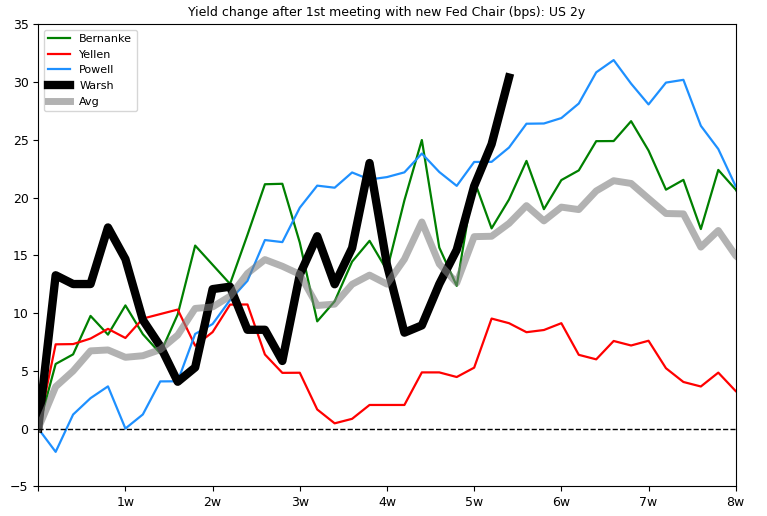
2y rise since 1st Warsh meeting is nearing the max of recent Fed Chair transition selloffs, but 10y still has room to go... 10y needs another +10 to match Powell and +20 to match Bernanke. Notable that Bernanke reaction was bear steepener (behind the curve) while Warsh is bear flattener.
@tr8derz Agreed but inflation backdrop is much worse. Greenspan was hiking in 1999 with inflation measures at levels that would make today's market worried about deflation.
@tr8derz Oct98 we got insurance cuts (Oct25?). Jul99 (purple) we got 1st hike (hike next week?). Dec99 (green) we already had 3 hikes with more being telegraphed. Interesting 2v10 ~30bps roughly matches today and didn't flatten further until we got closer to the end of the hiking cycle.
Autonomous doesn't create unlimited cars. If anything, it removes the largest expense for Uber and improves the passenger experience. Ladies prefer no driver. Wildly impressive that margins been improving despite tightening labor market and decreased immigration reducing driver supply.
US 2y tempting buy at 4.30. July hike odds have jumped from 10% last Friday to 35% today. I understand desire to hedge July hike more than usual because no forward guidance setup, but 35% is too high. Warsh went out of his way to say not 1 out of 19 Fed members advocated for an immediate hike.
Looking at recent 2y moves since early May: +20 (current), -19, +23, -17, +22, -18, +21, -16, +13, -13... avg ~20 matches current
Looking at the biggest 2y moves since Trump round 2: +63 (April - Now), +67 (Iran), -58 (25q3 labor slowdown + insurance cuts), +63 (25q2 liberation day), -60 (25q1 DOGE + inflation slowdown)... avg ~60 matches current
Fundamentally we look extended. Short-term comparisons we look extended (+20bps). Long-term comparisons we look extended (+63bps).
I am still skeptical on wages staying contained... @M_C_Klein has great substack showing aggregate wages dragged down by unbelievably low healthcare wages that won't sustain. @freyabeamish talks about tighter labor mkts translating into tighter feedback loop between wages and services inflation. I am buying 2y here for a tactical trade, still think long-term yields going much higher. https://t.co/5oKZHf94lA
US 2y tempting buy at 4.30. July hike odds have jumped from 10% last Friday to 35% today. I understand desire to hedge July hike more than usual because no forward guidance setup, but 35% is too high. Warsh went out of his way to say not 1 out of 19 Fed members advocated for an immediate hike.
Looking at recent 2y moves since early May: +20 (current), -19, +23, -17, +22, -18, +21, -16, +13, -13... avg ~20 matches current
Looking at the biggest 2y moves since Trump round 2: +63 (April - Now), +67 (Iran), -58 (25q3 labor slowdown + insurance cuts), +63 (25q2 liberation day), -60 (25q1 DOGE + inflation slowdown)... avg ~60 matches current
Fundamentally we look extended. Short-term comparisons we look extended (+20bps). Long-term comparisons we look extended (+63bps).
Stopped out of duration long, still have a steepener on. Don't like this cup and handle forming again. Would re-enter duration long if we get a couple rally days taking us back to 4.55 area.
Stopped out of duration long, still have a steepener on. Don't like this cup and handle forming again. Would re-enter duration long if we get a couple rally days taking us back to 4.55 area.
Maybe I'm being too cute trying to flip duration from short to long for 2 weeks but here is where I’m at from my internal notes to team…
Positioning is best described as an “athletic stance” as we enter the peak summer lull and await further catalysts.
Long-term, our bias is still higher global rates as the world continues shifting from a structural savings glut pre-pandemic to a structural savings shortage post-pandemic. Rates will continue to rise to balance the rising demand for savings (AI capex, electrification, re-shoring, militarization, fiscal deficits, etc) with the falling supply of savings (shrinking workforce, retirement withdrawals, capital repatriation, etc).
Short-term, most yields are once again approaching their 3-5y highs. Previous tests have failed and we have just entered peak summer lull with no material data releases or policy announcements scheduled until the Fed meeting on July 29th. We entered the summer lull with a series of disappointing datapoints (US NFP 57k vs 133k exp, US ADP 98k vs 120k exp, US CPI 3.5 vs 3.8 exp, US PPI 5.5 vs 6.2 exp, US ISM 53 vs 54 exp, CA CPI 2.8 vs 2.9 exp) and renewed skepticism on the sustainability of AI spending (SMH Semiconductor ETF -20% from highs). Given the challenging narratives and lack of scheduled catalysts for the next 2 weeks, we do not believe this is the time to bet on yields finally breaking out to new highs.
Hence, we have recently flipped our longstanding duration short into a modest duration long for a short-term tactical trade. During the 2-week late-July summer lull of 2024 and 2025, the US 10y yield declined -50bps and -25bps, respectively. We will reconsider our short-term mean reversion trade as August approaches and the calendar heats up.
In terms of yield curve positioning, we are overweight the front-end in both the US and CA (with larger overweight in US front-end), and we are underweight the long-end in both the US and CA (with larger underweight in CA long-end). This results in a bull-steepener and US long vs CA. Street consensus is heavily short the front-end, and we expect these shorts to begrudgingly cover with the lack of news flow to justify negative carry. Street consensus is mixed in the long-end, and we believe the marginal driver of these yields will remain growing government and corporate bond issuance (AI capex).
In credit, we continue to “high-grade” the portfolio, swapping lower quality into higher quality at all-time low yield give-ups. We have also further reduced our credit underweight.
To summarize, we are modestly long duration with a US bull steepener and underweight credit. The duration long is a short-term tactical trade trying to take advantage of mean reversion at attractive levels with stretched positioning and favorable calendar conditions. The credit underweight is a structural trade that is expected to persist and potentially grow further.
Seems Trump's newest 338 tariff on Canada will get overruled by an injunction before taking effect Aug19, and eventually blocked by Supreme Court within 6-12 months if Trump persists.
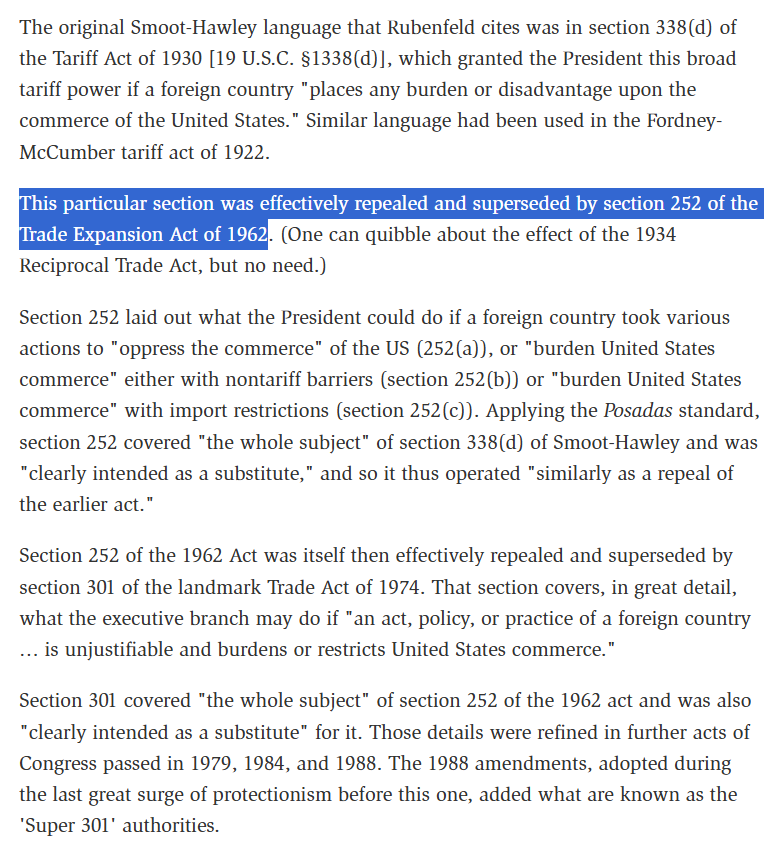
Lawyer and historian Philip Zelikow says that Trump's new tariff toy - Sec 338 of the Tariff Act of 1930 - is defunct ("effectively repealed and superseded by section 252 of the Trade Expansion Act of 1962").
Let the litigation/chaos begin!
https://t.co/oefCk1WWos
Renewed Iran tensions and new UK PM hinting at larger deficits are pushing global rates higher today. On Iran, watching if Houthis attempt and succeed at closing Red Sea (where Saudi is diverting oil exports). On UK, they typically walk it back after they see rates responding (UK 10y +8bps today). Another thing to watch is any new 301 tariffs (Jul24 122 tariffs expire). Delaying or reducing these tariffs could help with midterms (lower inflation, stronger growth).
Maybe I'm being too cute trying to flip duration from short to long for 2 weeks but here is where I’m at from my internal notes to team…
Positioning is best described as an “athletic stance” as we enter the peak summer lull and await further catalysts.
Long-term, our bias is still higher global rates as the world continues shifting from a structural savings glut pre-pandemic to a structural savings shortage post-pandemic. Rates will continue to rise to balance the rising demand for savings (AI capex, electrification, re-shoring, militarization, fiscal deficits, etc) with the falling supply of savings (shrinking workforce, retirement withdrawals, capital repatriation, etc).
Short-term, most yields are once again approaching their 3-5y highs. Previous tests have failed and we have just entered peak summer lull with no material data releases or policy announcements scheduled until the Fed meeting on July 29th. We entered the summer lull with a series of disappointing datapoints (US NFP 57k vs 133k exp, US ADP 98k vs 120k exp, US CPI 3.5 vs 3.8 exp, US PPI 5.5 vs 6.2 exp, US ISM 53 vs 54 exp, CA CPI 2.8 vs 2.9 exp) and renewed skepticism on the sustainability of AI spending (SMH Semiconductor ETF -20% from highs). Given the challenging narratives and lack of scheduled catalysts for the next 2 weeks, we do not believe this is the time to bet on yields finally breaking out to new highs.
Hence, we have recently flipped our longstanding duration short into a modest duration long for a short-term tactical trade. During the 2-week late-July summer lull of 2024 and 2025, the US 10y yield declined -50bps and -25bps, respectively. We will reconsider our short-term mean reversion trade as August approaches and the calendar heats up.
In terms of yield curve positioning, we are overweight the front-end in both the US and CA (with larger overweight in US front-end), and we are underweight the long-end in both the US and CA (with larger underweight in CA long-end). This results in a bull-steepener and US long vs CA. Street consensus is heavily short the front-end, and we expect these shorts to begrudgingly cover with the lack of news flow to justify negative carry. Street consensus is mixed in the long-end, and we believe the marginal driver of these yields will remain growing government and corporate bond issuance (AI capex).
In credit, we continue to “high-grade” the portfolio, swapping lower quality into higher quality at all-time low yield give-ups. We have also further reduced our credit underweight.
To summarize, we are modestly long duration with a US bull steepener and underweight credit. The duration long is a short-term tactical trade trying to take advantage of mean reversion at attractive levels with stretched positioning and favorable calendar conditions. The credit underweight is a structural trade that is expected to persist and potentially grow further.
@NickNemo17@JackFarley96@orrdavid Sorry don't mean to be that guy pushing back in the comments for the shared link to your interview. I am looking forward to listening to it, and I'm sure it will be well worth my time. I applaud your public conviction, and taking the time to respond to the other side.
But I can ignore the surrender risk because the companies and regulators doing are certainly not ignoring the surrender risk...
"[Surrendering] policyholders jeopardize their financial positions in favor of equity holders. Surprisingly, surrender contagion only mildly enlarges an insurer’s bankruptcy rate... Despite its public perception of posing a significant risk to insurers as similar to a bank run, surrender contagion does not critically threaten insurers’ solvency"
https://t.co/gyxzjSrqJq
@JackFarley96@orrdavid@NickNemo17 $80b FABN issued in 2025 with 7-10 maturity and non-puttable. Would take a serious private credit default wave to impair aggregate insurance company income enough to matter. Even at that point, I don't think anyone is talking about insurance as the big problem.
@JackFarley96@orrdavid@NickNemo17 Athene (Apollo) is the poster boy for this... But even Athene can still issue 10y BBB+ bonds well inside +150bps. I don't think there is enough jump risk to short these names or point to the industry as a contagion risk.
Sometimes they can be a decent size if capital surplus is the denominator you care most about. Lets say they do get hit on that denominator... The hit gets marked slowly over many quarters. Meanwhile they keep earning record income from rest of book to rebuild the surplus and treasury pulls many many levers to cushion liquidity. Treasury wont' run out of levers until the percent of assets denominator matters (which is a long way from here) OR entire financial system freezes like GFC (longshot from here).