X family: We’re GIVING AWAY a full beef box this weekend!!!
USDA prime, grass-fed & finished, dry-aged beef— raised right here in Lampasas, Texas
What’s included:
– 2 ribeyes
– 2 flat irons
– 8 wagyu burger patties
– 2 lb ground beef
– king sized picanha
– cross cut bone-in short ribs
We’ll ship it straight to your door!!
to enter:
• follow @ElkinsCattleCo
• repost this
• comment your all-time favorite beef cut
must be in the U.S. (AK/HI not included)
Winner announced monday 04/27 at noon CT
ships out Tuesday 04/28
1 winner will be announced + DM’d from this account only. Good luck! 🙏🥩🇺🇸
India ran the most important cardiovascular study of the 20th century by accident, and then immediately forgot about it.
In 1967, Dr. S.L. Malhotra published a study in the British Heart Journal examining heart disease rates among 1.5 million Indian railway employees. The population was extraordinarily useful for research purposes: same employer, same healthcare access, comparable income and working conditions, spread across the entire country.
The only meaningful variable was geography. Which meant diet.
North Indian railway workers: Punjab, Rajasthan, UP, ate a diet built around ghee and dairy fat. They consumed up to 19 times more fat than their southern counterparts. The fat was primarily saturated: clarified butter, milk fat, the short-chain saturated fatty acids that Ancel Keys had recently been telling the Western world were arterial death.
South Indian railway workers ate a diet based on rice, sambar, and seed oils: groundnut oil and sesame oil, primarily. They ate considerably less fat overall. By the standards of dietary advice being formulated in the 1960s, they should have been the healthy ones.
Heart disease mortality in South India: 135 per 100,000.
Heart disease mortality in North India: 20 per 100,000.
Seven times higher in the population eating seed oils.
Among railway sweepers specifically, the lowest-paid, most physically active workers, the gap was even wider. Heart disease was fifteen times more common in the South Indian sweeper population than in the North Indian sweeper population.
Malhotra controlled for everything he could reach: smoking, where Northerners actually smoked more. Activity levels, where the relationship was inconsistent. Socioeconomic status, where executives died more often than sweepers regardless of region. He found no variable that explained the gap except the type of fat in the diet.
He published the data. In a peer-reviewed journal. In 1967.
The study was cited periodically, acknowledged as methodologically interesting, and then set aside.
The decade in which Malhotra published was the decade in which Ancel Keys's fat hypothesis was being converted into policy. The American Heart Association was issuing guidance recommending polyunsaturated vegetable oils as replacements for saturated animal fats. The food industry was producing seed oils at industrial scale. The infrastructure of seed oil promotion was being built, expensively and with great institutional momentum.
A study showing that populations eating animal fat had a fraction of the heart disease of populations eating seed oils was not, in that context, a study that anyone particularly wanted to follow up.
Nobody followed up.
Almost sixty years later, the finding stands unrefuted in the literature.
It is not in the dietary guidelines.
This used to be an abortion clinic.
A Christian family bought it and turned it into a pregnancy resource center.
They transformed a place that ended lives into a place that welcomes life.
Glory be to God.
James Allan Francis preached this short sermon about Jesus about 100 years ago. It’s called “One Solitary Life”. How is this possible if there was no Resurrection?
"He was born in an obscure village, the child of a peasant. He grew up in another village, where he worked in a carpenter shop until he was 30. Then, for three years, he was an itinerant preacher.
He never wrote a book. He never held an office. He never had a family or owned a home. He -didn’t go to college. He never lived in a big city. He never traveled 200 miles from the place where he was born. He did none of the things that usually accompany greatness. He had no credentials but himself.
He was only 33 when the tide of public opinion turned against him. His friends ran away. One of them denied him. He was turned over to his enemies and went through the mockery of a trial. He was nailed to a cross between two thieves. While he was dying, his executioners gambled for his garments, the only property he had on earth. When he was dead, he was laid in a borrowed grave, through the pity of a friend.
[Twenty] centuries have come and gone, and today he is the central figure of the human race. I am well within the mark when I say that all the armies that ever marched, all the navies that ever sailed, all the parliaments that ever sat, all the kings that ever reigned—put together—have not affected the life of man on this earth as much as that one, solitary life.”
If there was no resurrection, how could this life be the most influential life of all time? I don’t have enough faith to believe that this one solitary life from a remote, ancient village could be the most influential life of all time . . . unless the Resurrection is true.
New research sheds light on the incredible, invisible mycelial networks beneath our feet—where plants and fungi engage in a complex trade of carbon and nutrients. Using cutting-edge robotic imaging, scientists have uncovered how mycorrhizal fungi form efficient, dynamic underground supply chains. This groundbreaking study reveals the fascinating behaviors of these networks and their crucial role in carbon sequestration.
Repost 🔁: @newscientist
🎥 Dr. Loreto Oyarte Galvez and Dr. Corentin Bisot/SPUN (@spununderground)
Two decades ago, researchers started an experiment that would challenge the prevailing scientific understanding of plant communities.
While modern agriculture treats diversity as inefficient, the Jena Experiment proved the opposite: complexity is the key to resilience.
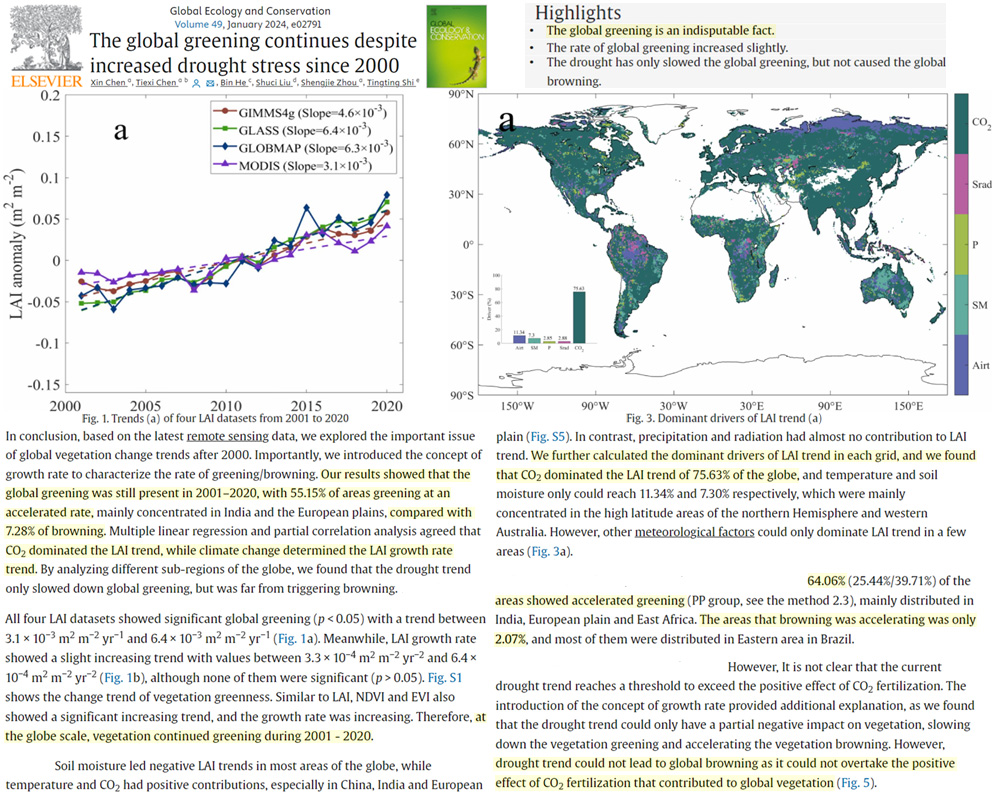
CO2 continued to green the Earth between 2001-2020, reports new study. So CO2 is great for plants and all life on Earth.
Additional comment: The study reports greening despite drought. But there is no actual trend in drought. https://t.co/ZmcBsEQvQY
Study: https://t.co/mutGFVfWMX
Discussion: https://t.co/2prbIlE1C4