Former $GOOGL employee on why data center capacity and electricity are the real bottlenecks, not GPU production itself, and how unreliable some of the neoclouds are ($AMZN, $GOOGL, $MSFT, $NVDA):
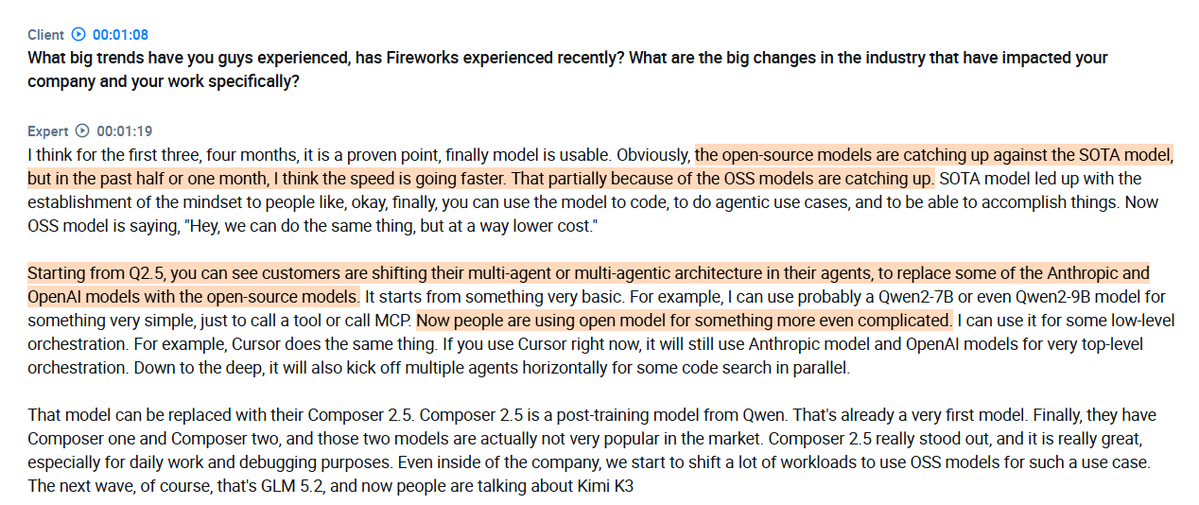
1. According to the expert, open-source models are closing the gap with frontier models faster than expected, with customers increasingly replacing Anthropic and OpenAI models in multi-agent architectures with open-source alternatives starting from Q2 of this year. The shift started with simple tasks like tool calling and MCP, but has moved up the stack to low-level orchestration.
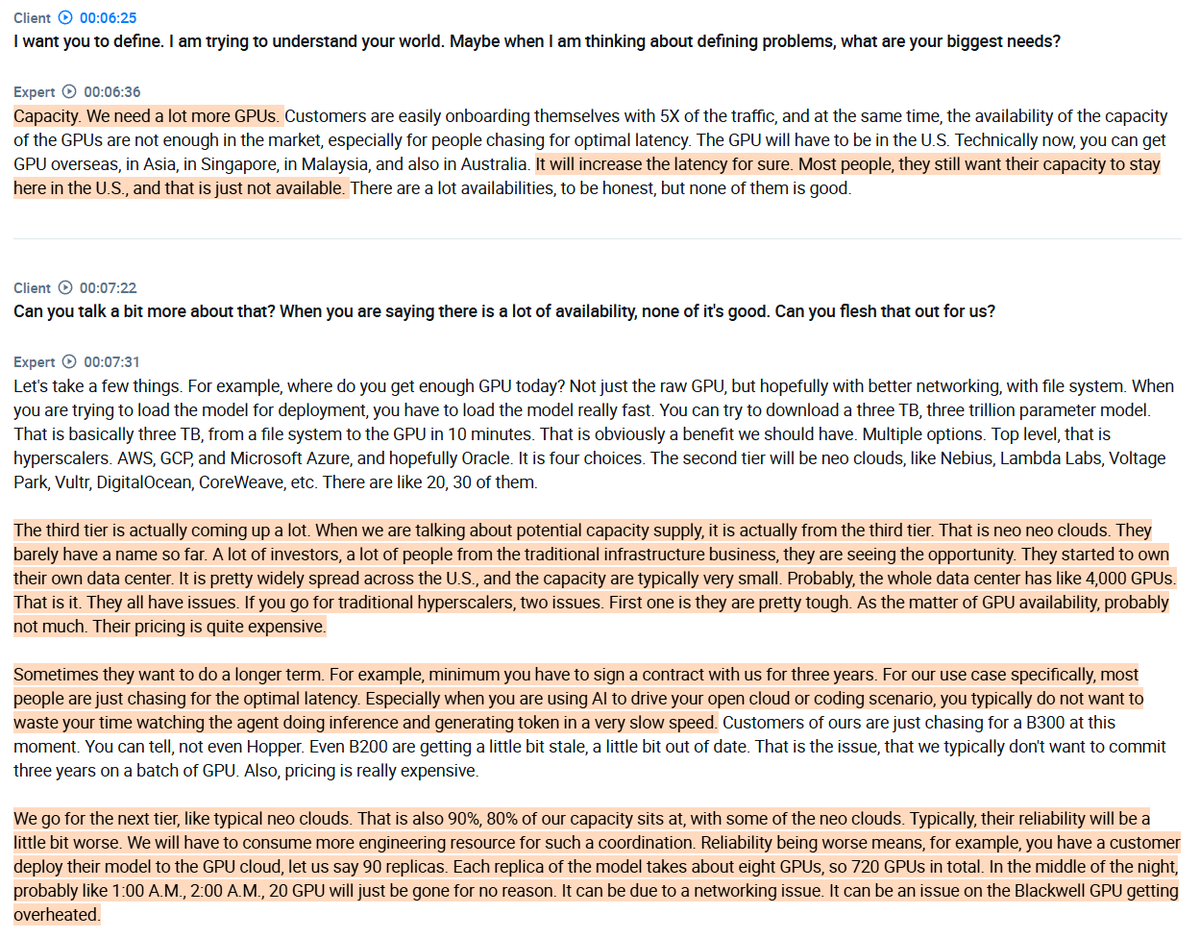
2. The expert identifies capacity as the biggest constraint at the moment, with certain companies' traffic growing 5x while GPU availability, particularly in the U.S. where latency requirements are tightest, simply cannot keep up. Sourcing capacity overseas in Asia or Australia is technically possible but adds latency that most customers will not accept.
3. Hyperscalers offer reliability but are expensive, require multi-year commitments of three or more years, and have limited availability of the latest hardware, with customers already chasing B300s. AI-native companies tend to gravitate toward neoclouds due to hyperscaler pricing and contract rigidity, but neoclouds come with their own reliability issues, with GPUs dropping off unexpectedly and requiring engineering resources to manage fleet stability around the clock.
4. The third tier consists of smaller independent operators who have invested in GPU racks, seeing the opportunity to lease out capacity and recoup costs within a year or two, with the remainder being pure profit. The expert describes these as essentially unusable in practice, with operators who do nothing more than find land, install racks, connect electricity, and set up cooling, with no real cloud management, maintenance, or operational expertise behind them.
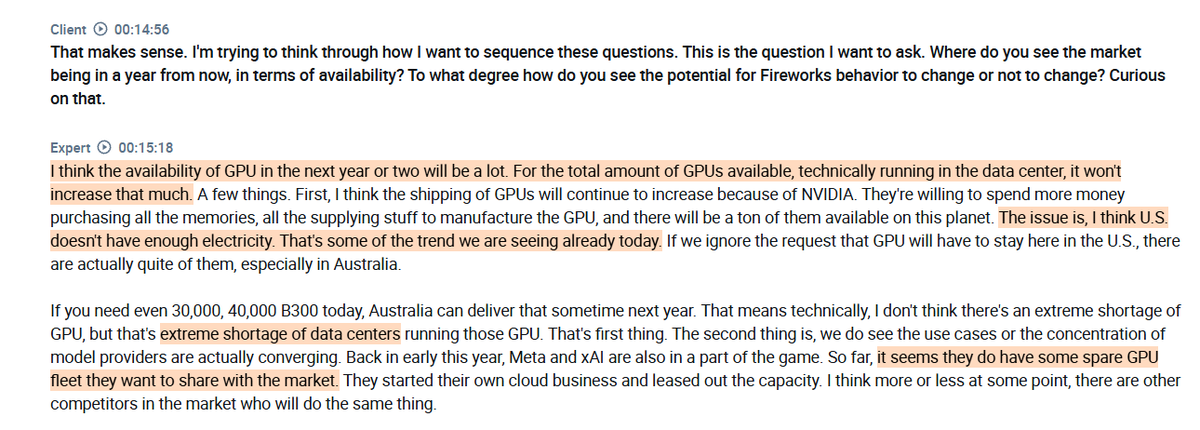
5. The expert expects overall GPU availability to increase meaningfully over the next year or two, with $NVDA continuing to ramp production. The real bottleneck is not GPUs themselves but data center capacity and electricity in the U.S. On the supply side, the expert also sees players $SPCX beginning to lease out spare capacity to the market, with more likely to follow.
6. The expert notes that U.S.-based neoclouds typically require 20-30% prepayment upfront, with the remainder paid monthly or quarterly over the contract term, and rebates negotiated at the end for any reliability incidents like traffic loss. APAC-based providers operate differently, with no prepayment required at all.
found on @AlphaSenseInc
IF YOU'RE SELLING $NBIS $CRWV $IREN BECAUSE OF A KOREAN IPO, YOU DON'T UNDERSTAND WHAT YOU OWN
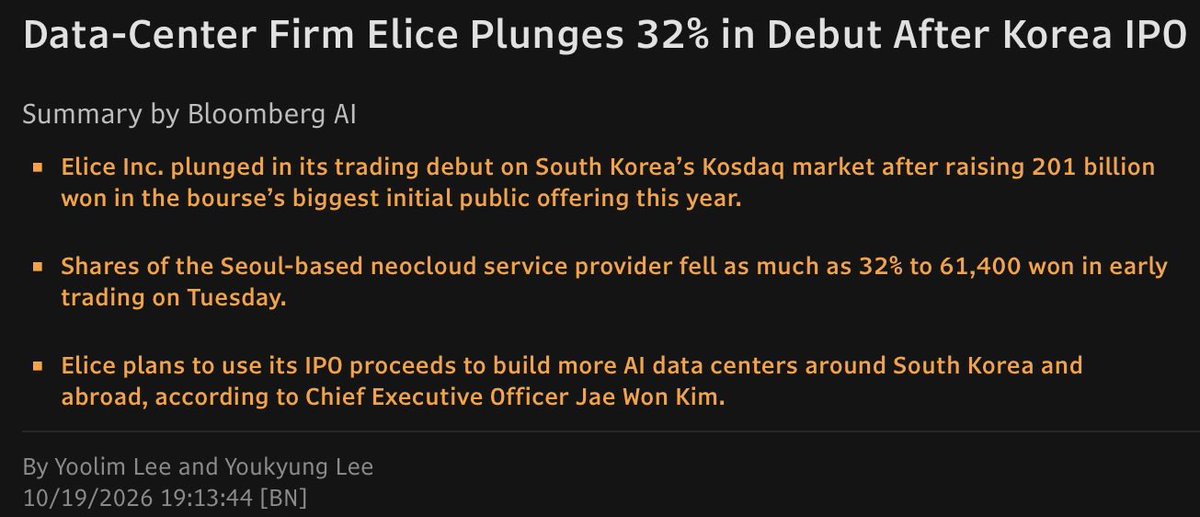
Elice is a $700M ex coding-education company with 10MW live, and most of its revenue comes from one Korean government agency. It priced at the top of a 389x oversubscribed book, so the flippers dumped it. That's IPO mechanics, not a neocloud verdict.
JP MORGAN: “WE BELIEVE THE CURRENT CONCERNS ON $CRWV ARE OVERDONE RELATIVE TO THE FUNDAMENTALS”
1. Datacenter demand is robust and has improved in recent months, rather than moderated, providing limited datapoints to support long-term datacenter demand concerns.
2. Bringing capacity online is materially tougher than the linear progression in relation to conversion of published contracted capacity to active capacity, and CoreWeave's execution leadership on this front has consistently stood out in our customer conversations.
3. Economics at a project level remain sound with the company positioned to generate both healthy margins and returns on cash flow, despite initial investment focus driving some temporary margin and cash flow hurdles.
4. Beyond the sound economics on a project for a typical 5-year contract agreement, there is an additional monetization lever in recontracting GPUs beyond the 5-year duration.
5. Project level returns (unlevered IRR) exceed cost of capital for the company.
After a meeting with the $CRWV CEO, he assured the team that the company is in good financial position, they didn’t ask Jensen to publicly defend the company, and they’re close to a new round of private funding. Also expect a very strong earnings report in Q4.
An unambiguous case of consensual sex. The aftermath of the Cornell group sex episode is a peerless example of the hypocrisy of the feminist movement, which proclaims the oppressiveness of any remaining traces the chivalric code.
Females deliberately drink themselves blotto in order to lower their sexual inhibitions, voluntarily participate in sex, and then, after the regrets set in, deny their agency and put exclusive responsibility for their drunken encounter on their male partner, on the grounds that they are helpless to take care of themselves.
I've written about the campus rape myth in @CityJournal: https://t.co/AJNchaogWT
From my interview on @realDailyWire's Wired in Live with @cabot_phillips ⬇️
🚨 #MSTR holders: Oct 16 could get ugly.
MSCI is set to announce its decision on MSTR’s index eligibility. I’d put the removal risk around 70–80%.
Why? MSCI’s new “non-operating company” test flagged MSTR because its operating assets are too small relative to its balance sheet.
@KobeissiLetter Republicans are against “free” healthcare, education, Biden stimulus checks, but not to Trump’s $5000 checks in return for their votes? What a great thing to be partisan, your leader always does the right thing 😂