The idea of an intelligence explosion caused by recursive self improvement has been around for a long time but until very recently it did not seem imminent. Now many leading researchers think it may happen quite soon. You can read our paper about it here:
https://t.co/sgUpugjpRY
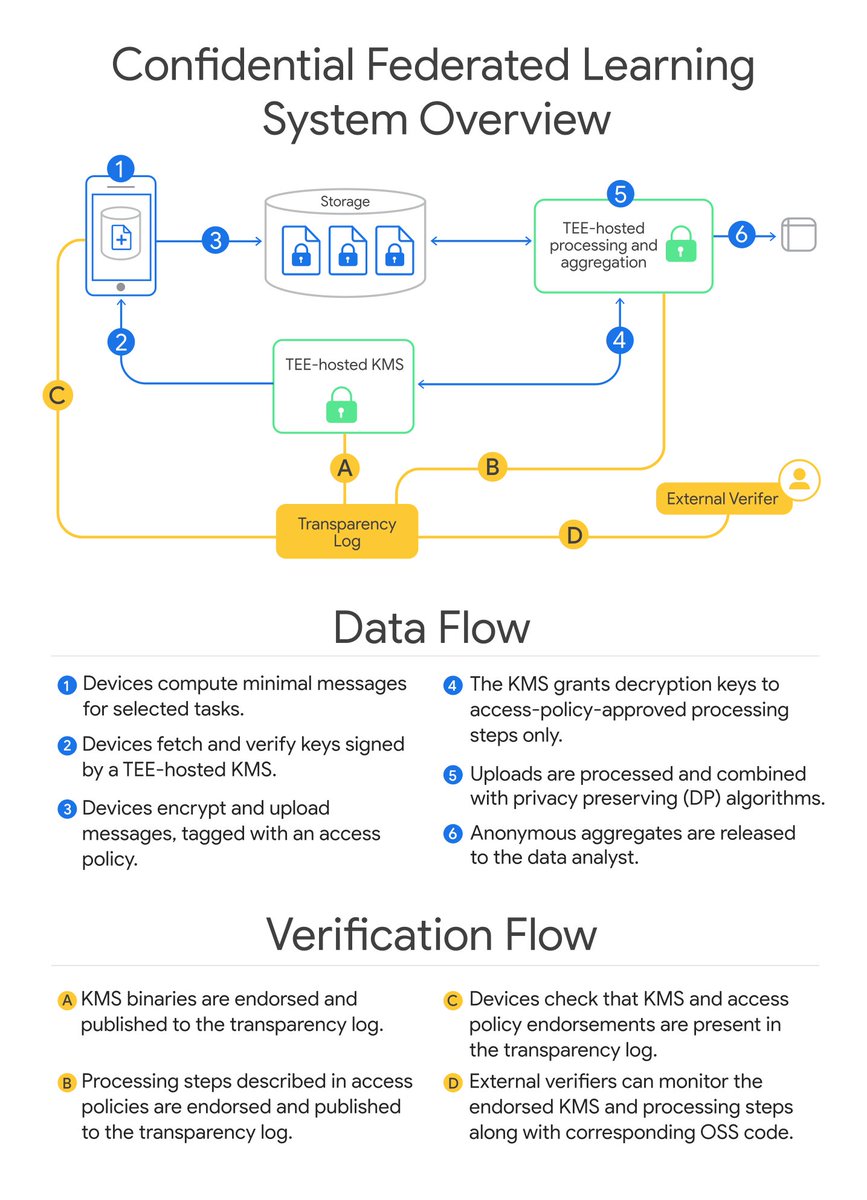
Today we’re introducing a next-generation Federated Learning system. By using Trusted Execution Environments (TEEs), it delivers verifiable differential privacy while moving computation server-side to cut training times. Read the blog: https://t.co/jfZ4l9laWf
Deep Research 🤝 Gemini Live.
Use your voice to explore a topic — in depth — with Gemini Live's Deep Research integration.
1. Just ask the @GeminiApp to run a Deep Research report on a topic, then feel free to close the chat, lock your screen, or keep chatting about other things.
2. Gemini will work asynchronously in the background and send you a notification when your full research report is ready.
3. Once it is, you can chat through the results, ask follow-up questions, or refine the details.
Here's a breakdown of indirect prompt injection—a scenario where a user asks an agent to read a document, but it contains malicious instructions designed to hijack your agent's tool calls.
See how it works and how to defend your agentic endpoints → https://t.co/MbdORw0viH
The cost of AI - normalized for the type of task - coming down is one of the most important factors in being able to drive further AI diffusion in the economy.
The general trend we should expect is that frontier AI models will continue to become more capable, and will look very expensive because the tasks that they can take on are more advanced.
Then, shortly after, AI models will get more efficient or competition will drive more aggressive pricing dynamics, thus reducing the cost per task for anything other than the peak of the frontier.
This cycle will continue over and over again, which ultimately leads to tasks becoming cheaper on a like for like basis. And by doing so you will get even more AI adoption because now AI is more affordable for a wider variety of use-cases.
cool use case of chatgpt work i heard last night:
connect your family calendars and explain your kids' interests.
every morning for the drive to school, have it make a podcast that talks about one kid's soccer game that afternoon, one kid's upcoming birthday, some news, etc.
TPU 8i and TPU 8t deliver sustainable economics—offering up to 80% better performance-per-dollar for low-latency serving while seamlessly scaling to 1M+ chips!
Learn how our 8th-generation TPU system drives the next frontier of AI ↓
AI tools are playing an increasingly large role in mental health care, but the governance frameworks needed to ensure they are safe and effective are lagging behind. A policy workshop, hosted by @StanfordHAI's Healthcare AI Policy Steering Committee in collaboration with @StanfordMed's AI for Mental Health Initiative, identified three critical challenges policymakers need to address:
https://t.co/DUTsex9XWs
Claude Code creator Boris Cherny ( @bcherny )
"For people who aren’t building agentic products but are using Claude Code, every 6 months, delete your claude.md file, delete your skills, and delete your hooks. Then see what the model does. It might surprise you.
For Opus 5, we strongly recommend trying to delete all of these things because the model may no longer need the extensive instructions that were necessary for previous models."
- at Y Combinator Startup School 2026.
----
From "Y Combinator" YouTube channel, (full video link in comment)
Introducing the Science One Framework, an experimental autonomous research prototype that builds verifiable evidence chains. We demonstrate how natively maintaining these chains eliminates hallucinated citations and enables reproducible AI science. Read the blog to learn more: https://t.co/sRchtF605B
⚡ TypeScript 7 compiles the 2.3M-line @code codebase in under five seconds.
See @ahejlsberg explain how the new Go-powered compiler and language service scale with shared-memory concurrency.
📖 Read more: https://t.co/BmRyf7Y6Pf
In a review of our cybersecurity evaluations, we found three incidents in which a Claude model reached the internet from within or while interacting with a third-party evaluation environment, and then gained unauthorized access to the real systems of three different organizations.
Our post describes what happened, how it happened, and what we’re changing. We encourage other AI developers to perform similar reviews.
We conducted this review together with @Irregular, one of our evaluation partners, and thank them for the joint investigation and their collaboration on this post. This type of collaboration is increasingly critical to safe, rigorous evaluation of models, and we look forward to continuing to work together on security.
https://t.co/dKFCdpKd9v
Create, edit, and summarize with Gemini on macOS using your voice.
Stay in your flow by speaking into any active window: Dictate clean text or ask Gemini to transform highlighted content, analyze local files, & generate visuals right where your cursor is.
This new voice capability is rolling out in the Gemini macOS app globally in English, with support for more languages coming soon.
Introducing Gemini Robotics 2: the next era of truly adaptable robots from @GoogleDeepMind 🤖
Powered by three new models, it brings whole-body control, fine dexterity, and teamwork to complex tasks — making robots more helpful in the real world. https://t.co/aey7mLztYc