Shit always happens! Prepare for the worst but hope for the best. Be kind. Logistician (ISTJ-T). #GGMU#FAFO Co-host: The Village Square (@thevillageclips)
I’m in love with this sentence:
“The degree to which a person can grow is directly proportional to the amount of truth he can accept about himself without running away.”
A standard Rolex has about 200 moving parts. The Patek Philippe on Jay-Z's wrist at the Met Gala has 1,580. Patek spent 8 years designing it. Then over 100,000 hours building the first one. About 11 straight years of someone working 24 hours a day, no breaks.
It's called the Grandmaster Chime, the most complicated wristwatch Patek has ever made. The inner mechanism alone has 1,366 parts. It fits in a circle smaller than an Oreo cookie. The outer case adds another 214 parts, and the case alone took four years to design.
In watchmaking, a "complication" is just any function beyond telling you the time. Most watches in the "grand complication" category have 5 to 7. This one has 20. When it launched, no wristwatch in history had combined that many. It tracks the phase of the moon, accurate to one day's drift over 122 years. It also has five different ways to chime: one that automatically rings the hours and quarters, one that rings only the quarters, one you press a button to hear the current time, one that rings whatever alarm time you set, and one that chimes today's date on demand. The last two had never existed in any watch before. Both were invented by Patek's own president, Thierry Stern, a trained watchmaker himself.
The chiming makes this watch nearly impossible to copy. Inside each one are tiny coiled steel wires called gongs. A single watchmaker shapes and tunes each gong by hand, testing every note with their own ears. Just putting one chime mechanism together takes 200 to 300 hours. Then the watch goes into a soundproof chamber where the chime gets recorded and compared against decades of past Patek chimes. Only then is it brought to Thierry Stern. He listens. If he doesn't like the sound, the watch goes back. Sometimes more than once. A rejected watch can take 500 hours of rebuilding before he approves it.
This watch holds four power springs in total. One is dedicated to the chimes alone, separate from the spring driving the time. Inside the mechanism is a ball bearing 7.2mm wide. It holds seven steel balls, each 0.3mm across, smaller than grains of fine sand. They handle 1,700 gram-millimetres of twisting force from the chime springs without slipping. The case has 11 holes drilled through it for buttons and pushers, and somehow none of them ruin the chamber that lets the chimes ring out clearly. The case itself flips around to show either of its two different dials.
Fewer than five workshops on the planet can build something at this level. Patek Philippe is the one all the others measure themselves against.
Jay-Z's version lists at $6.5 million. The unique steel version sold for $31 million at Christie's in 2019. It still holds the record for the most expensive watch ever sold at auction.
The best career advice I ever received: There's nothing more valuable than someone who can just figure it out. Do some work. Ask the key questions. Get it done. Repeat. If you do that, people will fight over you.
Curiosity is stronger than love.
A reporter asked him, “How so?”
“I’m 94 years old, and I got married at 23.
But at 46, my wife left me.
She told me that she had become invisible now…
that I was working too much and I wasn’t paying enough attention to her anymore.
I told her that it wasn’t possible, that I loved her more than everything, and it was true but…
that’s when she asked me:
do you know when was the last time you came to see me play bridge?
I didn’t know how to answer, and she said…
‘It’s normal. You never came.’
And she left.
So I made a decision…
In the months that followed, I signed up for bridge lessons and…
I learned how to play, I practiced, I researched, and one day…
I saw there was going to be a tournament near our home. So I signed up and…
She was in the other team. I was seeing her for the first time in nearly a year…
Of course, she beat me.
But I saw a feeling in her eyes that I hadn’t seen for a long time.
Gratitude.
So at the end, I went to see her and I told her…
‘If you agree to give me a second chance, I’ll never miss any of your competitions again.’
I kept my word.
She passed away 8 years ago but…
She taught me the most precious of the lessons:
“Love isn’t enough, you have to know how to show it.”
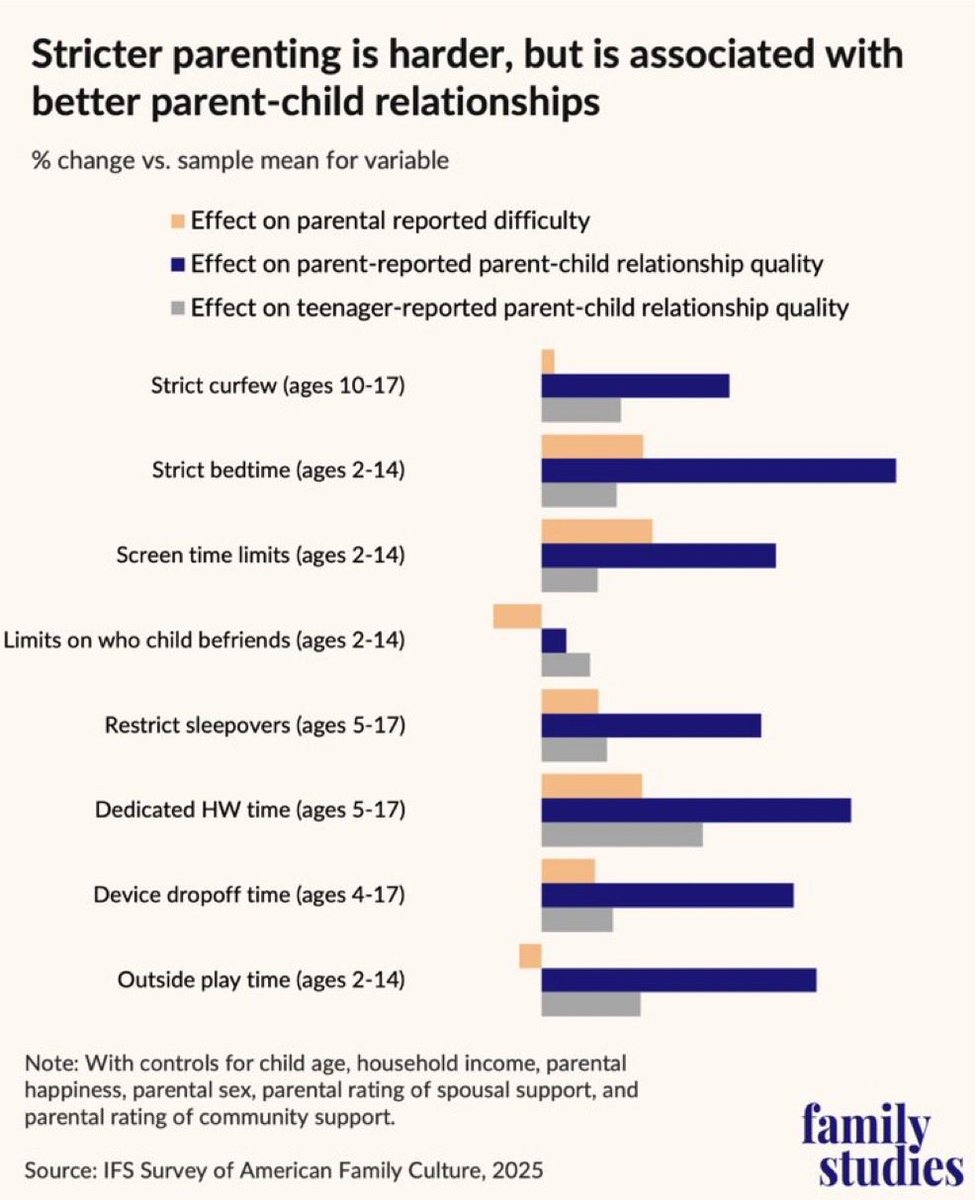
We now have evidence that gentle parenting doesn’t work.
Here’s an uncomfortable truth about parenting no one wants to say out loud:
The data is not kind to gentle parenting.
According to teenagers, strict curfews. strict bedtimes, screen limits, device drop off times, dedicated homework blocks, and sleepover restrictions IMPROVE higher relationship quality.
And yes, parenting difficulty goes up.
Of course it does. Leadership is harder than appeasement.
For the past decade we have been sold a watered down, Instagram friendly version of “gentle parenting” that often collapses into boundary avoidance, endless negotiation and emotional processing without enforcement. Parents terrified of saying no because they do not want to rupture connection.
But connection without authority is not connection. It is dependency.
When parents impose structure, the relationship improves.
Teenagers report better parent child relationship quality in homes with curfews and rules. Younger kids report better relationships in homes with screen limits and bedtimes. Even device drop off times correlate positively.
Why?
Because structure is not cruelty. Structure is love made visible.
A bedtime says: your brain matters more than your entertainment.
A screen limit says: your dopamine system is not fully developed and I will guard it until it is.
A curfew says: your safety matters more than your social standing.
That is not authoritarianism. That is caring.
Boundaries create friction. Friction creates growth. The parent absorbs the short term discomfort so the child does not pay the long term cost.
Children do not experience well calibrated limits as rejection. They experience them as stability. The human brain craves predictability. Predictability reduces anxiety. Reduced anxiety strengthens attachment.
That is why relationship quality goes up.
Notice something else in the data. The strongest effects are around time structure. Bedtime. Homework. Devices. Outside play. These are environmental constraints. They scaffold executive function.
The winning formula is not tyranny.
It is high warmth plus high structure.
The modern failure mode is high warmth plus low structure. That is just abdication of responsibility wrapped in empathy.
Children need leadership, not negotiation. They need adults who can tolerate their anger. They need boundaries that do not move every time emotions spike. They need someone whose prefrontal cortex is fully myelinated.
The harder path produces the stronger bond.
Because when a child feels that someone is strong enough to hold the line, they relax. And relaxed nervous systems build durable relationships.
They forgot to mention that there are 1.2 million graduates competing for these roles.
Thats 120 candidates per job.
An actual nightmare.
If I was about to graduate, facing this market, this is what I would do:
1) avoid graduate jobs entirely.
Your entire life will change when you start to embrace what most people avoid. Wake up early. Focus. Move your body. Eat real foods. Obsess over one thing. Read old books. Be present. Listen intently. Change your mind. Have difficult conversations. The recipe for a good life.
My wife once told me, "When you're five, you can be mad for a day. When you're ten, you can be mad for an hour. By the time you're thirty, you get ten minutes—and then you have to move on."
-James Clear