For the acquisition uninitiated, here are some additional points to consider:
1. Not all contracts are in FPDS. Especially big ticket, classified contracts, independent agencies, or acquisition savvy agencies that know what they’re doing and prefer to use their own system.
2. Ceiling represents capacity. Obligations represent planned spending. Expenditures are real spend. DOGE cuts and contract cancellations should translate to reduction in expenditures.
3. Deobligations happen all the time, especially throughout the life of the contract.
4. Reduction in ceiling, does in fact reduce unpoliced spending. It means if you need to buy, you have to make an effort to communicate what and why.
5. Program offices are incentivized toward bigger than needed ceiling to be agile and have headroom for unplanned needs. Sometimes this is abused, sometimes no.
6. It is much easier to max out small contracts instead of large ones. There are many more small contracts than big ones. This is not reflected in the %s below. It’s unclear what the distribution of small vs large contracts in the % maxed.
7. Some contracts are dead on arrival and will never be used. Sometimes this isn’t known until after award.
I’m not an acquisition expert, but do love this part of my job as it intersects with business politics (little p), and technology. I always try to do it right, for the best interest of my org, and for the good of the People.
At the same time, I have to make buy decisions NOW for what we might need 5 years from now. That’s not always easy regardless of how much scenario planning, roadmapping, and war gaming you do.
A classic case of Fake News. This @politico article is misleading at best, and politically motivated at worst.
Politico claims that DOGE’s cost savings are somehow not real because DOGE is using a “faulty” methodology predicated on ceiling values. Politico argues that the ceiling “can far exceed what the government has actually committed to pay out.” Theoretically true, practically false: the government WILL likely max out to the ceiling!
In federal contracting, ceilings matter because they are almost always maxed out.
For example, an analysis of the last 3 years of FPDS data shows that:
-of the 5.3M awards at contract end in FY22, 97.64% were spent to the ceiling
-of the 5.4M awards at contract end in FY23, 97.84% were spent to the ceiling
-of the 5.4M awards at contract end in FY24, 98.12% were spent to the ceiling
We think there’s a pattern here that perhaps a more intrepid reporter might have uncovered. Ceiling minus obligations is true savings in government contracting, making the $20k credit card analogy lazy and trivializing the very real work of protecting taxpayer dollars by using cheap jabs like ‘time for lunch.’
This is also why lowering ceilings is real savings. It prevents unpoliced “drunken sailor” spending. For extra measure, DOGE reviews entries with agency partners and makes adjustments as reported. We don’t pad results; the math is conservative, and the savings are real.
If Politico is still struggling with 'why' ceiling is in fact the right way to measure savings and is not in fact “an accounting trick,” we invite them to personally guarantee a sample of government contracts for the full ceiling amount. That should clarify things.
We can agree on one thing, though: Congress needs to pass more rescission packages so that the unused funds go back to the Treasury instead of being spent by default.
LiDAR may not be a household name, but the technology provides millimeter‑level data of America’s infrastructure. We cannot rely on Chinese LiDAR systems to examine our roads, and I’m glad my bill to protect America from this spy technology is included in @TransportGOP’s BUILD America 250 Act.
The human-perceived RGB is image 1 and the Tesla AI photon count reconstruction is image 2.
This is why Tesla FSD can see so well at night or through extreme glare.
Nobody ever gets my Ender’s Game references or analogies at work. I always say “Not everyone can be Bean. Some people have to be Ender.”
I just get blank stares.
Then I explain it.
Then I say you should read the damn book(s).
Thank you for this note on submission feedback @orsonscottcard
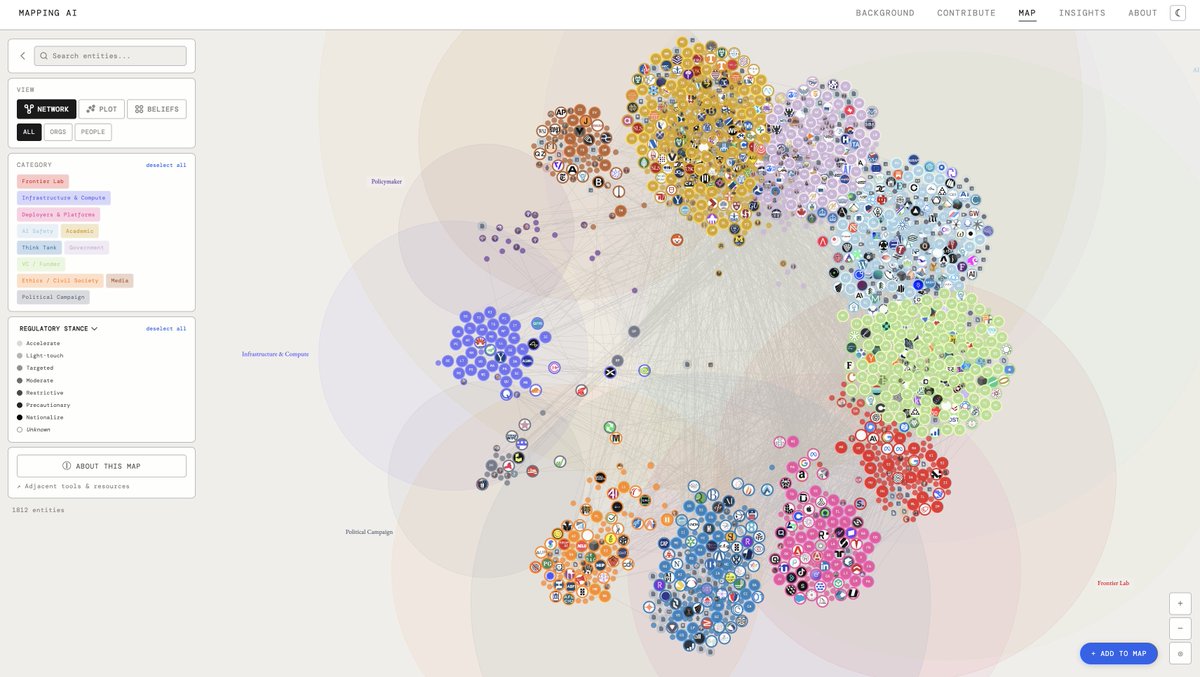
Who actually shapes AI policy in the U.S.?
We mapped 1,812 entities: 745 people, 918 organizations, 2,925 relationships. Frontier Labs, AI Safety orgs, Think Tanks, Government, VCs, and more.
https://t.co/6RDB1R0qNd
Shapefiles had a legendary run, but they’re no longer the modern GIS default due to multi-file bundles, 10-char field names, weak encoding/CRS metadata, size limits.
The path forward is cleaner: GeoPackage for durable local data, GeoJSON for the web, Parquet and FlatGeobuf for scale.
@MollySOShea@jasoncarvalhoHQ Most companies trying to crack government don’t actually know who the buyers are (like me!).
Also, if we really want to buy your stuff, we can sponsor the ATO ourselves. FEDRAMP is just an excuse to not buy sometimes.