Mainly Harmonic Patterns & Price Action.
Trying to soak up the knowledge this platform has to offer.
Working on a financially more independent future.
Journal.
3. MarketSmith setup in Tradingview by @DumbleDax (also IBD RS Rating), and @amphtrading
Over 100+ hours spent coding every indicators to save your $150/month. 2 different version below
@DumbleDax version
https://t.co/RKKdqnhoDL
@amphtrading version
https://t.co/VxQQMmvmYM
God dammit Clement 🫠
Druck shouted this book out speaking with hedge funds last month. I rushed to read it, as I see my friend did here as well. Great read, very unfortunate consistencies between now and then. Hope it's all wrong, but what can we do other than read the tea leaves?
The whole book looks at the relationship as if Data Centers now are the railroads back then. Railroads in the 1860s are the AI infrastructure of today, transformative technologies that require enormous amounts of capital upfront.
Their finance mechanism of choice?
MASSIVE BOND ISSUANCES to fund construction.
When investors began questioning whether railroads could generate enough revenue to service their debts, financing dried up.
The big red flag in similarities is the building of infrastructure ahead of demand as they bet the building of said infrastructure would create demand. They were developing railroads in sparsely populated areas thinking they'd attract settlers. Sometimes it worked like a charm, other times companies went bankrupt before the anticipated economic activity came through.
The analog works as such:
-Hyperscaler builds a massive data center assuming AI inference demand will explode.
-It purchases GPUs based on the expected utility several years in the future.
-Signs long term power contracts and infrastructure agreements.
-Financial projections assume customers will pay enough to justify the enormous investment.
WHAT BROUGHT DOWN THE WORLD ECONOMY BACK THEN: the anticipated economic activity failed to justify the lofty financial projections and the enormous debt accumulated to fund them.
The 1873 crisis wasn't necessarily about railroad stocks collapsing due to lack of growth, it was more about the railroad bond market losing its ability to finance the continued expansion. The railroad businesses were booming! They were simply not growing enough compared to the aggressively lofty expectations.
The aspect most striking to me was the net positive that railroads did for society and still lead to the market influx. The railroad boom was absolutely correct in its future utility. They DID transform commerce as they connected national economies, reduced shipping costs and overall helped create modern capitalism. Just like AI WILL cure diseases and all these other amazing things. So the technology was ABSOLUTELY evolutionary, but the capital allocation is what lead to the market top.
THE BIG DIFFERENCE THOUGH, between now and then, were the financiers. Hyperscalers got a lot of cash and generate a whole lot more whereas the financing in the bond offerings simply dried up back then when investors began to doubt the growth projections. Jay Cooke got cooked back then but we know guys like Zuck will spend forever. They are all in and will keep spending to keep this trade in motion.
I have no idea what happens next, I am not calling anything. I have been on margin long for weeks until today.
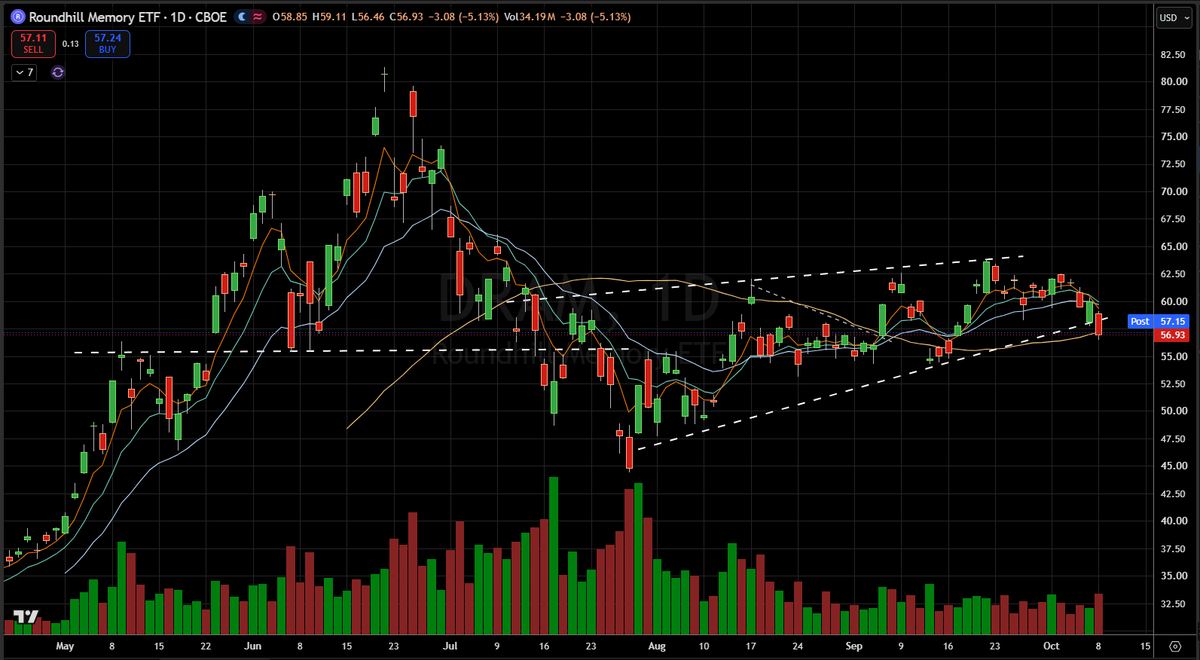
The one thing i DO KNOW, is that memory looks like absolute shit after today.
$DRAM here was looking like a base for weeks and with today's failure is resembling much more of a stage 3 top.
Again, I am not saying this is set to happen. I am simply explaining @Clement_Ang17 's post. If this post triggers you in any sort of way ... BLAME CLEMENT!
Hi @Deepvue
every time there is an update the site crashes / buggs out on mobile & desktop - would be much appreciated if I could use your paid for services during market hours. Makes it very unreliable, especially during market open
All I need to know:
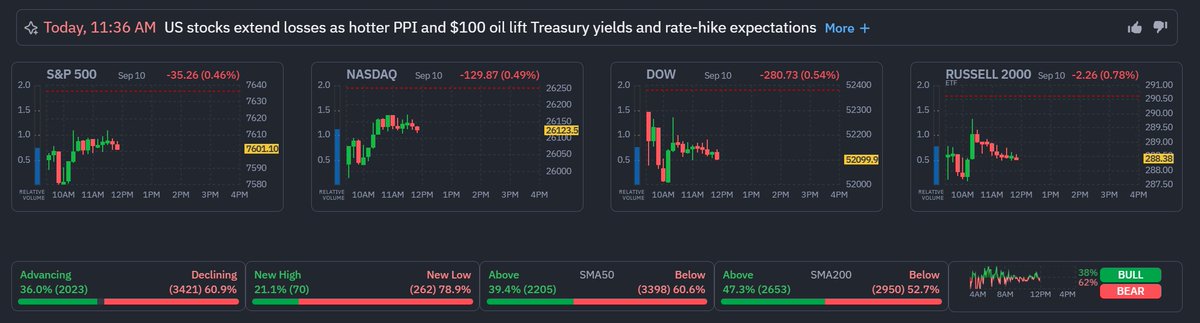
The market is 2/3 against you, making longs difficult. As a novice, I want the odds stacked in my favour, and this isn’t the environment.
80% of my watchlist is red, even with high 90+ RS stocks. Don’t focus on the few outliers. Trade when the tape is right.
Prove it to me. That's how I'm approaching the market right now. I'm long a few select names and still short the $IWM. I actually added to the short this morning. But I'm holding off on aggressive commitment one way or the other until the market proves itself. I'm still long $DE.
The market remains under pressure, with weakening breadth and deteriorating momentum arguing for increased caution and consideration of hedges. The calendar also carries some event risk.
Today’s Treasury auction and buyback announcement are followed by PPI on September 10, CPI on September 11, the FOMC on September 16, and triple witching on September 18. With several potentially market-moving catalysts packed into a short window, this remains an environment where selectivity and risk control should take precedence over aggressive exposure.
Leadership is undergoing another rotation, with semiconductors attempting to reassert themselves from oversold levels after sizable corrections.
SOXX rallied into the 537/50-day resistance area. MU similarly reclaimed its 50-day area, while strength broadened across the data-center and semiconductor ecosystem, including BE, VRT, INTC, AMD, SNDK, LITE and COHR. Higher-beta participation also expanded into CRWV, NBIS and WULF. At the same time, IGV, IBB and XLV have retreated toward support rather than suffering decisive technical breakdowns, leaving open the possibility that their pullbacks are constructive rotations rather than the end of their leadership
The most obvious weakness remains concentrated in Consumer, Financials and Housing. HD, LOW, LEN, TJX, CASY and BURL reflect the deterioration in consumer-related areas. Regional banks are also weakening. MA and V are threatening more significant deterioration, and housing remains particularly poor as ITB and XHB make lower lows into downside gaps. These groups currently represent some of the clearest areas to avoid.
Meanwhile, agriculture and energy-related commodities are emerging. DE, CTVA, ADM and MOO provide equity-market vehicles for the agricultural theme. This is another indication of a highly rotational tape: leadership isn't disappearing altogether, but capital is moving rapidly between themes.
Bottom line: The market is still producing some opportunities (mostly short term trades), but the internal picture has weakened enough to warrant respect and patience.
Semiconductor/data-center names are attempting to re-emerge, while Health Care, Biotech and Software are pulling toward support and could potentially reset. At the same time, Consumer, Housing and Financials are deteriorating, while agriculture, selected energy exposures and Latin America are gaining sponsorship.
With breadth weakening and several major catalysts immediately ahead, this is a market for targeted exposure rather than broad aggression—stay with relative strength, watch the semiconductor re-rotation closely, explore hedges against the weakest groups, and avoid forcing trades ahead of the coming inflation and Fed events. https://t.co/JXzFFTmMtn
Focus List W37 2026
$AII $ANF $AVAH $LIFE $MAN $QMCO
Not focusing much on semis & memory here.
They can absolutely continue moving positively but the current setups aren't actionable for me.
Looking for high 1M & 3M RS with tightening action.
$CAI is tightening up nicely around the 10 EMA, with the 21 EMA now coming in as well. My first attempt was stopped out after the steep pullback to the 21 EMA.
Still worth keeping an eye on. Tightness is usually a good sign, but staying cautious given the current market.
Tough market, so I’m slowing down.
Fewer trades, ~0.5% risk. The 21 EMA seems to be working better than the 10 EMA, giving stocks more room to breathe.
W36: −0.46% | €15.12k
More on this week's trades in the blog.
This does not mean I have hold them for the whole run. Majority of size came only recently in the last month. I am not a trading expert like most on this platform 🙄 I just don't find other stocks respecting their MAs as cleanly as these two.
What helped my portfolio gain traction is focusing on the true market leaders. Clearly that are $SDNK & $MU
Both are my largest positions but trimming with every gap up of 5%+ and trying to find a balance between profit-taking and keeping core positions.
What helped my portfolio gain traction is focusing on the true market leaders. Clearly that are $SDNK & $MU
Both are my largest positions but trimming with every gap up of 5%+ and trying to find a balance between profit-taking and keeping core positions.
@jfsrev Hi Jeff curious about subbing through Substack or X. Is there a difference and what do you recommend to familiarise myself with your trading style?
@mwebster1971@801010athlete One of the most valuable people on this platform. Appreciate you and your content! Really helps us more inexperienced traders to improve gradually!