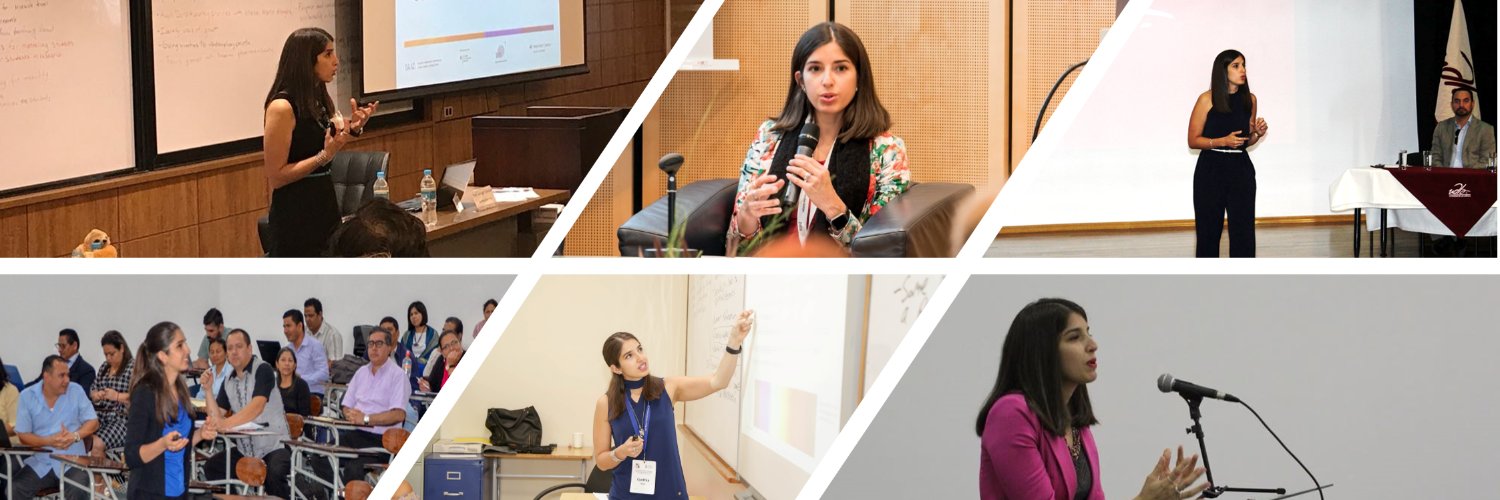
Investigadora y Consultora- Conexiones| Docente y Ex-Decana- Psicología Universidad de las Américas| Docente invitada- Harvard University (Extension School)|
Las investigaciones han identificado a los Millennials como el grupo de edad menos apto financieramente. Esto no se debe sólo a la agitación económica o a las brechas en la educación. Un factor fundamental que frena a los Millennials es la falta de confianza financiera.
Research has identified Millennials as the least financially adequate age group. This is not only due to economic turmoil or gaps in education. A critical thing holding Millennials back is a lack of financial confidence.
https://t.co/LaNLPtMs6z
In our age of optimization, we desperately try to maximize our productivity.
But our perfectionism doesn’t translate into perfect decision-making. Thanks to bounded rationality, we settle on “good enough” rather than striving for the best.
https://t.co/8HcaOA735c
“Although developers might be unable to easily anticipate or contain the butterfly effect, they can continue to be vigilant and thoughtful in their approach to AI bias.”
"As AI technology continues to proliferate, it’s important to remember that bias removal is not a one-time fix. Rather, it’s an ongoing process that demands constant monitoring, refinement and adaptation." Via @FastCompany:
https://t.co/myTHUTotJy
“Illusory correlations can cause us to make misguided and risky decisions […] when we make decisions surrounding a phenomenon, we look at its relation to other variables and make risk calculations based on how sure we are of those relations holding in the future.”
We all know someone who insists that their horoscope has foretold the future. In reality, these variables are not correlated with outcomes — but one or two coincidences are often enough to persuade people that they are.
https://t.co/3uKwAKroXV
“‘The most powerful science from a public education point of view is when the science tells you something your grandmother could have told you,’[…]. Of course, place matters, but how much it matters and how individual children respond is where things get interesting.“
People shape young brains, but so does the environment. A new @HarvardCenter working paper gives a clearer picture of how place impacts a child's development.
https://t.co/13cDHmWPCe
"It’s important that we understand the illusion of validity so that we can learn to reign in our confidence when making predictions. It’s perfectly alright to predict that something will occur, but to act that it’s a certainty can have serious implications"
We overestimate our own ability to make accurate predictions based on a limited amount of data. What's more, we often fail to update our decision-making process based on past failures, leading us to make the same misguided predictions again and again.
https://t.co/0Xb9IEpFAG
"Giving Parents Better School Quality Data Encourages Them to Consider Less Affluent, Less White Schools—To a Point [...] Information Nudges Fall Short of Prompting Behavior That Could Diversify Schools"
In a study published in @AERAOpen, researchers @d_m_houston & Jeffrey R. Henig found that providing parents with achievement growth data encourages them to consider schools with greater economic and racial diversity, but only up to a point. https://t.co/tg6lVJyOUR
"There is increasing evidence that what we eat affects how we feel"; "consuming healthy foods and micronutrients fosters better mental health, while poor-quality diets diminish it"
We are what we eat—a growing body of research highlights the connection between nutrition and mental health.
“If you feed the brain what it needs every day, you will provide the foundation it needs for excellent functioning.” https://t.co/EPn5eW4gzb
"The study revealed that consuming a diet high in sugars and saturated fats leads to deterioration in the quality of deep sleep [...] Despite the same duration of sleep, the depth or restorative quality of sleep was impacted after consuming junk food."
New research uncovers the troubling effect of junk food on sleep quality. Despite same sleep hours, depth of sleep suffers with a high sugar, saturated fat diet. Unhealthy food might be stealing your good night's rest.
#neuroscience
1/3
“The research indicates that the widespread and prolonged uncertainties caused by the global lockdown potentially overwhelmed cognitive resources, affecting the brain region responsible for problem-solving and decision-making.”
COVID-19 Pandemic's Impact on Students' Decision-Making
New research reveals how the pandemic-induced uncertainties affected cognitive resources, leading to inconsistency in problem-solving. A crucial insight into pandemic brain effect.
https://t.co/VyyYcQqIc4
#neuroscience
1/2
Ever thought your morning run was doing more than just burning calories? Dive into the fascinating world of Neuroscience Of Fitness and discover how regular exercise boosts your brain power, improves sleep quality, and even helps manage stress! 🧠💪
#neuroscience#exercise
1/3
Psychology continues to help solve some of the greatest challenges we face as a society. From the youth mental health crisis to the fight against misinformation, here are 11 trends we're watching in 2023. #PsychologyWeek
“Music, dance, drawing, storytelling […] have been a part of human cultures for tens of thousands of years. As a result, ‘we're really wired for art,’ [and when we make art] we increase the brain's plasticity — its ability to adapt in response to new experiences. #music#brain
Can music make us better learners? A growing number of researchers believe so.
"Children that are playing music, their brain structure actually changes and their cerebral cortex actually gets larger."—@susanmagsamen https://t.co/OYMR6b5rm5
If we replaced cancel culture with critical thinking, we'd have empathetic conversations instead of emotional reactions. And, by talking, we learn to separate honest mistakes from actual hate.
If we have to make one go "first", I would argue for "attitudes" and "values", but this is still an interesting take. "Here's why education systems need to start taking a 'skills-first' approach" https://t.co/j3e9HLguDC @wef
Social media sites are "designed to be limitless scrolling,[...] When there’s a big [news-related] topic of conversation that’s negative, it can dominate what you’re seeing. It can give the impression that this is the only thing that’s happening.”
You don't need to go "cold turkey" to manage news-related stress. Protect your mental health with these small steps:
• Turn off notifications
• Limit social media scrolling to 15 minutes
• No-screens policy for mealtimes
• Find ways to take action https://t.co/ZgJd3b0ZL4
This common mental error can negatively affect our relationships, decision-making, and understanding of social issues, @drjessica17 explains. Here's what we can do to overcome it. https://t.co/3EGEyUbWuO
The brain is a complex and fascinating organ that has the ability to learn and adapt throughout life. Let’s make education a journey of passionate discovery and growth! #education#brain#neuroeducation 🧠🌱
What a fun week spent unlocking the secrets of the most complex organ in the human body! I hope everyone had a great #BrainAwarenessWeek exploring the amazing capabilities of our brains and promoting the importance of brain research for a better tomorrow. #Neuroscience💡🧠
Don't be misled by the title: it's not that implicit bias training is ineffective, but that expecting a one-day program to make a real difference is unrealistic. All training must be integrated into the organizational culture and ongoing, not a box-ticking exercise.