In 1979 a talk show host tried to corner a Nobel economist on live television about greed. Two minutes later the professor had taken him apart so cleanly that the clip is still passed around 45 years after it aired.
His name was Milton Friedman. He won the Nobel Prize in economics in 1976 and spent decades at the University of Chicago shaping how governments around the world think about money.
The host leaned in with the question everyone thinks is a trap. Isn't capitalism just built on greed. Friedman did not flinch. He asked one question back that flipped the whole room. Tell me, is there some society you know that does not run on greed.
His point was simple and it stings. There is no system run by angels. The question is never whether people chase their own interest. They always will. The only question is whether the rules push that self interest into building things other people actually want.
The footage is grainy. The suit is from another era. The argument has not aged a day.
Milton Friedman to Phil Donahue in 1979 on why most people stay poor: "the money goes to the ones who build and own. you were taught to resent them instead of becoming one"
this is 45 minutes of the sharpest free market mind alive calmly taking apart a host who thinks the rich are villains, why he says "greed" is just a word for the other guy's self interest, and what he says the moment Donahue tries to corner him
Donahue pushed: isn't capitalism just built on greed - Friedman did not blink: "and what is greed? of course none of us are greedy, it is only the other fellow who is greedy. is there some society you know that does not run on greed?"
"the record of history is crystal clear. there is no system ever discovered that has done more to lift ordinary people out of poverty than free enterprise. none"
the crowd wanted him to flinch. he never did. he just kept explaining, in plain words, why the system they were taught to hate is the one thing that ever pulled people like them out of poverty
forty five years later Donahue is a clip and Friedman is quoted every day. he described the exact machine you were never taught to plug into, live, on daytime tv, and most people still just watch
Scott Galloway is a perfect example of perhaps the most pernicious people in society: the stupid-smart person.
Educated beyond his intelligence. Smart enough vocabulary to justify his ego and smugness, but too stupid to understand basic realities of communists.
Smart people internalize history and make good decisions. They also know the dangers of hubris. Stupid people don't know enough to even opine on the issues in the first place, so their stupidity isn't a threat. But the stupid-smart person can teach at NYU, he can build a big successful business, he can even give a good TED Talk, but he's not smart enough to see the limits of his own capacities...so he asserts himself in society with an outsized level of confidence. Sadly, he's articulate enough to fool lots of people into elevating his stupid ideas...and that's the problem.
People listen to the stupid-smart guys, like him. Then they're genuinely baffled when there's a Kalashnikov pointed at their head as they're staring at a cinder block wall behind the politburo headquarters. In a functional society, this clown would be a pariah. I have precisely zero empathy for his plight in NYC. He endorsed it. Now he can eat it, good and hard.
Tons of people reaching out w high CAC scores so time for a periodic retweet. Get a CAC for $150 - can save your life. Heart attacks are preventable. We started the @Ctr4HeartAtkPrv bc widespread CACs could save 50k lives per year! 🤍🇺🇸🤍
@elonmusk How about you advocate for something actually realistic and far more environmentally stewarding rather than your myopic cheerleading of the technology you happen to sell and this so-called "solar future?" Let's crunch some numbers with the help of your darling, Grok.
In 2035, let's assume China reaches their goal of 200GW of nuclear, and all existing hydro and wind are in place. Let's assume for the sake of this thought exercise that fossil fuels have been phased out. What would this hypothetical "solar future" look like for just China.
For the remainder of their electricity needs to be met with solar PV + battery storage, they will need almost 9,000 TWh of solar PV to meet 2035 projected electricity consumption. Accounting for avg. capacity factor and weather intermittency, this would require up to 20,000 GW of installed capacity, or ~7X of existing total global installed capacity. Just for China.
Now, of course you know that the sun isn't always shining, so power for 2/3 of a 24 hour day needs to come from batteries on a sunny day, let alone a single rainy day, a week-long storm, or seasonal fluctuations. Now we're looking at potentially up to 50,000GWh of battery capacity since the grid would hypothetically be ~2/3 solar PV + batteries.
Let's then think about an 80+ year lifespan for a nuclear reactor as a comparison. Unfortunately, you're lucky to get 25-30 years out of PV panels and batteries, so you'll have to undergo this unbelievably huge undertaking THREE times over the course of a reactor's lifetime.
To give an idea of the mineral requirements of this effort, the Lithium for this battery storage capacity alone will require THIRTY FOUR YEARS of current annual mined Lithium supply. The silver for the PV panels will require 37.5 YEARS of current annual mined silver supply.
Now, of course the rest of the world isn't standing still, making the raw material requirements of the above not only unlikely, but actually physically impossible and incredibly environmentally catastrophic. This level of PV buildout will require 5% of the total land area of China – or 476,000 square kilometers...an absolute blight on the landscape and an environmental nightmare.
To be clear, I'm not against solar PV or battery storage. Right now, it's a fast way to get some generation online, or in the case of China, to extend their coal reserves. Rooftop solar is great, but also has it's limits due to grid destabilization.
But to think for one second that the future should (or even COULD) look like the planet blanketed with panels that need not only replacing every 2-3 decades but support from batteries requiring devastating levels of mineral extraction – is ill-informed and far from desirable, let alone even possible. Calling solar PV "clean energy" is absurd and driven solely by "carbon is bad" myopia.
@elonmusk@chamath I respect you both. I would just ask that you both do even a small amount of realistic due diligence on this subject so that your large audiences can better understand not only physical realities, but realistic and optimal paths forward.
The conversation around energy conservation is apparently off the table. With this reality, the path forward should not only consider what is "fast" or – according to bullshit LCOE metrics – "cheap," but also what is best for the flourishing of humanity for the next generations and the earth that sustains us all.
Here’s what I think will happen in NYC under Mahdami.
The free buses and government grocery stores won’t happen, they never do. They sound good during campaigns, but collapse under basic math. You can’t run a city on ideas that cost billions and produce no revenue.
The only way to make housing affordable is to build more housing. The free market lowers prices, not regulation. Every time politicians try to control rent or force affordability by decree, developers stop building and landlords stop maintaining. Supply dries up, the quality collapses, and the few properties that remain skyrocket in price.
Once landlords can’t make a profit, they sell, lose properties, or walk away. Eventually, the government takes over.
Taxes will rise to pay for the promises, and the middle class will be the ones shouldering the burden. The rich will relocate, the poor will depend on subsidies, and the productive class will be squeezed from both sides.
Thriving businesses are the foundation of any thriving city. When they leave, everything else follows, jobs, schools, grocery stores, stability. Chicago already proved this. Boeing, McDonald’s, Caterpillar, Citadel, nearly 70k jobs, all gone. Now they’re facing billion-dollar deficits, half empty schools and neighborhoods without grocery stores.
I saw someone who lived in a rent-controlled apartment in California put it perfectly, he said his landlord could no longer afford maintenance so the pool was filled with dirt, the floors had soft spots, and the foundation ended up cracking. That’s what overregulation does, it destroys quality.
People who voted for this will eventually feel the pain but they won’t blame the policies or the politicians, they’ll blame the rich for leaving.
This conversation is always difficult because most people simply don’t understand market dynamics or incentives. In a free society, people act in their own self-interest. If you remove profit and reward dependency, productivity dies and the city with it.
If you think things are expensive now, just wait until they’re “free.”
Also Japan has 17 reactors that need refuel as a pro nuclear PM will pivot aggressively into nuclear. This Japanese election is easily the most bullish demand side news of 2025 and it ain't even close.
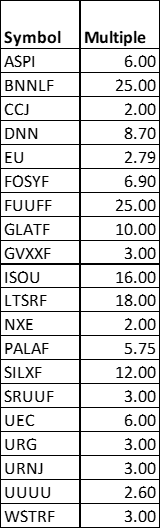
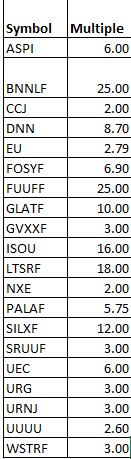
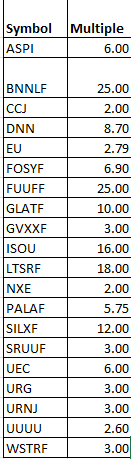
@quakes99 But where to put your money? These are the multiples predicted by Chatgpt for $150 uranium. Are they correct? This is all an investor cares about. Maximizing returns.
@capnek123 Sorry - i messed up on the last post. I ran this through chatgpt for $150 uranium and these are the multiples it came out with. comments? this is where to put your money.
@Real_RobN@grok i guess so...
by J.J. Carrell, a retired U.S. Border Patrol Deputy Patrol Agent in Charge, during a joint hearing held by the Subcommittee on Border Security and Enforcement and the Subcommittee on Oversight and Accountability, , on November 19, 2024.