Quality of the data matters! at least for predicting glioma progression from a patient's initial biopsy before any progression has occurred. Excited to share our new pre-print, authored by Michal Polonsky, Jonathan Fox, Yunrui Lu and Sheel Shah. (1/7)
https://t.co/sXX4NyxPJW
We are inviting applications for a Postdoctoral Fellow/Scientist I (Cell Engineering) to join our growing team at Biohub NY's Lab of Synthetic Spatial Omics and work together! @biohub
Please help spread the word🙏
https://t.co/cyBnLQ9fq5
I am honored to be selected as one of the Young American Scientists by @sciam for developing seqFISH+ in the spatial biology field at @Caltech with @LongCai_Lab. Read more about our work and explore the full cohort profiles here: https://t.co/BRKGKTQRyM #SciAmYoungScientists
Thrilled to share our @CellCellPress paper with Shosei Yoshida & Ben Simons, led by @ChakraArun:
1) spatial geometry can resolve temporal dynamics
2) Sertoli cells run an intrinsic cycle coupled to germline, suggesting oscillator coupling as a principle of tissue organization
Our paper is finally out in Cell! Years of work on one of biology's most beautiful tissue clocks, and finding an intrinsic oscillator that helps organize tissue dynamics. From my PhD work at @LongCai_Lab, with Shosei Yoshida and Ben Simons!
🧵(1/10)
https://t.co/fRFxG3rbo2
Our paper is finally out in Cell! Years of work on one of biology's most beautiful tissue clocks, and finding an intrinsic oscillator that helps organize tissue dynamics. From my PhD work at @LongCai_Lab, with Shosei Yoshida and Ben Simons!
🧵(1/10)
https://t.co/fRFxG3rbo2
Very proud to finally publish Giotto Suite after many years of hard work. It's a big milestone for our lab and will be a massive stepping stone for our ongoing projects and ideas. Take a look at https://t.co/OqYpzxaqKy and feel free to share feedback and ideas for improvement.
I'm excited to share our new preprint on LagTag, a method that recovers both past and present chromatin states from the same mammalian cells.
https://t.co/GEGQpN0Ff0
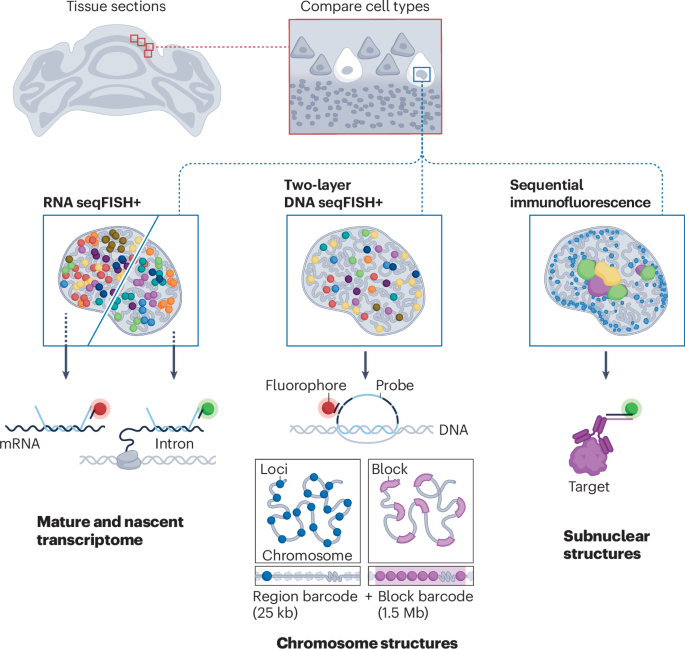
Excited to share our new paper out in @Nature revealing cell-type specific nuclear organization and its link to gene regulation using new spatial multi-omics technologies! https://t.co/0LC2GlEpQs
Released my preprint! Here, we leverage spatial information to resolve temporal dynamics in male germ cell development! We reveal that Sertoli cells are precisely synchronized with periodic germ cell development and have an innate cyclic program independent of the germ cells!
Our new preprint with S.Yoshida and B.Simons! Led by @ChakraArun, we leverage spatial information to resolve temporal dynamics in spermatogenesis!
https://t.co/S5hhzqMi3g
Also check out a complementary preprint by S.Y. and B.S using live imaging! https://t.co/rrbxyFYylk
(1/10)