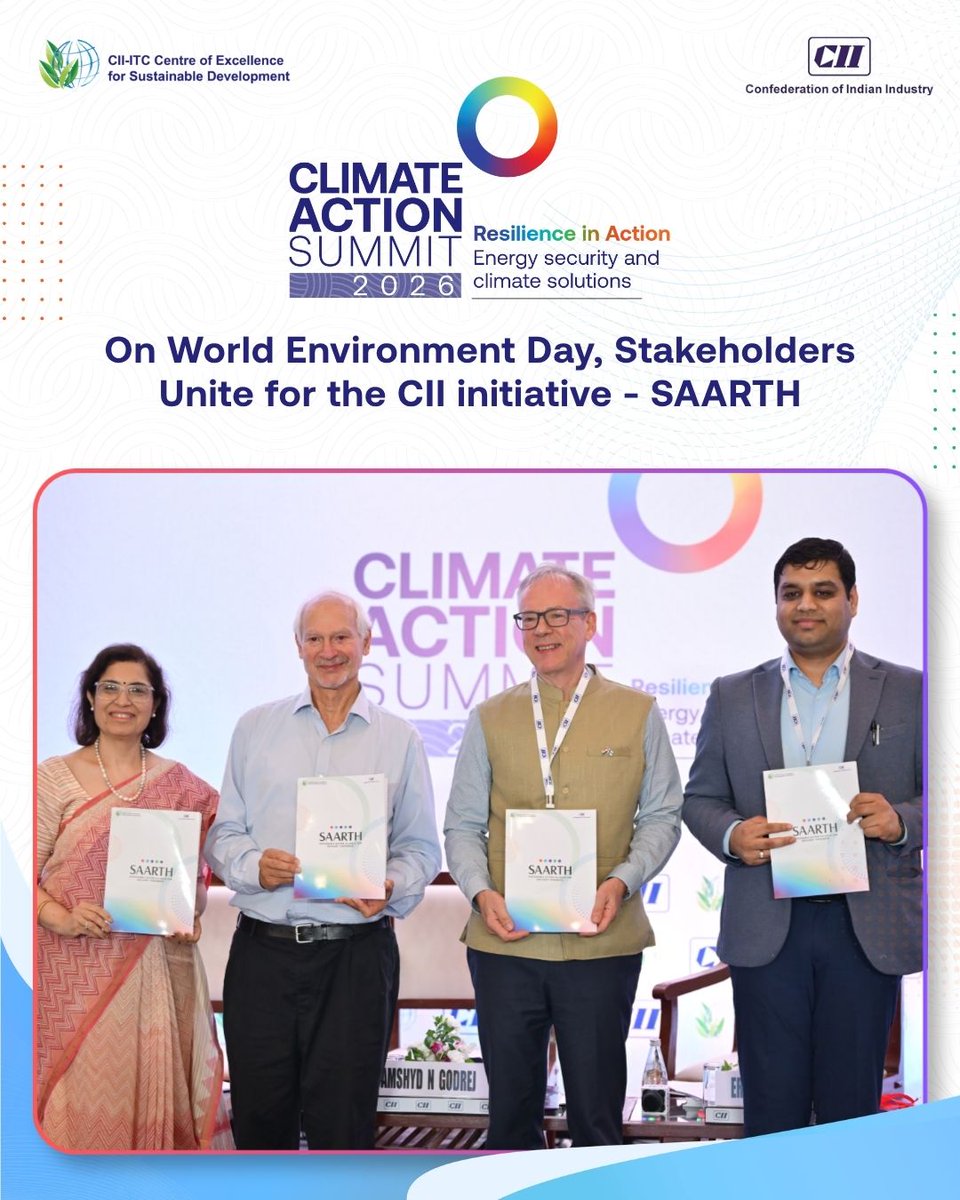
As climate risks become more frequent and more complex, the need for practical, scalable resilience solutions has never been greater.
Launched at the CII Climate Action Summit 2026, SAARTH (Sustainable Action Alliance for Resilient Tomorrow) aims to strengthen climate adaptation and resilience through tools, knowledge, capacity building, and region-specific solutions that help stakeholders prepare for a changing climate.
As one of the Founding Members of SAARTH, @ITCCorpCom supports the coalition’s vision of building resilience at scale and accelerating climate preparedness across sectors and communities.
Mr. Ganesh Kumar Sundararaman, CEO - Agri Business Division, ITC Limited, shares his perspective on the growing urgency of climate resilience and the role of collective action in creating resilient and regenerative futures.
#SAARTH #CIIClimateActionSummit #ClimateResilience #ClimateAdaptation #ClimateAction
@FollowCII@seematweet@CIIEvents@CII4WR
Building resilience at scale requires stronger partnerships, shared learning, and a collective commitment to action.
Launched at the CII Climate Action Summit 2026, SAARTH (Sustainable Action Alliance for Resilient Tomorrow) brings together industry, policy makers, financial institutions, knowledge partners, and development agencies to strengthen preparedness and enable coordinated climate action.
As one of the Founding Members of SAARTH, @AdityaBirlaGrp supports the coalition's vision of advancing resilience through capacity building, knowledge exchange, and collective action.
Reflecting this shared vision, Mr. Vadiraj Kulkarni, Business Head – Cellulosic Fibres, @GrasimInd, shares his perspective on helping industries move from ambition to implementation.
#SAARTH #CIIClimateActionSummit #ClimateResilience #ClimateAdaptation #ClimateAction
@FollowCII@seematweet@CIIEvents@CII4WR
This World Environment Day, we are spotlighting perspectives from leaders on the role of industry in building climate resilience and enabling access to finance, across sectors and regions.
Hear from @PCAcharya, Group Chief Sustainability Officer, @TheJSWGroup as he shares his perspective on the change that is needed across systems.
#WorldEnvironmentDay #Sustainability #ClimateAction #ClimateResilience
@FollowCII@seematweet@CIIEvents@moefcc@CII4WR
This World Environment Day, we are spotlighting perspectives from leaders on the role of industry in building climate resilience and enabling access to finance, across sectors and regions.
Hear from Koushik Chatterjee, Executive Director & Chief Financial Officer, @TataSteelLtd as he shares his perspective on the change that is needed across systems.
#WorldEnvironmentDay #Sustainability #ClimateAction #ClimateResilience
@FollowCII@seematweet@CIIEvents@moefcc@CII4WR
This World Environment Day, we are spotlighting perspectives from leaders on the role of industry in building climate resilience and enabling access to finance, across sectors and regions.
Hear from @ashwini_tewari, Managing Director & Board Member, @TheOfficialSBI as he shares his perspective on the change that is needed across systems.
#WorldEnvironmentDay #Sustainability #ClimateAction #ClimateResilience
@FollowCII@seematweet@CIIEvents@moefcc@CII4WR
This World Environment Day, we are spotlighting perspectives from leaders on the role of industry in building climate resilience and enabling access to finance, across sectors and regions.
Hear from @randomguy2100, Group Chief Sustainability Officer, @MahindraRise as he shares his perspective on the change that is needed across systems.
#WorldEnvironmentDay #Sustainability #ClimateAction #ClimateResilience
@FollowCII@seematweet@CIIEvents@moefcc@CII4WR
Renewable energy is increasingly becoming a strategic lever for strengthening energy security, industrial competitiveness, and long-term resilience.
At the CII Climate Action Summit 2026, the session, "Powering India's Future: Building a Secure, Competitive, and Low-Carbon Energy System", examined how renewable energy can support economic growth, strengthen energy systems, and contribute to India's transition towards a more sustainable future.
Panel 2, "Renewable Energy as Strategy: Strengthening Power, Industry and Security", was moderated by Mr. Prabodha Acharya, Group Chief Sustainability Officer, JSW.
Other delegates who were part of the panel were Mr. Amar Narula, Partner, Energy, Infrastructure and Projects, Trilegal; Ms. Shivangi Rajpopat, Group Company Secretary and Head Sustainability, Apraava Energy; and Mr. Ankit Gupta, General Manager - Sustainability, ITC Ltd.
The discussion highlighted the role of renewable energy in enhancing energy security, supporting industrial decarbonisation, improving competitiveness, and building resilience in an evolving energy landscape.
Key takeaways:
- India's path forward lies in combining renewables, storage, biofuels, hydrogen and flexible balancing solutions into a cohesive energy system. No single source can carry the load alone.
- The real challenge today is execution. Policy clarity, financing frameworks and system readiness are being built. The focus must now shift to translating this groundwork into on-ground action at speed and scale.
- Energy is no longer just an input. It is a strategic driver of competitiveness and growth. For the country, for industry and for future generations, how India manages its energy transition will define its economic trajectory in the decades ahead.
#CIIClimateActionSummit #ClimateAction #RenewableEnergy #EnergySecurity #EnergyTransition #Resilience #Sustainability
@FollowCII@seematweet@CIIEvents@moefcc@CII4WR@PCAcharya@TheJSWGroup@TrilegalLaw
*Post Copy*
Carbon markets are increasingly evolving from compliance mechanisms into tools for investment, innovation, and value creation.
At the CII Climate Action Summit 2026, the session, "Scaling Carbon Markets with Integrity: From Compliance to Value Creation", focused on the role of transparent, credible, and high-integrity carbon markets in supporting decarbonisation and accelerating climate action.
The session was moderated by Mr. Piyush Jha, Head Climate and Sustainable Finance, Tata Steel Ltd.
Other delegates who were part of the panel were Ms. Nishtha Singh, Assistant Director - Climate, Asia Society Policy Institute; Mr. Anil Jauhri, Chairman of Governing Council, Carbon Registry-India; Dr. Harish K. Ahuja, Head of Sustainability, Carbon & Power Markets, Listing (IPOs), & Social Stock Exchange, National Stock Exchange of India; and Mr. Vivek Adhia, Chief Sustainability Officer, UltraTech Cement.
Conversations centred on market integrity, transparency, standards, and the conditions needed for carbon markets to deliver meaningful climate and business outcomes.
Key Takeaways:
- Carbon markets are shifting from a compliance cost to a strategic competitiveness tool.
With CBAM now in effect, industries can no longer ignore the price of carbon. India's CCTS must be built on a robust MRV system, strong governance and broad capacity building to be credible and globally recognised.
- Integrity is the foundation without which carbon markets cannot function.
Conflicts of interest across verifiers, project developers and financiers have eroded trust. Recent UNFCCC standards have been significantly tightened, including prohibiting verification bodies from being linked to consulting or financing entities.
- Carbon markets are most powerful when used strategically, not just for compliance.
Carbon finance can make otherwise unviable projects commercially viable. For hard-to-abate sectors like cement and steel, where process emissions cannot be eliminated through efficiency alone, carbon markets can unlock deep decarbonisation technologies that would otherwise have no business case.
#CIIClimateActionSummit #ClimateAction #CarbonMarkets #CarbonFinance #Decarbonisation #Sustainability
@FollowCII@seematweet@CIIEvents@moefcc@CII4WR@aniljauhri@UCarbonReg@NSEIndia@AsiaPolicy@vivadhia@UltraTechCement@TataSteelLtd
As India's energy landscape evolves, building an energy system that is secure, competitive, and resilient will be critical to sustaining growth, strengthening energy security, and supporting long-term competitiveness.
At the CII Climate Action Summit 2026, the session, "Powering India's Future: Building a Secure, Competitive, and Low-Carbon Energy System", explored the role of an evolving energy mix in supporting industrial growth, enhancing resilience, accelerating innovation, and enabling net-zero ambitions.
Panel 1, "The New Energy Mix: Powering Growth, Resilience and Net-Zero Futures", was moderated by Mr. Prabodha Acharya, Group Chief Sustainability Officer, JSW.
Other delegates who were part of the panel were Mr. Venkatesh R, Managing Director and Director - Energy Business, Wärtsilä India Private Ltd.; Mr. Nitin Jain, Head Corporate Centre, L&T Energy GreenTech; Mr. Mayank Jain, Head Strategic Intelligence and RMM, Middle East, India and Africa, Novonesis; and Mr. Yash Kashyap, India Lead, Mission Possible Partnership and the Industrial Transition Accelerator.
The discussion highlighted the opportunities and challenges associated with integrating diverse energy sources, scaling clean energy technologies, and building a more resilient energy ecosystem for the future.
Key Takeaways:
• A diversified energy mix will be critical to India's energy future.
Balancing energy security, affordability, and decarbonisation will require renewables, storage, flexible generation, and sustainable fuels to work together.
• Storage and transmission infrastructure must scale faster.
Addressing intermittency, curtailment, and grid constraints will be essential as renewable energy capacity continues to expand.
• Green hydrogen is moving from pilot projects to large-scale deployment.
The next challenge is building the supporting ecosystem, including renewable power, transmission, storage, transport, and demand.
• Bioenergy can strengthen both energy security and circularity.
Ethanol, compressed biogas, sustainable aviation fuel, and waste-to-energy solutions can support decarbonisation while utilising agricultural and municipal waste streams.
• Innovation and technology scale-up will determine the pace of transition.
Stronger support for R&D, startups, pilot projects, and industry collaboration will be needed to accelerate deployment of emerging clean technologies.
#CIIClimateActionSummit #ClimateAction #EnergyTransition #EnergySecurity #Resilience #NetZero #Sustainability
@FollowCII@seematweet@CIIEvents@moefcc@CII4WR@larsentoubro@wartsilacorp@novonesis@MPPindustry
CESD organised tree plantation at its corporate office to mark #worldenvironmentday and support the Prime Minister's #EkPedMaaKeNam campaign. When the planet grows, everyone flourishes.
This World Environment Day, we are spotlighting perspectives from leaders on the role of industry in building climate resilience and enabling access to finance, across sectors and regions.
Hear from Mr. Jamshyd N Godrej, Past President, CII; Chairman, CII - Climate Change Council; and Chairman and Managing Director, @GodrejEntGroup, Godrej & Boyce Manufacturing Company Ltd., as he shares his perspective on the change that is needed across systems.
#WorldEnvironmentDay #Sustainability #ClimateAction #ClimateResilience
@FollowCII@seematweet@CIIEvents@moefcc@CII4WR
Mobilising capital at scale will be critical to accelerating India's climate transition and unlocking new opportunities for sustainable growth.
At the CII Climate Action Summit 2026, the session, "The USD 2.5 Trillion Finance Opportunity: Investing in India's Climate Transition", explored the role of finance in accelerating decarbonisation, scaling climate solutions, strengthening resilience, and enabling long-term economic growth.
The session was moderated by Mr. Manish Chourasia, Proposed Managing Director and CEO, Climate Finance India Pvt. Limited (subject to RBI approval).
Other delegates who were part of the panel were Mr. Shalabh Tandon, South Asia Regional Head of Climate Operations and Climate Change, International Finance Corporation (IFC); Mr. Ashwini Kumar Tewari, Managing Director, State Bank of India; Mr. Chirag Mehta, CAIA, Chief Investment Officer, Quantum Asset Management Company Pvt. Ltd.; Mr. Krishna Kumar, Partner, India-Japan Fund, National Investment and Infrastructure Fund Limited (NIIFL); and Mr. Koushik Chatterjee, Executive Director and Chief Financial Officer, Tata Steel.
Key Takeaways:
1 Climate investment is expanding into circularity, recycling and energy efficiency. Investors are actively looking beyond renewables into battery recycling, plastics and energy efficiency for hard-to-abate sectors. The primary bottleneck is scale, as most companies in these segments are too small to absorb large institutional capital.
2 The USD 2.5 trillion climate finance need is real but unevenly investable. About 50% covering renewables and EVs is already commercially viable. The rest, including green hydrogen and hard-to-abate sectors, will need blended finance and policy support to become bankable.
3 Blended finance and viability gap funding are essential to unlocking early-stage climate sectors. IFC's experience in solar, and now green hydrogen, shows that early concessional capital can de-risk sectors enough for private capital to follow. The same model needs replication across battery storage and adaptation finance.
4 Carbon pricing and a clear climate taxonomy are the missing levers for transition finance. Hard-to-abate sectors like steel will only accelerate decarbonisation once carbon is priced. The government's long-awaited climate taxonomy is equally critical to give banks and investors a consistent, greenwashing-proof framework.
5 ESG investing requires on-ground verification, not desk-based ratings. Companies with rigorously verified ESG practices have proven to be long-term market compounders. However, most investors still treat ESG as a checkbox filter rather than a merit-based weighting, undermining investment outcomes.
#CIIClimateActionSummit #ClimateAction #ClimateFinance #ClimateTransition #SustainableFinance #BusinessReadiness
@FollowCII@seematweet@CIIEvents@moefcc@CII4WR@ashwini_tewari@TheOfficialSBI@TataSteelLtd@Quantum_MF@NIIFIndia@IFC_org