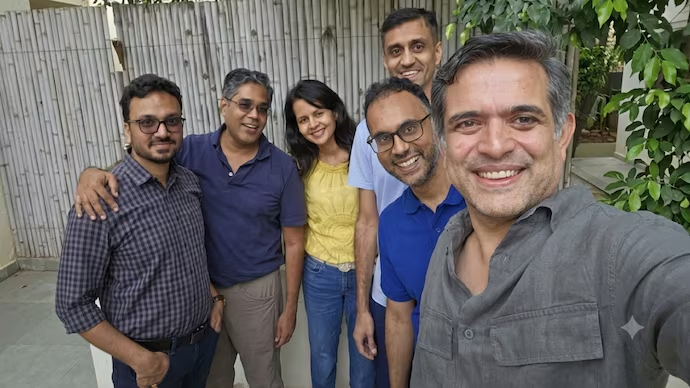
If you join a startup and they give you:
- a MacBook
- Codex and Claude subscriptions
- your job offer on a Sunday night
- a random urgent task on your first day
- a founding team with kids
you’re probably in the right place.
If they give you:
- a Windows laptop
- one responsibility for the next six months
- Outlook
- PowerPoint decks
- an office on the outskirts of town
good luck. You’re going to need it.
3 engineers sold a successful chip company. Then they spent six months learning quantum computing from scratch. Today, with an IIT Madras professor as co-founder, they're building India's room-temperature quantum computer.
Read more: https://t.co/m7cJu73OlJ
NVIDIA did it again..
they trained a GPT that generates human movement instead of text.. next-token prediction, but the tokens are body motions.
it's called GPC and it hit a 99.98% success rate reproducing a massive corpus of motion clips.. cartwheels, vaults, flips, all of it.
→ 99.98% success rate reproducing motion clips
→ learns cartwheels, flips, vaulting from raw data
→ adapts to new tasks with <1% extra parameters
studios spend 6-12 months and millions of dollars building custom controllers for one character in one game.
GPC does it in one forward pass.
Pixar, Ubisoft, and every mocap studio on the planet just felt a chill down their spine.
the same next-token trick that gave us ChatGPT is now doing parkour inside a physics engine.
i think a lot about that guy in the early 1900s who went to bosnia to the last illiterate communities in europe and found out they were still reciting homer epic-length poems to each other from memory.
but when they became literate they lost the ability to remember the poems
A new father became so terrified of never learning anything again that he accidentally dismantled the biggest lie in education.
His name is Josh Kaufman, and he wasn't a neuroscientist or a professor. He was an author working from home, running a business with his wife, with a newborn daughter who had just obliterated any concept of free time he thought he had.
Around week 8 of sleep deprivation, he had the thought every parent has.
I am never going to learn anything new ever again.
And because he was the kind of person who responds to panic with research, he went to the library and started reading everything he could find about how humans acquire skills. He read book after book, study after study.
Every single one said the same thing.
10,000 hours.
He had a full-body reaction to that number. 10,000 hours is a full-time job for five years. He didn't have five years. He didn't have five hours. He had a newborn and a business and a wife who was also building a business in the same house.
So he kept digging. And here is where it gets interesting.
The 10,000 hour rule came from a researcher named K. Anders Ericsson at Florida State University. What Ericsson actually studied was professional athletes, world-class musicians, chess grandmasters people at the absolute tip of ultra-competitive, ultra-high-performing fields. His finding was that the people at the very top of those narrow fields had put in around 10,000 hours of deliberate practice.
That is all the finding said.
Then Malcolm Gladwell wrote Outliers in 2007, and the message went through a game of telephone that destroyed its meaning entirely.
It takes 10,000 hours to reach the top of an ultra-competitive field became it takes 10,000 hours to become an expert, which became it takes 10,000 hours to become good at something, which became it takes 10,000 hours to learn something.
That last statement is completely false. And the actual research had been showing something different the entire time.
When cognitive psychologists study skill acquisition, they measure a graph that looks identical across every domain they have ever tested. At the start, performance is terrible. With a small amount of practice, it improves rapidly. Then it plateaus, and subsequent gains become much harder and slower to achieve.
The steep part of that curve the jump from knowing nothing to being reasonably good happens much faster than anyone tells you. Not 10,000 hours. Not 1,000 hours.
20 hours.
Kaufman tested this himself. He had always wanted to learn ukulele. He picked one up, put 20 hours of focused deliberate practice into it, and stood on a TEDx stage playing a medley of recognizable pop songs in front of a live audience. The crowd went wild. He then told them that performance was his 20th hour.
But 20 hours is not just a number. There is a method inside it.
The first step is to deconstruct the skill. Most things we think of as single skills are actually bundles of dozens of smaller skills. You do not need all of them. You need the ones that get you to your specific goal the fastest. In music, this means most songs use four or five chords. Learn those first. Ignore the rest until they matter.
The second step is to learn just enough to self-correct. Get three to five resources books, courses, videos but do not use them as a reason to delay practice. The point of learning is not to master theory first. It is to get good enough at noticing your own mistakes that you can adjust as you go.
The third step is to remove barriers to practice. Not through willpower. Through structure. If the instrument is in the case in the closet, you will not play it. If your phone is in the room, you will not focus. Kaufman was brutal about this. The environment does the work that discipline cannot sustain.
The fourth step is the one that actually makes the system work. Pre-commit to 20 hours before you start.
Here is why this matters. Every skill has what he called a frustration barrier. The early part of learning anything is genuinely terrible. You are incompetent and you know it. That feeling is so uncomfortable that most people quit before they ever cross to the other side of the curve. By pre-committing to 20 hours, you are making a contract with yourself to push through the frustration long enough to arrive at the part where things start clicking.
The barrier to learning something new is never intellectual. It is emotional. We are afraid of feeling stupid.
That fear costs most people everything they could have learned.
Kaufman figured this out while holding a baby and running out of time, which is the most human possible condition for having a breakthrough.
Most people are waiting for the perfect season to start. He just started.
20 hours is 45 minutes a day for a month. That is it. That is the price of going from knowing nothing to being genuinely capable at almost anything you can name.
The 10,000 hour rule was never about learning. It was about becoming the best in the world.
You probably do not need to be the best in the world.
You just need to start.
@EyasuNimeselu@EthiopianNewsA Zoomalian stay out of our business, we are the captains now, your country is not a country and you dare to laugh 😆 if you are really Eritrean, you must be a pathetic diaspora who dares to laugh at Ethiopia while your country fades into dust
There's a physicist at Stanford named Safi Bahcall who modeled this exact principle and the math is wild.
He calls it "phase transitions in human networks." When you're stationary, your probability of a lucky event is limited to your existing surface area: the people you already know, the places you already go, the ideas you've already been exposed to. Your opportunity window is fixed.
When you move, your collision rate with new nodes in a network increases nonlinearly. Double your movement (new conversations, new cities, new projects) and your probability of a serendipitous encounter doesn't double. It roughly quadruples. Because each new node connects you to their entire network, not just to them.
Richard Wiseman ran a 10-year study at the University of Hertfordshire tracking self-described "lucky" and "unlucky" people. The single biggest differentiator wasn't IQ, education, or family money. Lucky people scored significantly higher on one trait: openness to experience. They talked to strangers more, varied their routines more, and said yes to invitations at nearly twice the rate.
The "unlucky" group followed the same routes, ate at the same restaurants, and talked to the same 5 people. Their networks were closed loops. No new inputs, no new collisions.
Luck isn't random. Luck is surface area. And surface area is a function of movement.
The lobster emoji is doing more work than most people realize. Lobsters grow by shedding their shell when it gets too tight. The growth requires a period of total vulnerability. No protection, no armor, soft body exposed to the ocean.
That's the cost of movement nobody posts about. You have to be uncomfortable first. The new shell only hardens after you've already moved.
🚨 Today in @Nature, we report GEMINI—a genetically encoded intracellular memory device that writes cellular dynamics into tree-ring-like fluorescent patterns within cytoplasmic protein assemblies.[1/n]
https://t.co/eVchPCiK6f
‘.. I think I’ve come to realize that this is partly due to ‘locking in syndrome’ which comes from many still fresh wounds, mistakes and missed opportunities for which there is no place but the present, in its urgency.’
I thought about this before and wrote this down
‘I used to wonder what the true distance between me and some men, young fathers in particular for some reason give off this sense of determination and a certain degree of sharpness or brisk understanding of what needs to be done..’
Once you have kids the pretense of childless men trying to “big bro” you becomes so absurd. People who have kids have biologically different brains afterwards— (patrescense) neuroplasticity increases & your brain is fundamentally rewired. It’s like puberty— the childless man trying to talk down to a father is like a teenager talking down to an adult. It’s just ridiculous. There’s no discourse to have. There’s no way to convey what it is they lack perspective on.
@ArchitectLoop@spoiltkid I suggest you stop using AI to get little dopamine ego boost hits, it won’t end well, I also suggest you stop spouting nonsense if you want to be perceived as ‘educated’ and forget about the clearly non-existent charisma which one normally doesn’t announce about themselves lol
@ArchitectLoop@spoiltkid AI told you that you are a ‘charismatic autodidact’ and here you are running around spouting absolute nonsense about how ‘The world financed the US military’, like are you even real, I mean these days even dumb bots seem more thoughtful and informed that than lol



![DingchangLin's tweet photo. 🚨 Today in @Nature, we report GEMINI—a genetically encoded intracellular memory device that writes cellular dynamics into tree-ring-like fluorescent patterns within cytoplasmic protein assemblies.[1/n]
https://t.co/eVchPCiK6f https://t.co/KPmYKFgnZt](https://pbs.twimg.com/media/HCgxFtcWkAAoaPS.jpg)





