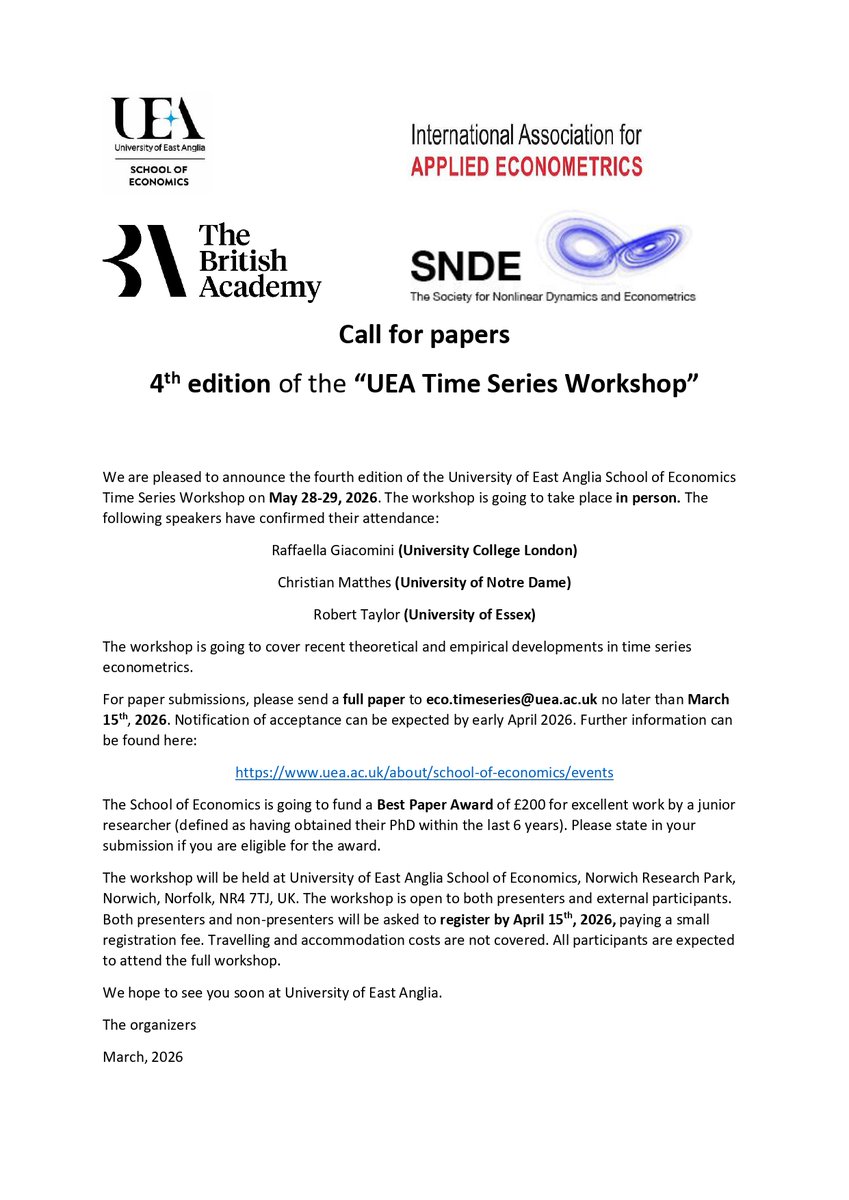
Are your shocks exogenous? 🤔
An updated “Causality versus Serial Correlation: an Asymmetric Portmanteau Test” is now out: https://t.co/cQ5CPWUdwd
A package implementing the test will be available soon.
Stay exogenous, stay tuned!
#EconTwitter#Econometrics#TimeSeries
📢 The call for papers for the 12th BdF-BoE-BdI International Macro Workshop just dropped!
This year's theme: "New Risks in International Macro and Finance" 🌍⚖️🛢️🤖💵
Make sure to send us your papers by 28 June👇
"UK monetary policy surprises are relatively large and getting larger" https://t.co/z19q07RgMU @JoelSuss@FT which references the @_SiLviA_mA paper https://t.co/aPmyDBafxH
One day, mathematician Shizuo Kakutani was teaching a class at Yale University.
During the lecture, he wrote a lemma on the blackboard and told the students that its proof was obvious.
A student hesitantly raised his hand and said that the proof was not obvious to him. He politely asked if Professor Kakutani could explain it.
Kakutani paused for a moment and tried to think through the argument. After a while, he realized something surprising—he could not immediately prove the lemma himself.
Smiling a little awkwardly, he apologized to the class and said he would return with the proof in the next lecture.
After the class ended, Kakutani went straight to his office and began working on it.
He spent a long time trying different ideas, but the proof would not come. The problem kept bothering him.
Eventually, he decided to search the library for the original source of the lemma.
After some effort, he finally located the paper where the lemma first appeared. The statement was written clearly.
Then he looked at the proof.
Instead of a detailed explanation, it simply said: “Exercise for the reader.”
At that moment, Kakutani realized something amusing—the paper had been written years earlier… by himself.
It was a gentle reminder that even great mathematicians sometimes forget the details of their own work.
I took a UCLA class on causal inference taught by @yudapearl more than 10 years ago. Recently together with my co-author Egor we applied causal DAGs to persuasion. I believe it is worth a read: causality.pdf https://t.co/f6qHDC47QN
Uniform asymptotic theory for local projections with unknown/infinite lag order. LPs can achieve semiparametric efficiency and support robust IRF inference.
New paper by Xu:
https://t.co/dgGo192pTc
#REStud#EconX#EconTwitter
An MIT professor taught the same math course for 62 years, and the day he retired, students from every country on earth showed up online to watch him give his final lecture.
I opened the playlist at 2am and ended up watching three of them back to back.
His name is Gilbert Strang. The course is MIT 18.06 Linear Algebra.
Every machine learning engineer, every data scientist, every quant, every self-taught programmer who actually understands how AI works learned the math from this one man. Most of them never set foot on MIT's campus. They just opened a free playlist on YouTube and let him teach.
Here's the story almost nobody tells you.
Strang joined the MIT math faculty in 1962. He retired in 2023. That is 61 years of standing at the same chalkboard teaching the same subject to 18-year-olds.
The interesting part is what he did when MIT launched OpenCourseWare in 2002. Most professors were skeptical. They worried that putting their lectures online would make their classrooms irrelevant. Strang did not hesitate. He said his life's mission was to open mathematics to students everywhere. He filmed every lecture and gave it away.
The decision quietly changed how the world learns math.
For decades linear algebra was taught the wrong way. Professors started with abstract vector spaces and proofs about field axioms. Students drowned in the abstraction. Most never recovered. They walked out believing they were bad at math when they had simply been taught in an order that nobody's brain is built to absorb.
Strang inverted the entire curriculum.
He started with matrix multiplication. Something you can write down on paper. Something you can compute by hand. Something you can see. Then he showed his students that everything else in linear algebra eigenvectors, singular value decomposition, orthogonality, the four fundamental subspaces was just a different lens for understanding what the matrix was actually doing under the hood.
His rule was strict. If a student could not explain a concept using a concrete 3 by 3 example, that student did not actually understand the concept yet. The abstraction was supposed to come last, not first. The intuition was the foundation. The proofs were just confirmation that the intuition was correct.
The second thing Strang changed was the classroom itself. He said please and thank you to his students. Every single lecture. He paused mid-derivation to ask "am I OK?" to check if anyone was lost. He never used the word "obviously" or "trivially" because he knew exactly what those words do to a student who is one step behind. He treated 19-year-olds learning math for the first time the way he treated his own colleagues. With patience. With respect. With the assumption that they belonged in the room.
For 62 years.
The result is something that has never happened in the history of education. A single math professor became the default teacher of his subject for the entire planet.
Universities in India, China, Brazil, Nigeria, every country with a computer science department, started telling their own students to just watch Strang's lectures. The University of Illinois revised its linear algebra course to do almost no in-person lecturing. The reason was honest. The professor said they could not compete with the videos.
His final lecture was in May 2023.
The auditorium was packed with students who had never met him before. He walked to the chalkboard, taught for an hour, and at the end the entire room stood and applauded. He looked confused for a moment, like he genuinely did not understand why they were cheering. Then he smiled and waved them off and walked out.
His written comment under the YouTube video of that final lecture was four sentences long. He said teaching had been a wonderful life. He said he was grateful to everyone who saw the importance of linear algebra. He said the movement of teaching it well would continue because it was right.
That was it. No book promotion. No farewell speech. No legacy management.
The man whose teaching is the foundation of modern AI just thanked the audience and went home.
20 million views. Zero ego. The entire engine of the AI revolution sits on top of math that millions of people learned for free from one quiet professor in Cambridge.
The course is still on MIT OpenCourseWare. Every lecture, every problem set, every exam, every solution. Free.
The most important math course of the 21st century is sitting one click away from you. Most people will never open it.
📢We're launching the Policy Calibration Tool based on Barnichon & Mester 2023. Basic idea: Given forecasts of inflation and unemployment, and your weight of price stability vs. employment, what is the optimal policy rate path? Check out! CMR website: https://t.co/pom6LJDqS3
Today, on International Women’s Day #IWD2026 , I want to honor those warriors who paved the way for us—all those courageous women who, against the establishment, never gave up.
Let me just mention two of my greatest inspirations: (1) Émilie du Châtelet, whose work gave us the energy approach to mechanics (basis for Lagrangian and Hamiltonian mechanics); (2) the great Emmy Noether, whose work on abstract algebra and symmetries brought us one of the most beautiful theorems in mathematical physics.
By Noether’s theorem, every continuous, differentiable symmetry of a system’s action corresponds to a conserved quantity.
Here’s a tribute to Noether (and to all of us women): the proof that if the system’s action is invariant under time translation, then energy is a constant of the motion.
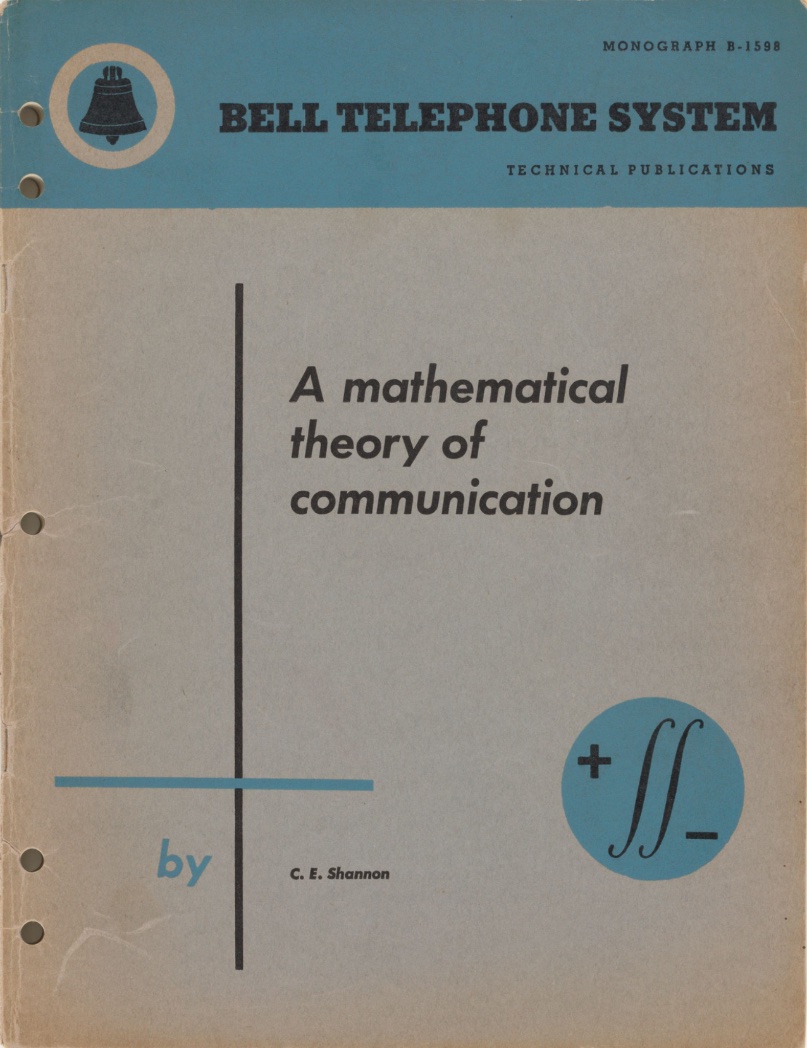
We rave about giants like Newton, Einstein, Bohr, Tesla, and Edison. But in terms of direct impact on our lives in the information age, nobody comes close to Claude Shannon.
In 1948, he dropped a straight 10/10 paper:
A Mathematical Theory of Communication.
His work has imbued us with the ability to send whispers across continents.
The paper doesn’t just suggest techniques, it draws the boundaries of reality for information... how far compression can go (entropy), the maximum rate a noisy channel can carry reliably (capacity), and why error correction isn’t optional if you want those whispers to arrive intact.
We are excited to again sponsor a session at the Annual Meeting of @CebraOrg. If you have a policy-relevant recent working paper in international finance, macro-finance, and/or #monetarypolicy, please consider submitting your work!
Deadline March 2 #CEBRA26@sffed