In the 1960s, a direct flight to Neptune would have taken nearly 30 years. That was longer than most spacecraft could survive. Reaching the outer planets seemed almost impossible.
But one engineer, working quietly with a pencil, found a way around this problem.
Gary Flandro, a scientist at NASA’s Jet Propulsion Laboratory, was asked to study how spacecraft might travel to the distant planets despite the limits of rocket technology at the time. Fuel was scarce, and engines were not powerful enough for such long journeys.
Flandro turned to a clever idea from physics called a gravity assist, sometimes known as a planetary slingshot. The concept is simple in principle. When a spacecraft passes close to a large planet, the planet’s gravity pulls it in and then flings it forward. In doing so, the spacecraft steals a tiny bit of the planet’s motion around the Sun. The planet slows down by an amount too small to notice, but the spacecraft gains a huge increase in speed without using any fuel.
With only paper, pencil, and the limited computers of 1965, Flandro calculated the future positions of Jupiter, Saturn, Uranus, and Neptune. What he found was remarkable. In the late 1970s, these giant planets would line up in a rare formation. This alignment would allow a single spacecraft to travel from one planet to the next, gaining speed at each step.
This opportunity appears only once every 176 years.
Flandro showed that a spacecraft could use Jupiter’s gravity to reach Saturn, then use Saturn to reach Uranus, and finally use Uranus to reach Neptune. This chain of boosts would cut the travel time to Neptune from about 30 years down to just 12.
This elegant piece of mathematics changed everything.
It became the foundation for the Voyager 1 and Voyager 2 missions, both launched in 1977. Thanks to this precise planning, the two spacecraft sent back the first close images of the outer planets. They later continued their journey beyond the solar system, becoming the first human-made objects to enter interstellar space.
All of it began with a simple insight, worked out by hand, that turned an impossible journey into a reachable one.
The rot of narcissism has destroyed the very concept of duty in our society. Duty means doing what is required because it is required, whether or not it benefits you, excites you, rewards you, or makes you look good.
Modern people hate duty because duty is indifferent to their feelings. The clearest evidence of this rot is the collapse of the birth rate. A society that worships the self will stop having children because children require things like selfless sacrifice and duty.
A father must provide whether he feels inspired or not and a mother must nurture whether she is praised or not.
Duty is the death of childishness, but unfortunately we live during a time of endless adolescence when we desperately need adults.
NAIROBI ON ASIA-TYPE SUPER GROWTH
95+ TOWERS RISING (20+ FLOORS EACH)
The undisputed capital of Africa will be unrecognisable in 2030.
Nothing close to this in Africa. Nairobi is adding Dubai/Shanghai-style density
Hotspots: Westlands (28+ towers), Upper Hill (9+) and Kilimani/Parklands
Full list 🧵👇
HOW NAIROBI GOT HER GROOVE BACK
There are three things I live for: good food, good drink, and women in good dresses.
When you come down to it, that is all a man should live for. Beyond making money, staying healthy, staying debt-free, and being secure in the knowledge that you will never vote for Ruto, what else is there, really?
I keep thinking about how miserable the 2010s were in Kenya. The feminists were in full cry, and not the witty kind. Fesibuku belonged to the Kilimani Moms, where the national sport was kulimana. Twitter A was full of shit, we couldn’t get a word in edgeways. Instagram was in its infancy.
Ulikuwa unaamka, unapata madeadbeat washaanikwa before you’d had breakfast. We had the laziest president in living memory. The music was so bad that Nyashinski had to come down from a ten-year hiatus to rescue us, then ruled the airwaves for the next ten. We had no sex symbol, male or female. Nairobi had no soul.
Beyond a few rugby matches, nothing was happening. Few book festivals. Fewer concerts. Burna Boy would stagger onto a paid gig at 5 a.m., drunk, and call us peasants. Davido came on Larry Madowo’s The Trend wearing an attitude. Dark days, those.
The 2020s arrived as the stark opposite. No sooner had COVID lifted than Nairobi sat up and stretched. The music turned good again. Suddenly, there were more young musicians than I could count: Bensoul, Coaster Ojwang, Bien. The women were even better. From Nikita Kering to Bridget Blue, Nadia Mukami to Sanaipei, they have been dropping banger after banger over videos that are cool, unbothered, and quietly sensual.
And somewhere in there, Nairobi got dressed. I noticed it the way you notice a season turning, one good dress at a time, and then all at once. The city that not long ago treated a clean kitenge as formal wear now does brunch like it is a runway that happens to serve mimosas. Over the last two years, I have seen beautiful dresses and even better legs, and I say that strictly as a connoisseur, in pure appreciation of the art. Facebook and Instagram have become genuinely dangerous to a man’s productivity. Not in a sleazy way. In the way, a gallery is dangerous to a man who likes paintings.
Economists have a theory called the Hemline Index. The idea is that skirts get shorter when the economy is booming and longer when it is in the dumps. By that logic, Nairobi makes no sense at all. The shilling spent two years on its knees, and yet the hemlines kept climbing. So either the theory is nonsense, or our women are simply more optimistic than the National Treasury. I know which one I believe.
The men are catching up, too, though slowly and with great effort, the way men do. We have discovered the linen shirt and the fitted trousers, and a few brave souls have located a tailor. It is not parity yet. The women are still operating several leagues above us. But for the first time in a while, a man can step out of the house and feel like he is part of something rather than apologizing for it.
The point is that there are events worth dressing up for now. Brunches. Road trips. Book festivals. Concerts. Plain old clubbing. It is as though Nairobi quietly got its soul back and forgot to issue a press release. The women clean up beautifully, they are sharp company, and hanging out is fun and funny again. We get along. The tribal lines blur a little more each weekend, usually over food and loud music, and the city keeps inventing new versions of itself.
So if you are young, savor all of it. These things run in cycles. Who knows, the 2030s may turn out to be the darkest of the lot.
So dress up and show up.
En muchas iglesias protestantes encontrarás una cruz vacía.
En muchas iglesias católicas encontrarás un crucifijo con la imagen de Cristo.
Y algunos preguntan:
“¿Por qué mostrar a Jesús en la cruz si ya resucitó?”
La respuesta es sencilla.
Los católicos creen firmemente en la Resurrección.
Pero tampoco quieren olvidar el precio de la salvación.
San Pablo escribió:
“Nosotros predicamos a Cristo crucificado”.
No dijo solamente a Cristo resucitado.
Porque la cruz revela hasta dónde llegó el amor de Dios por la humanidad.
El crucifijo no significa que Jesús siga sufriendo.
Significa que jamás debemos olvidar lo que hizo por nosotros.
Y pensemos algo profundo.
Vivimos en una cultura que quiere resultados sin sacrificio.
Victoria sin lucha.
Gloria sin entrega.
Pero el Evangelio muestra algo distinto.
Antes de la Resurrección vino el Calvario.
Antes de la corona vino la cruz.
Por eso el crucifijo sigue recordando una verdad incómoda y hermosa:
Nuestra salvación tuvo un precio.
Y ese precio fue el amor de Cristo entregado hasta el extremo.
There is a loud ten per cent on this app whose entire intellectual output is grievance. They produce no policy and no institutional design for the things they claim to care about. Outrage dressed in liberation language is their only export, and they ship it daily.
People celebrated a football result on the streets of Nairobi and this crowd saw mental slavery. What was actually on display is the output of a deliberate attraction architecture. The English Premier League is probably the most successful application of that model anywhere in the world. Its broadcasting contracts are engineered for every time zone, and its sponsorship pipelines are localised to specific markets. Three decades of digital engagement strategy sit underneath that, feeding into grassroots academies that give young players a visible path from Sunday league to stadium. That product works because someone sat down and designed it to work. It is simple, accessible, and engineered to travel. Match kicks off, you know the time, you know the stakes, you know where to watch.
Now place civic engagement next to that. The supplementary appropriations bill matters more to your household than an Arsenal title, but nobody has packaged it to compete. There is no broadcast schedule for fiscal policy. There is no civic equivalent of Sky Sports pulling you in on a Saturday afternoon. That infrastructure barely exists, and where it does, it is underfunded, poorly designed, and invisible.
Nyakundi raises a version of this question but frames it as an anger deficit. Kenyans are not angry enough, not desperate enough. This is not a critique of him specifically. He has done real work in civic awareness and earned his platform the hard way. But I disagree with the framing. The variable is design, not temperature. Freedom of choice is constitutional. When a world-class attraction engine meets an absent civic infrastructure, the streets will reflect exactly that imbalance. Blaming citizens for choosing the better-engineered product is not analysis. It is an admission that there is nothing competitive to offer.
And this is where the grievance crowd must answer for itself. If your entire contribution to African civic life is pointing at joy and labelling it colonialism, you are the gap you keep describing. I ask the question from inside, not from the gallery. I run an institutional research publication. I build the analytical architecture I think the continent needs. Some days it reaches five hundred people. Some days five thousand. The reach is not the point. The act of building is the point, because the alternative is being one more voice on a timeline, performing outrage for applause, solving nothing.
So before you call celebrating Kenyans mentally enslaved, answer a prior question. What have you built? If the answer is nothing, then the problem you are describing starts with you.
Kenyans:
I spend a lot of time talking to you all about the economic apartheid that is our economy.
I call it that because frankly - I don't know what else to call it.
It's a system full of wasted opportunities.
Because it is a system where most of us contribute sweat, tears, taxes, and sometimes blood, and get very little in return.
While a tiny fraction of us consumes everything.
Let me put two or three exhibits on the table to make this point.
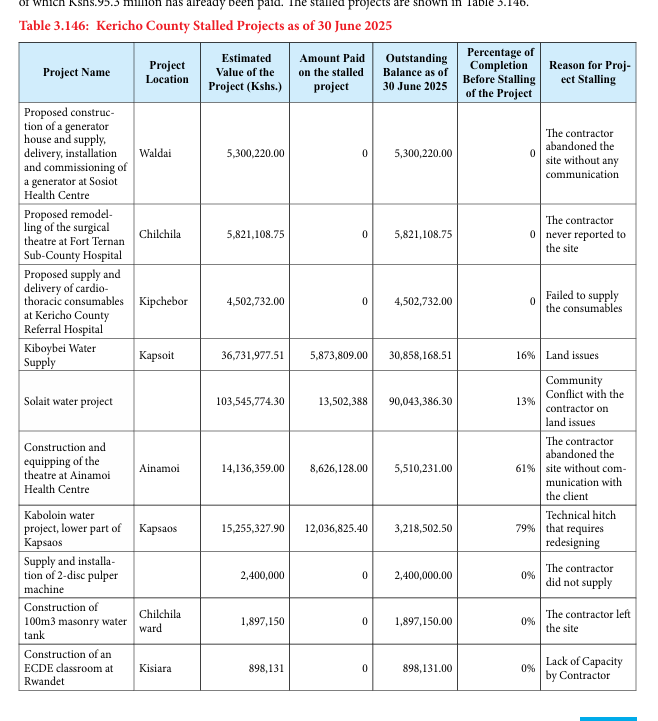
The first attachment is a summary of an audit I conducted a few months ago, about corruption and wastage at the National Government.
Look at the findings:
Close to KSH 700 billion in projects that are stalled.
Stalled. Money has been allocated, often paid, but our country - in which the 18-34 years age group faces a staggering 53% unemployment - is apparently ok with KSH 700 billion in Stalled Projects.
Our country today is spending over 80% of our national revenue on debt service.
Debt services includes paying interest on this KSH 700 billion.
KSH 700 billion that is not serving any Kenyan.
There are over 10 million unemployed in that age group - that need work. That are ready to work.
But they cannot do it, because projects are stalled.
And when you look at the reasons that almost all projects provide, here are the most common reasons:
(1) Contractor abandoned site. Got up and left.
(2) No funding. Meaning - the contractor sometimes is not paid, because money is diverted or just stolen.
How is it possible that almost every contract issued, faces abandonment?
How is it that all the contractors feel ok to walk away?
The truth is this: almost all of these contracts are given to criminal associates of those in and around government.
That is why we have hundreds of billions in stalled projects. No bona fide contractor wants a situation like that. They want to their part, get a profit, and move on to the next project.
Criminals, on the other hand - are in it to make a profit without work. So- they might spend years looking for someone with the expertise and ability to do the work for a small fraction of the contract amount.
But the price if this is paid by Kenyans who need these economic opportunities.
Make no mistake about it.
Take a look at the second and third attachments.
Second one is from Kericho County. Third one is from Machakos.
These are stalled projects at the county level - and their numbers are separate from the KSH 700 billion I mentioned above.
The contractor got up and left.
In Machakos - many, for lack of payment.
KSH 1.1 billion in projects in Machakos - are frozen. They are not serving one citizen there.
And the reasons are, "we don't have money".
Or - the contractor abandoned site.
This county of Machakos - in this particular year, started with KSH 13 billion in budget.
To serve 1.5 million people.
But @Wavinya_Ndeti spent 60% of that budget on salaries alone - for the less than 10,000 in government.
0.6% of the population took 60% of the budget.
In salaries, alone.
The result is that KSH 3.2 billion in cash was illegally diverted to this 0.6% in government through illegal salaries.
With the 40% that remained - she spent KSH 621 million traversing the globe.
For nonsense. You look at these trips that cost KSH 621 million, and you are depressed.
A county that has no Arabs - spends millions to send people to attend an "Arab Healthcare Summit" in Dubai.
Women's Leadership Program in - Lord have mercy - Albania!
Albania!
These people, ladies and gentlemen - are beyond belief.
Absolutely insufferable.
After stealing KSH 3.2 billion in illegal salaries, and KSH 621 million on totally wasteful travel, Wavinya says: we don't have money for these projects.
We don't have the money!
I want you to imagine a situation where someone else is charge.
That person says: my government understands the purpose of government. Which is to serve people.
As such - we will not spend a shilling above the legal limit of 35% of revenue on salaries.
Immediately, that decision saves KSH 3.2 billion just in one year.
The Governor says: we will not spend KSH 621 million on unending trips learning nothing.
You save KSH 600 million.
And this is not impossible. In this same year, Makueni County spent KSH 46 million on travel all year.
Why did Machakos spend 10 times more?
So in just two simple decisions - KSH 3.8 billion is immediately available to serve citizens.
100% of the stalled projects are now fully funded.
Citizens are now able to get employment.
Small businesses are now able to get work and customers.
The county can spend KSH 2 billion on infrastructure - roads, water sources - whatever, creating jobs.
Uplifting everyone.
Young people are able to find something to keep them busy and productive.
Do you see the difference?
In 2027, let's all demand Prudence, Purpose, and Progress!
The African student who memorizes Western economic theory is not receiving a neutral education.
They are being taught to see their continent through the eyes of the people who designed its current arrangements.
They will learn about comparative advantage, the theory that says each country should specialize in what it produces most efficiently.
In practice, for many African countries, this means: keep producing raw materials, because that is your comparative advantage.
Do not process them.
Do not manufacture.
Do not climb the value chain.
Export the cocoa bean. Import the chocolate.
Export the cotton. Import the shirt.
Export the bauxite. Import the aluminum.
This is called efficiency.
What it is, actually, is a permanent assignment of African economies to the bottom of every value chain, guaranteed by a theory that presents this arrangement as the natural outcome of rational markets rather than as the result of deliberate historical policy, colonial infrastructure investment, and trade rules written by the people at the top.
But the student learns the theory before they learn the history.
The theory makes the history invisible.
That is the function of the curriculum.
What happened to the industry? It was the perfect storm: an unsustainable fiscal policy colliding with a collapsing business climate. Let me explain with one product as an example.
When we opened Tribeka in August 2011, we sourced beer from distributors at KES 82–89 per bottle. We retailed it at KES 200 Monday to Wednesday, then KES 250 from Reggae Thursday all the way through Sunday. That delivered a 200% gross margin. It was incredibly lucrative. We paid down debt fast, took on new debt for expansion, and opened Natives in November 2012.
Then everything started unravelling. The new administration chose to fuel growth with massive debt-financed infrastructure. They pointed to the low tax-to-GDP ratio (distorted by counting these non-cash-generating assets toward GDP) and declared taxation too low. The lowest-hanging fruit? Sin taxes on alcohol. Annual hikes followed, and by 2018 wholesale prices had climbed to KES 180. To protect our old margin we would have needed to sell at KES 540 — but the street price stayed stuck at KES 250. Our gross margin collapsed to just 38% before salaries, rent, taxes or anything else.
The tax burden had by then spread across the entire economy. Real incomes stagnated, so people cut household spending to the bone. The era of dropping KES 100k on a table was over.
By 2015 we had scaled to 8 venues, 380 permanent staff (550 on weekends counting temps), and $11 million in annual revenue. The cracks were already visible. I hoped the crazy 8%+ deficits were just a pre-election anomaly and that we’d see budget discipline after the vote. Instead, they doubled down. They even indexed alcohol tax hikes to CPI — which was madness, because the inflation was being caused by the very taxes and money printing they were doing.
By 2018 we were injecting fresh millions just to cover salaries and rent in some outlets. We were actually relieved when leases expired, even as some landlords tried to muscle us for “goodwill” payments. Minimum wage had jumped from KES 8k to 14k, Tribeka rent had soared from KES 500k to 1.2 million, and we faced an endless parade of extortionate “bureaucracy taxes” and compliance costs.
Today purchasing power hasn’t recovered much. The liquor business is nothing like it was. I walked away with heavy losses, but the lessons I learned are worth their weight in gold. No regrets.
If I were starting again today, I’d open a Michelin-starred restaurant serving a cozy 50 pax and cater strictly to the 1% — the ones who’ve used the Cantillon effect to suck the country dry through rent-seeking, plus the rich foreigners riding the same wave.
“Mr President, you started a war that closed the Strait of Hormuz and wiped five trillion dollars from global markets.”
“No I didn’t.”
“Yes you did.”
“No I didn’t.”
“You started a war on February 28th.”
“No I didn’t.”
“Operation Epic Fury. That was you.”
“No it wasn’t.”
“It had your name on it.”
“No it didn’t.”
“Mr President, the strait closed the moment the bombs dropped.”
“No it didn’t.”
“Yes it did.”
“No it didn’t.”
“Five trillion dollars.”
“No.”
“I beg your pardon?”
“No.”
“We opened the strait.”
“You did, yes. After closing it.”
“No I didn’t.”
“So it closed itself.”
“Correct.”
“And you opened it.”
“Greatest opening in history.”
“Of a strait you closed.”
“No I didn’t.”
“Yes you did.”
“No I didn’t.”
“This is a five trillion dollar argument.”
“No it isn’t.”
?
Stay informed,
Follow Gandalv @Microinteracti1
@MediocreJoker85 A computer programmer goes to buy some bread.
On his way out, his wife says, "OK, buy the bread, and if they have eggs, buy 10."
The programmer comes back home with 10 loafs of bread.
Game theory shows that you can win the game but still lose. That's because winning is not the only factor deciding your success. The resources you spent and the energy you invested decide the final payoff. Is it truly a win if you have to invest 5x more energy than your opponent? In most cases, game theory has a simple answer to this: it was not worth it. If the price of playing outweighs the result, don't engage.
@kamauwaruhiu During the 2007 PEV, the most prominent items in the photos of evacuation caravans and buses were mitungis and mattresses. Ground zero largely comprises mitungis and mattresses
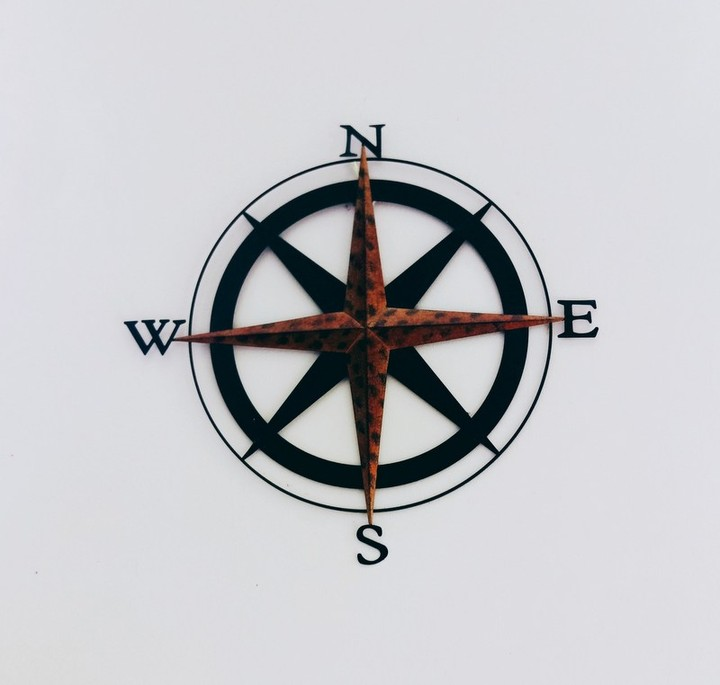
Ever wondered why North is at the top of our maps?
If you're assuming there are logical, scientific, Nature-driven reasons for it - yeah, me too.
In fact, they're often whimsical, arbitrary or just plain ridiculous.
Hold onto your hat. This may turn your world upside-down.
1/
Fellow Kenyans, wake up. Welcome to Media Manipulation 101, and I have the honour to break down something you’re seeing without really seeing it right there on today’s Daily Nation front page.
Before proceeding, note these terms:
• Media manipulation: picking, framing, or ommiting facts to twist or create another reality.
• Disinformation: deliberately spreading information to deceive, divide or cause bias.
• Propaganda: pushing information to steer public opinion toward a hidden agenda.
Now look at that headline👇. It gives a vibe its already decided that Gen Z will deliver exactly 5 million registered votes based on some mysterious IEBC target and official reports. We don't know from who.
Second, examine the framing of the headline and the reality it paint in the minds of Kenyans. The information itself is an educated guess, but it is presented here boldly as the reality. Who counted the GenZs in Kenya?
Third, check the tiny overline above the headline. That is the kicker that should’ve been the main headline. It quietly admits that 12 million eligible Kenyans are still unregistered due to apathy, yet the paper chooses to hype a fictional 5 million instead of shouting the real crisis.
Apathy is described as the feeling that voters contribution is meaningless and helpless. The size of the overline itself, despite carrying weighty information, is tiny and almost meaningless. It is apathy in action.
Here’s what this framing is quietly setting the stage for ahead of 2027:
1. If Gen Z actually turn up in huge numbers and smash past 5 million, the figure can be quietly adjusted back down. The idea of 5m Genz voters is already planted in your mind and nobody will ask the hard questions.
2. The same trick applies on report3d regional share. Regional politics get played and manipulated before a single vote is cast.
3. That purpoted 5 million becomes the magic benchmark. If someone claims that the 5m votes were split between 5 presidential candidates, anyone desperately needing just one million more has a ready-made excuse to rig us speechless. You know who.
4. As a national paper, this page becomes the reference point even when reality screams otherwise. The paper is attempting to build an alternative version of the truth.
The Daily Nation has not practised journalism today, but narrative engineering. As an Advocacy Journalist, it's my work to advocate for a level political ground ahead of the 2027 elections.
@DailyNation
@IEBC
#NikoKadi
#MediaManipulation #RutoMustGo
This will go into ant history as a moment of divine punishment, utterly incomprehensible in scale and method. Entire ant religions will be founded on this.