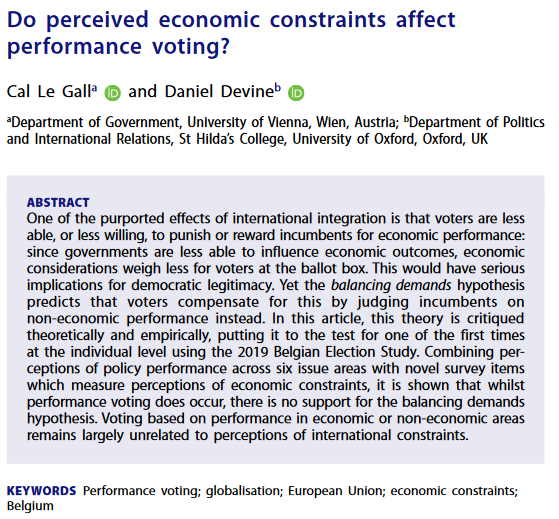
Ever asked yourself if economic constraints from EU and globalisation affect how we hold incumbents accountable on different policy areas? With @DanJDevine, we tried to answer these questions in a new article, which is now out in @WEPsocial
https://t.co/XORp70bih7
A thread ⬇️
When mainstream parties signal openness to ruling with radical right populists, it benefits the latter without yielding electoral gains for the mainstream https://t.co/IRVr4e1mrN
Political parties are, on average, more likely to seize the opportunity to win over new voters when they perceive their established voter base as sufficiently loyal https://t.co/XyDQcJBONY
🚨 New #OpenAccess publication alert! 🚨
Why do parties sometimes bend over backwards to accommodate new demands, and why do they remain focused on their core policies at other times?
Over the moon to see my single-authored study out in @EJPRjournal
👉 https://t.co/HsAjWjzkn0
To what extent are campaign priorities contrasted or convergent, and why? In our forthcoming @cps_journal article, @e_grossman_fr and I argue that parties converge to similar priorities because they monitor each other and take up issues from opponents 👇
🆕 What causes #PoliticalTrust?
@DanJDevine, @viktor888, Will Jennings, @ProfStoker & @_HannahBunting present the first experimental study of the distinct roles of ✅ competence, 😊 benevolence and 🤝 integrity in shaping trust in government.
👉 https://t.co/nMWqgTERoc #OA
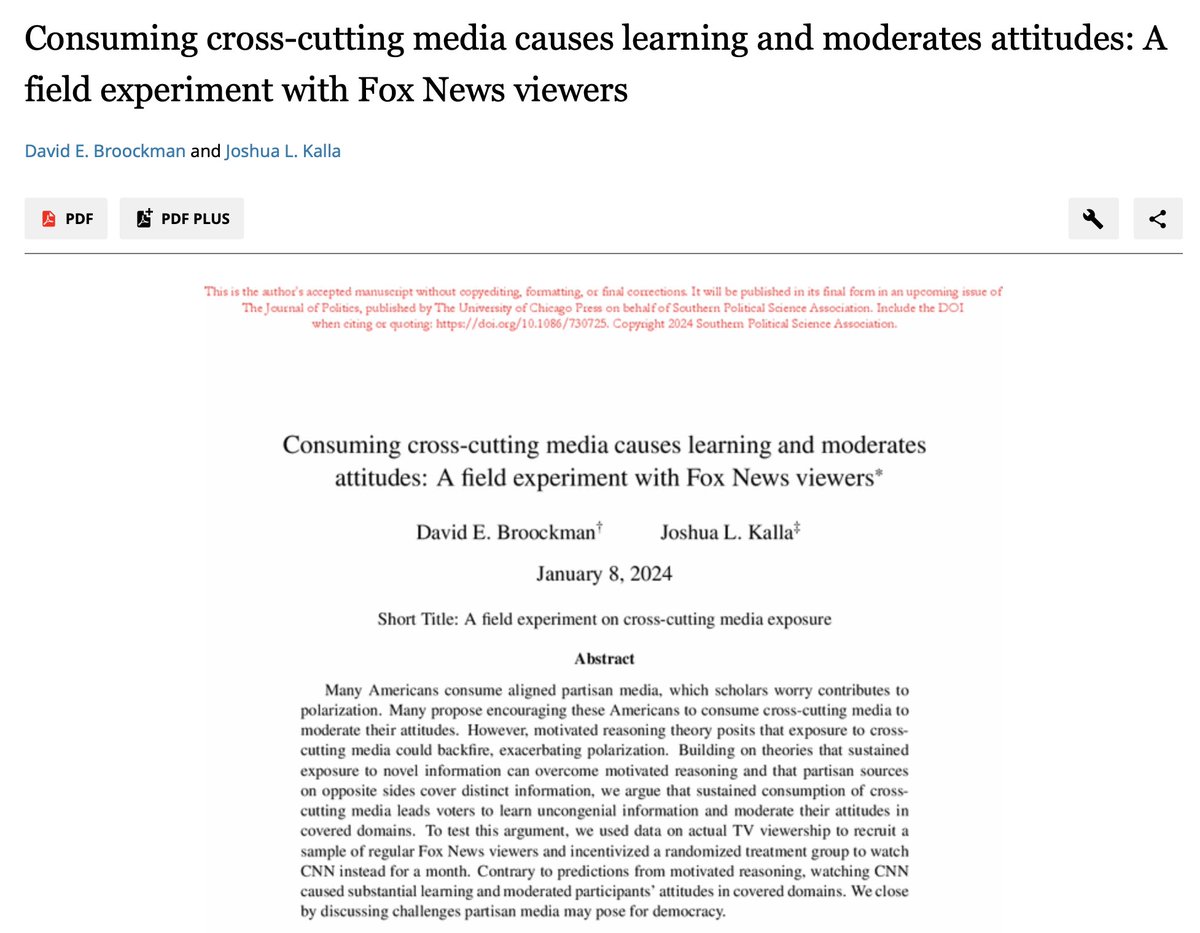
With Fox News hosts nominated for the cabinet, I wanted to share takeaways from two recently-accepted papers w @j_kalla on partisan TV.
There's been much skepticism that partisan TV actually affects public opinion.
Our findings rebut that skepticism: partisan media matters! 🧵
“austerity measures increase both electoral abstention and votes for non-mainstream parties… the effects of austerity on polarization are particularly pronounced when the mainstream right and left parties both stand for fiscal restraint.“
Podcast Alert! 🚨In the sixth episode of our podcast
@V_Burgi and I talk to @SiljaHausermann about the crisis of the social democratic parties, its origins and what strategies these parties might adopt to get out of it. 🧵👇
https://t.co/I61r0X7kWH
The shadow economy hurts democratic responsiveness because it reduces government revenues and decreases the reliability of economic statistics https://t.co/wgn2xFgKWV
Our paper on "Electoral Turnovers" with @benjaminmarx and @vincent_rollet is now forthcoming at @RevEconStudies !
Full thread on what we do and find here: https://t.co/2MNr1aB4Mv
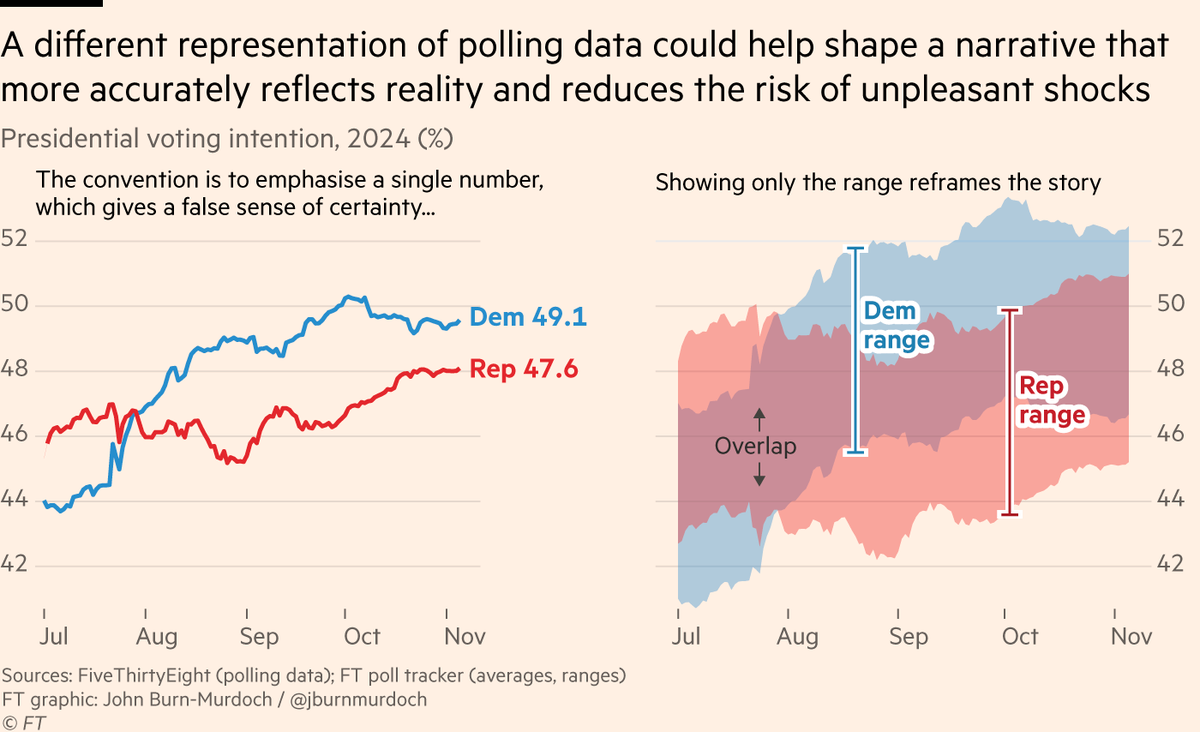
My wish for the next election is that poll trackers look like the one on the right 👉 not the left
This was yet another election where the polling showed it could easily go either way, but most of the charts just showed two nice clean lines, one leading and one trailing. Bad!
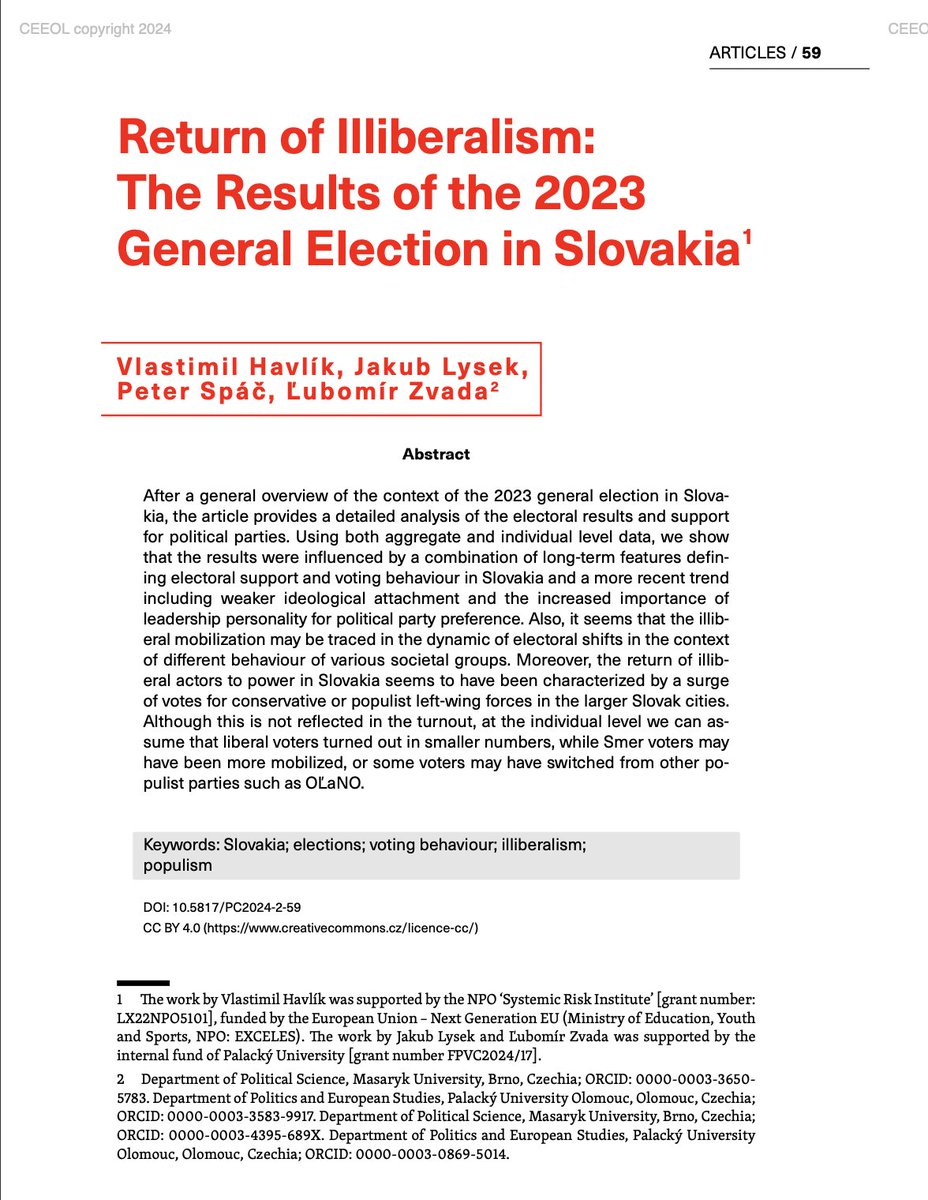
Hanácko-Brněnsko-Slovenská spolupráce🇸🇰🇨🇿 a její výsledek!📰🖊️📊 Mapy, regrese a storytelling k tomu! Ty sněmovní volby vlastně naznačily prohru Korčoka, populistická levice získávala i ve větších městech, kde relativně poklesla i volební účast ➡️2025🇨🇿🤔 https://t.co/640yd67V2l
🧵 New note published in @journalEPOP! 🎉 While much research focuses on what drives voter support for the radical right, less attention is paid to how candidate shortages impact these parties. Here’s what I found: 👇
We’re going to hear lots of stories about which people, policies and rhetoric are to blame for the Democrats’ defeat.
Some of those stories may even be true!
But an underrated factor is that 2024 was an absolutely horrendous year for incumbents around the world 👇