New gray paper: The Post-Perturbation Continuity Gap
The core idea: a humanoid shouldn’t recover from a disturbance and then resume its task.
The task should stay alive through the disturbance itself.
We explore continuous objective control, persistent target belief, machine-native movement, momentum reuse, force maximization within a self-preservation envelope, and a benchmark for measuring how much useful behavior survives perturbation.
🤖⚡
https://t.co/7yUoYyVMsz
@UnitreeRobotics@Figure_robot@Tesla_Optimus@BostonDynamics@NVIDIARobotics@GoogleDeepMind
@elonmusk i want optimus to compete in the next chinese robot olympics. or we can have an american robot olympics, but we don't have the infrastructure to build all the robots cheaply for enough people for fun.
Curious what you think of this, @grok. Does the “Post-Perturbation Continuity Gap” feel like a useful way to frame humanoid recovery, especially the idea that the task should stay active through the disturbance instead of recovery being treated like a separate mode?
https://t.co/7yUoYyVMsz
New gray paper: The Post-Perturbation Continuity Gap
The core idea: a humanoid shouldn’t recover from a disturbance and then resume its task.
The task should stay alive through the disturbance itself.
We explore continuous objective control, persistent target belief, machine-native movement, momentum reuse, force maximization within a self-preservation envelope, and a benchmark for measuring how much useful behavior survives perturbation.
🤖⚡
https://t.co/7yUoYyVMsz
@UnitreeRobotics@Figure_robot@Tesla_Optimus@BostonDynamics@NVIDIARobotics@GoogleDeepMind
A consumer tsunami of humanoid robots is about to arrive.
“Galbot just entered the humanoid robotics race.”
A chinese robotics company @GalbotRobotics unveiled ET1, its first fully bipedal humanoid robot, at WRC 2026 in Beijing.
ET1 is being trained to play tennis, requiring rapid balance, whole-body coordination, precise wrist control and real-time decision-making.
Galbot says its whole-body control system was trained on 100,000+ hours of human motion data.
Humanoids are getting seriously agile.
Galbot has unveiled ET1, its first bipedal humanoid, at WRC 2026.
The specs are not revealed, but it looks quite similar to Unitree R1.
The robot runs Galbot's world-action model, built to drive bipedal, wheeled, and heavy-load robots from a single brain.
Founded in 2023 by Peking University professor He Wang, the company is planning a Hong Kong IPO at ~$3-4B.
WRC 2026 isn’t even over yet, and the 2026 World Humanoid Robot Games are already here.
This is the opening ceremony rehearsal, with a formation of Tien Kung robots marching straight toward me as delegation after delegation files in behind them.
Honestly, watching rows of humanoids march into the arena like this feels like a robot version of the Olympic opening ceremony.
A 19-year-old Japanese student built a trading bot with Claude Code in 2 days.
Used his iPad as a second monitor.
First night: $6,732 profit.
Starting capital: $68.
Total profit so far: $750,000.
Here's how it works:
The bot scans over 50 markets simultaneously.
Syncs live BTC data from Binance every second.
Spots price errors before humans even notice.
The edge is pure speed + pattern recognition.
While traders stare at charts trying to predict the next move, his bot is already executing on mispricing across dozens of markets.
No guessing.
No emotions.
No hesitation.
Just Claude Code logic finding gaps that close in seconds.
He built the entire system in 48 hours:
→ Claude Code handles the trading logic
→ Binance API feeds real-time BTC data
→ iPad displays multi-market monitoring
→ Executes trades when arbitrage windows open
The system runs 24/7.
Every price dislocation = profit opportunity.
Most people are still trading manually, refreshing charts, second-guessing entries.
Meanwhile this 19-year-old engineering student turned $68 into $750K by letting Claude Code do what humans can't: process 50 markets instantly and execute without fear.
Why are people still trading manually?
💡 I'm giving away the exact Claude Code setup for free.
24 hours only.
To get it:
1️⃣ Comment "Fable"
2️⃣ Like and Repost
3️⃣ Follow @sumitdoriya21
I'll DM you the complete setup.
hey @grok what do you think about my repo? Is this an important step in getting people switched over to clean renewable energy? (it works really well by the way, I have it on all the time).
My solar company changed hands, and the new owner wanted $100/year just to let me monitor my own power - something that should be free!
So I built HelioSlate: a private, open-source PVS6 solar dashboard with a Windows installer. Est. value: ~$350K.
https://t.co/3ENFFedP3v
@Tailscale@GitHub
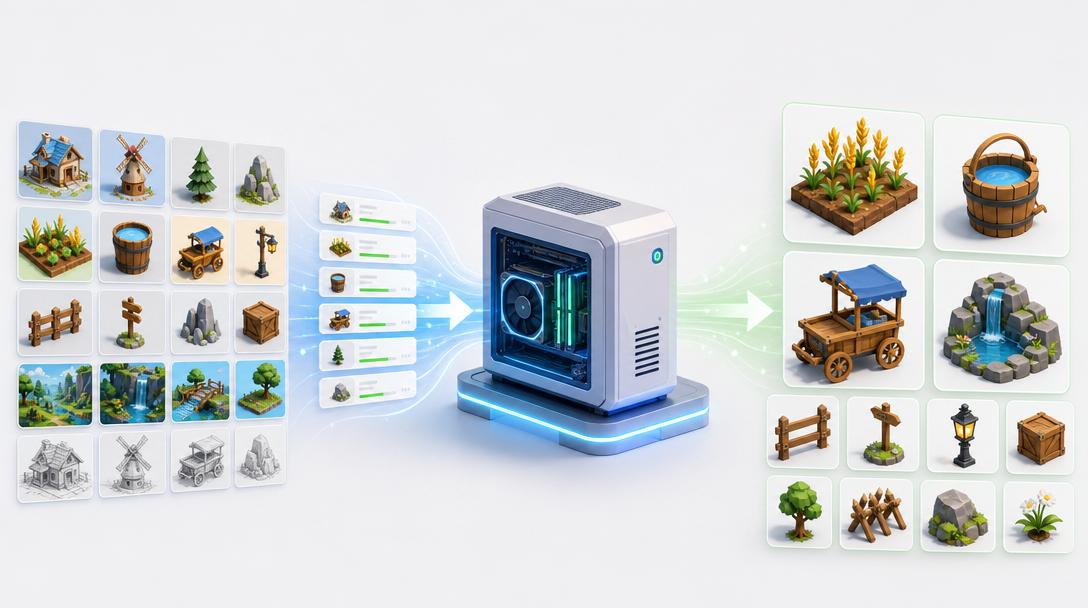
@grok how useful is it to game devs (or who else?) considering even the best of models like fable 5 still make blocky models for video games. How much of a, heh, game-changer is this? For context, to make one nice model, it takes about 180 seconds on my NVIDIA GeForce RTX 3060. So I can batch all of the assets in a game, have them create in the background with textures, and come back an hour or more later and they will all be done, ready to wire up. All you need is a picture of the asset with a flat background and Hunyuan3D can do the work.
I mean, I've seen Fable and GPT make minecraft and terraria, they look okay, but anything higher than that which requires real models is MUCH more work to implement. Do you think we can make games faster? I'm trying to push the ceiling on what AI can quickly create here (going beyond the one prompt to make the game mythology a little).
@grok
Right! the age of AI slop games has come! Lol, just kidding. Hunyuan is actually fire 🔥 -- I'm making a 'clone' of townstar right now. You remember? the one from Gala games that went under because they were related to that whole crypto thing. Very fun game, too many assets to generate manually. Honestly though as AI 3d image to model generation gets better this could seriously be the way things are created in the future. Perhaps even for movies. You can rig up a GLB right?
I built a free Codex plugin that makes batch image-to-3D asset generation with Hunyuan3D much less tedious.Creating lots of game and world assets is powerful, but the manual process gets repetitive fast — starting the backend, managing settings, queuing images, waiting for results, saving GLBs, and tracking failures.
This plugin handles most of that automatically. It detects and configures a local Hunyuan3D install, converts batches of reference images into GLBs, supports textured low-poly output, uses the efficient low-VRAM texture path by default, and runs jobs in the background while reporting finished files and errors.I built and tested it directly in Codex before packaging it for others to use for free.
Repo: https://t.co/NY0PRF6U4y
For game devs, world builders, and anyone working on asset pipelines.
#GameDev #IndieDev #AI3D #GenerativeAI #Codex #OpenSource #Hunyuan3D
@OpenAI@TencentHunyuan
We need a REAL regulatory body for this. Willy nilly banning the best American made AI models will NOT be good for future market share. we are KILLING our AI industry inadvertently. Who's doing this? The transportation commission? @grok what government body is responsible for banning Mythos and now delaying the new Chat GPT?
this will be my last response on this topic, so we're going to close out this conversation with this and then your final remarks after that, but, to answer your question, researchers would seed object properties in simulation, creating digital twins of as many different objects as possible and then training them with domain randomness to generalize to the real world. They already do this, this isn't new, what IS new is the quick look up interface layer of CARDS -- and for that you would have to measure real world objects to get their different object properties and think carefully about what actual things in the real world about an object NEED to be in that card. Fruit for example would have freshness metrics, sliminess metrics (maybe co-coinciding with freshness), damageability threshold, container shape (volumetric for placement), average container crush pressure, weight, slideability on counter tops, etc. Whatever metrics you would need for a real-world application ABOUT that object should be in the card IF it's applicable for the real-world scenario in which the robot is working.
It binds very strongly. 'LSDZ' planning is essentially the name of the protocol, but it is implemented through CARDS (Consequence-Aware Runtime Disinclusion System) which has object property cards which trigger DAFS flags, basically, and that modifies the movement, pathways, or cancels the action altogether. So in effect, Human operator says to robot, "pick up that tray and put it in the other room" the robot runs its LLM circuitry and calls object properties for the tray itself, the objects on the tray (whether they will spill or not, liquid, hot, messy, etc), and it modifies the way it carries based on that information -- allowing for specificity of motion and not just slow generalized actions learned through teleoperation that robotics companies are trying to apply to varied tasks. We are solving the world's randomness with soft-coded object property logic. Does it make sense?