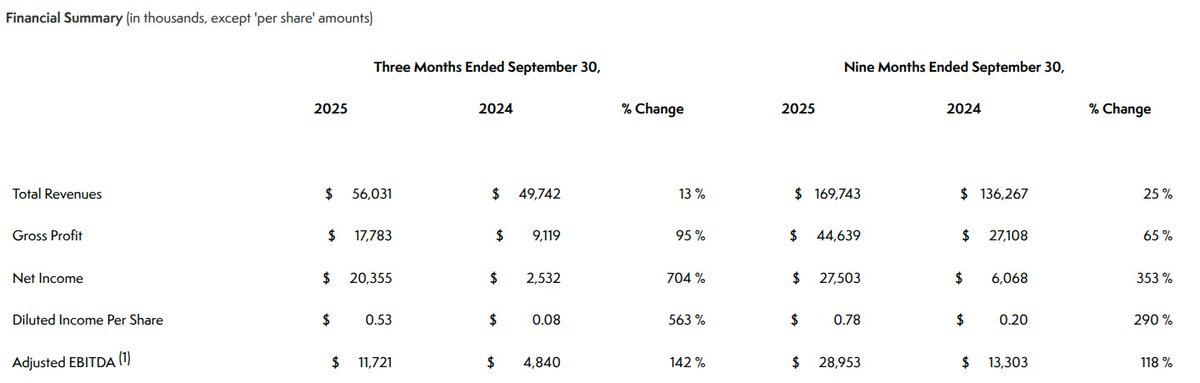
@FishOnCapital Data Analytics was also only 15% of revenue (>300% YoY) but accounted for 48% of gross profit. It can't hide much longer and will start driving accelerated bottom-line growth here in the next couple quarters
It’s weird that the war in Iran is overwhelmingly popular with Israelis and unpopular with the majority of Americans. It’s as if we’re two distinct countries, with very different interests and maybe our elected officials should start viewing the relationship that way
@fedex774 They gave the same guidance of ~22% growth for both 2025 & 2026, then raised the guide through 2025 and will probably do the same in 26 as they pretty reliably sandbag
EBIT margin more than doubled in 2025 & their guide puts them at 15.5% in 26, only due to short-term pressures
I want bitcoin to go to zero and I want all the grifters who pumped this to rubes on the back of moronic fearmongering of monetary policy and promises of generational wealth to be fully invested as it happens. Thank you for your attention to this matter.
Can we please understand the basics. $STRC and the other prefs ARE NOT “DIGITAL CREDIT.”
$STRC is not even credit. It is equity that is subordinate to all creditors.
$STRC has no legal claim on any asset, including the sainted BTC. $STRC is not legally backed by anything.
All this “digital credit backed by BTC” is stupid and factually wrong.
In fact, $STRC is even less favorable than usual pref structures in terms of key reps and warranties
- no rep that $MSTR’s BTC holdings will be maintained
- specific legal statement that the $STRC is not backed by anything (a reserve, escrow or ring fenced assets)
- specific assertion that $STRC has no claim on any assets
- no maintenance covenants (BTC to debt, minimum capital, leverage limit, restrictions of debt issuance or any encumbrance of assets)
- no change of control provision (that is unusual and makes $STRC even riskier than most prefs)
This is why nobody is buying $STRC. It’s not credit, it’s just equity risk.
Some thoughts on Autonomy & Robotaxis from $TSLA, $RIVN, $GOOGL’s Waymo, and $NVDA…
1) Google’s Waymo clearly has the lead on true autonomous driving with no backup driver. They have the most miles, the most revenue (~$350M TTM), and the most vehicles (~3,000). Plus, they have a fantastic safety track record. Anybody who doesn’t acknowledge Waymo’s lead is fooling themselves (and those people are usually $TSLA shareholders).
However, Waymo also has huge disadvantages: they don’t make their own vehicles. They put a sensor suite on top of an existing vehicle, which is costly and labor-intensive. This lack of full-stack control, combined with a slow organizational structure (two CEOs at Waymo who then report to Google’s CEO, Sundar), means they will likely lose their lead…
2) Tesla is in a prime position to benefit from Waymo’s lack of vertical integration. Tesla is the Apple of cars. They own the full stack of vehicle, hardware, and software, along with their own training data from millions of vehicles that are collecting data. They are producing a two-passenger Robotaxi vehicle at a cost of ~$25K, which is lower than anyone else in the industry.
These advantages can’t be understated and put Tesla in the “most likely” position to lead in Robotaxis within 1 to 2 years!
But Tesla, too, is not without its disadvantages… Elon set his foot down that Tesla will do autonomy without lidar. He made that bet around 2019, before the new neural net approach to AI driving proliferated in 2022. So far, Tesla’s vision-only approach has shown results well beyond anything most people thought possible. FSD on Tesla vehicles today is truly impressive.
However, Tesla’s Robotaxi fleet is still using backup drivers for much longer than anybody thought. And so far, the safety track record of Tesla robotaxis is not on par with Waymo, which could be a huge disadvantage. Nobody is going to prefer a less-safe vehicle.
If Tesla comes to the conclusion that it needs to add other sensors (such as radar and lidar), I’m sure Elon will eventually bite the bullet and do it, but this might delay Tesla by as much as a year or two because of Elon’s stubbornness on this topic.
3) $NVDA’s approach to autonomy is similar to Google’s approach to mobile phones with Android. Google knew that the world needed an alternative to the iPhone and made the Android OS free and open-source. NVIDIA recognizes that the world (all other car companies) needs an alternative to Tesla’s FSD, and they’ve built Alpamayo, an open-source autonomy stack for any car manufacturer to run with.
NVIDIA doesn’t actually care who wins or loses in the autonomy space, as long as some of the winners are using NVIDIA’s stack. The reason is that using NVIDIA’s autonomy stack means more chip sales for NVIDIA. This is exactly like Google’s Android approach: more Android usage means more Google search and more ads served by Google on Android phones.
One interesting thing to note about NVIDIA’s approach is that their team believes you need lidar to achieve Level 4 autonomy with high levels of safety. This flies in the face of Tesla and @elonmusk’s insistence that you don’t need lidar.
4) $RIVN’s approach to autonomy is similar to Tesla’s, except with the addition of more sensors (five radars and one lidar). They have the full stack for autonomy, including building their own AI chip, and are in the second-best position to make the lowest-priced autonomous vehicles, after Tesla. If it turns out that radar and lidar make these autonomous systems safer, Rivian might actually be in the best position to make autonomous vehicles.
Rivian’s big issue is scale. Their 2027 vehicle run-rate will likely be in the ~200,000 range, which is not nearly enough to meet demand for such vehicles. Their Georgia plant will add another 400,000 in vehicle capacity, but won’t be online until 2028 and will likely not be at capacity until 2029. So Rivian’s 2029 capacity will still be in the ~600,000 range.
What Rivian has going for it is undeniable. As an investment, it’s the only company that has all the components and talent needed to build the full stack of EVs, along with autonomy, and even a charging network, and the entire company is valued at just $24 billion!
If any major player, such as $AMZN, $GOOGL, $AAPL, or numerous others, gets serious about autonomy, even if they paid a 400% premium for $RIVN, it would be a steal at $100 billion for them to have a chance to catch up to $TSLA's lead quickly. @RJScaringe might be in the most desirable position of all of them.
@leveraged_cat Haven't listened yet but will get around to it later today. Stock fell at the open in the first 15 minutes of trading though, before the CC started at 10am, so it wasn't anything mgmt said on the call (at least initially)
$FTK Now trading for <18x TTM EPS while growing at an insane pace. Their Data Analytics segment remains slept on
And because it's a small cap, the pre-market 10% pop has now turned into a >3% decline
@LogicalThesis Hard to invest in bio when the FDA can just rug-pull as they please. Plus the Tidmarsh resignation
There are currently no adults in the room on the admin side, which unfortunately will hurt a lot of meaningful & life-changing science and reduce future investment in the space
$SURG Pre-announced Q3 revenue of >$18M and re-affirmed 2026 guide of $225M, and yet still no one wants to believe them
2026 guide comes out to ~35% quarterly sequential growth after Q3, so assuming Q3 growth isn't a one-off, their guidance definitely doesn't seem unrealistic
It's a tragic reality of investing that $IONQ $RGTI $QUBT etc won't crash until Shkreli capitulates. Despite his best efforts, it will only be his martyrdom that can cause shockwaves that ultimately lead to the collapse of quantum mania
It's a cruel, cruel world