Updated FAQs on newly diagnosed multiple myeloma for 2026!
1. Which frontline regimen to use?
Quad regimen, either Dara-VRd or Isa-VRd
2. How long to give the Quad regimen?
4 months and then transplant, or
6 months if transplant ineligible or deferred
3. What maintenance after initial therapy?
Standard risk: Dara or Isa plus Lenalidomide
High Risk: Dara or Isa plus Lenalidomide; or bortezomib plus Lenalidomide
4. How long to give maintenance?
Standard risk: Lenalidomide for 2 years and stop; Dara or Isa till progression.
High risk: Till progression.
5. Is transplant still recommended in eligible patients?
High risk myeloma: Yes.
Standard risk: Early vs delayed- Shared decision making based on age and patient preference.
6. Definition of High risk myeloma?
Del 17p is high risk by itself
All the others (4;14, 1q, 1p, etc) all need two abnormalities together to call as high risk.
(P53 mutation and bi-allelic del 1p also high risk; but small numbers)
Check out https://t.co/qeXZaqzOpV to make this assessment easily.
7. What about CART or bispecifics in newly diagnosed myeloma.
Totally Investigational. Done only on approved clinical trials
8. What about frail patients who cannot tolerate quadruplet?
Triplet: DaraRd or IsaRd; if that’s not possible or safe: Rd or even single agent Dara may sometimes be needed at least initially till performance status improves.
9. What about patients with acute renal failure?
Prefer Dara-VCd rather than Dara-VRd
10. How long to give the Dex?
Keep Dex only for initial 4-6 months. No dex in maintenance.
https://t.co/URmEGy3xvU
One-stop free-to-use website to risk stratify myeloma, MGUS, smoldering myeloma, Waldenstroms Macroglobulinemia, Amyloidosis.
Also links to iStopMM calculator to determine when a bone marrow is needed in MGUS.
Will be regularly updated. More calculators and links to key articles will be added soon!
Just out: Our study using NHANES samples in persons age 10-49 shows that MGUS starts at a younger age in Black people and that there is a markedly higher risk of MGUS in African Americans compared to White people. The 2-3 fold high risk of MGUS in Black people is the reason why Multiple Myeloma is 2-3 fold more likely to occur in African Americans compared to the White population. Study done in collaboration with @DrOlaLandgren over 15 years. This is the third paper and uses highly sensitive mass spectrometry.
Monoclonal Gammopathy of Undetermined Significance (MGUS) is the premalignant precursor of multiple myeloma. The reason age adjusted prevalence of myeloma in African Americans is mainly because they have a 2-3 fold higher higher risk of MGUS and not felt to be due to a higher risk of progression of MGUS to myeloma. This is an important point. Genetic differences in other words predispose to the “polyp” (MGUS) but not the cancer (myeloma).
We believe there is a genetic predisposition to the origin of MGUS presumably due to an aberrant response to antigen stimulation in Blacks in the US and in Western Africa compared to Whites. We don’t think that the disparity in the occurrence of MGUS is due to environmental exposure differences. For one it’s seen in all socio economic strata. Second the higher prevalence is seen in studies we did in Ghana exactly similar to what we see in African Americans. And third, in a study we did in a Southern US cohort where we looked at African American and White women living in the same region with same socioeconomic status, we found a 2-3 fold higher risk of MGUS in African American women. So it’s unlikely to be environmental differences. Our study of other modifiable risk factors in NHANES doesn’t explain the disparity.
We suspect that the disparity we see in African Americans and in studies Western Africa, may or may not be present in Eastern African countries. Which is why we are studying the Somali population in Minnesota currently.
Our NHANES study just published @BloodCancerJnl shows that the disparity in occurrence of MGUS is apparent even at age 30-39 in African Americans compared to White population in America.
https://t.co/XzxrKVGfY6
Just out!! In @NEJM - Our randomized trial in myeloma (ENDURANCE trial) shows limited duration of lenalidomide maintenance is just as good as indefinite therapy, with less side effects!!! @eaonc@theNCI
Implications are HUGE. This is a drug we spends billions on each year:
-Less side effects
-Less second cancers
-Similar overall survival
-Less cost
@myelomaMD@Myeloma_Doc@SagarLonialMD
National NCI funded trial led by @eaonc and joined by @ALLIANCE_org & @SWOG
https://t.co/k8nGWeSA03
This ENDURANCE trial has already delivered before: the maintenance component we report is the second randomization.
Previously we reported in @TheLancetOncol from the first randomization that KRd was not superior to VRd. This finding also led to lower cost of myeloma care since bortezomib is low cost and generic, and we showed that we do not need much higher cost therapy at least for standard risk patients.
Although all 4 trials were done in relapsed myeloma with 1-3 prior regimens, the type of patients varied including by type of prior exposure. So comparing head to head HRs is not advisable.
Patient and disease factors, access, affordability, and shared decision making come into play, especially in first relapse. In second relapse we have to also add belantamab. https://t.co/rMu8MdadmL
Just out: presented at #EHA26 and published @NEJM
Randomized trial of 2 talquetamab combinations vs DPd in relapsed myeloma. The Monumental-3 trial.
Both Talq-Dara-Pom and Talq-Dara beat DPd in PFS and OS.
Choice of a Talq combination vs Tec or Tec-Dara in relapsed myeloma will be driven by patient and disease factors and requires significant expertise. Congrats @RobertoMinaMD@PlasmaCellPete@mbeksac56@paurotero@mvmateos@thanosdimop@RahulBanerjeeMD et al.
https://t.co/DA04B3OjgS
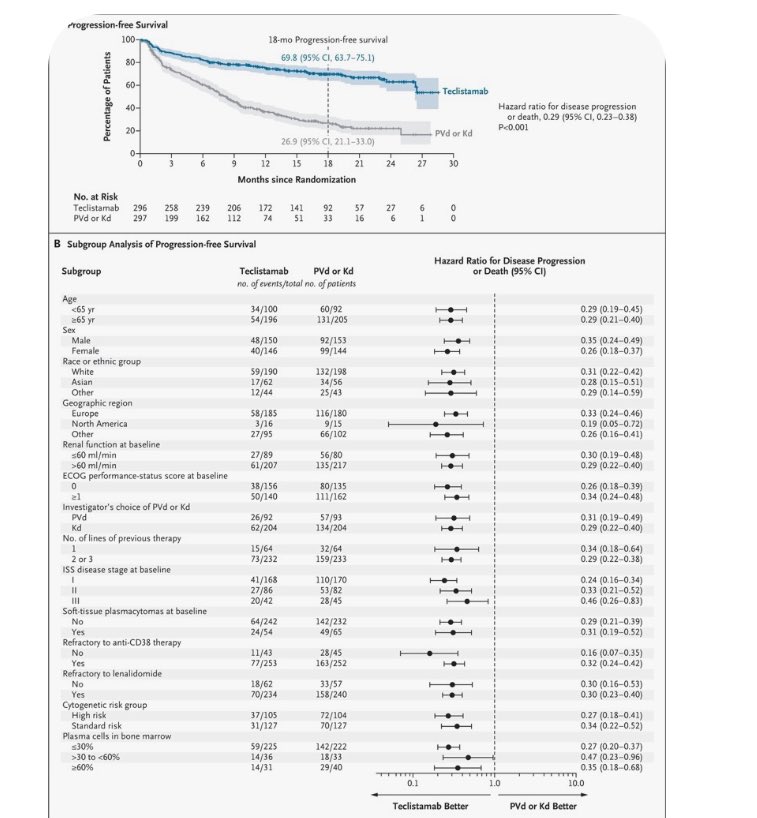
Just out: Majestic Majestec-9 results.
#ASCO26@NEJM
Single agent teclistamab beats standard triplet in relapsed myeloma.
https://t.co/2TeFjBuZSv
@DrOlaLandgren@thanosdimop
Human scientific ingenuity and hardwork, not AI. Human clinical trialists and patients, not AI
The standing ovation at #ASCO26 for the unprecedented results in metastatic pancreatic cancer with daraxonrasib an oral RAS inhibitor is the result of research excellence and perseverance, and a witness to this.
AI won’t do the work or run the trials to make these advances. It can make the process easier in the future. But you still need human ingenuity and hard works to take a chemical and make it an effective approved medicine.
Institutions and companies must nurture the human talent. Academic medicine is bleeding talent. Leaders are appointed for pliability over excellence. With NIH funding of new investigators at an all time low, coupled with institutions and organizations extolling the efficiencies and prioritizing the virtues of AI, we are at risk slowing down our ability in drug development.
https://t.co/2YRwESyIuu
AI will spit out information that is the loudest, most prominent, most prolific rather than be able to distinguish truth from competing options.
I can call our AI nonsense in myeloma routinely and easily. But I won’t be able to spot out AI nonsense or errors in most other diseases. AI is sufficient if you need better than average. For serious illness like cancer where you want expert information you it will be awful compared to the disease expert in that particular disease.
This Worst case scenario is a good example of how it is scouring the internet for everything about a given condition, true and false. LLM ability to string together words based on probability is not medical intelligence. It’s probably better than the average doctor for most things because medicine is complex, but it is not an expert or intelligent.
https://t.co/AH1CvWnkto
AI is not a medical expert. AI is a pseudo expert. It possesses incredible a capacity to scour all of the available information and put together a coherent answer or summary. This answer or summary will greatly help the general public and physicians who are not experts in a given disease by making search, retrieval, synthesis of available information. But it’s not an expert.
AI cannot be expected to know data that’s known to experts but is not yet published. It cannot know when data in published form differs from that experienced in real world practice by clinicians who see a large volume of patients with the same disease. Where the published data are wrong or exaggerate benefits or minimize risks. It cannot judge the right treatment option among similar competing treatment options (except superficially), especially based on what the patient evaluation reveals on history and examination.
AI appears to be an expert in everything in the world by knowing what experts have written and made public but lacks wisdom by the very nature of how it works to produce the answer. It’s not thinking. It knows as the famous saying where the puck is but not where it’s going to be.
That’s why the even the most ardent proponents of AI including the uber rich who own the models will always seek out the best human expert available for serious diseases. They may use AI to provide a summary of their disease for the expert but they are not going to mistake or substitute AI for the expert. I don’t see this changing. Because medicine is more than knowing everything that’s published or being able to retrieve it quickly.
We live in a world of medicine where it’s easy to confuse pseudo experts who have gained or granted prominence with real depth of expertise and wisdom. So it’s easy to see how a lot of us are mesmerized by the speed and eloquence of AI to answer queries. Yes it does that well (and is probably sufficient 90% of the time). But as you learn how LLMs and other AI tools work you know it’s no expert, but a useful side kick. I do think it can help both experts and non experts but we must know what it’s capable of and what it’s not.
How does major clinical practice change happen in medicine? What are the requirements? Do influential voices on social media have influence?
Smoldering multiple myeloma (SMM) offers a great perspective on this with the rapid adoption of daratumumab in the community after the AQUILA trial results.
These 5 points on how practice change happens will apply to any new treatment or disease.
1) Practice change happens when the evidence is strong. This means convincing trial results.
2) Practice change happens when the treatment actually works. The drug must work and work as promised in the trial. This is important. If physicians in practice get outcomes contrary to what a trial reports, they will abandon it.
3) Practice change happens when the treatment is feasible. FDA and EU regulatory approval is essential for major practice changing treatments.
4) Practice change happens when the treatment is aligned to what physicians and patients actually wanted to do all along. This is important. In smoldering myeloma most were uncomfortable with watch and wait. So when there is effective therapy, practice changes.
5) Practice change is probably influenced by influential voices on social media, but only if it rings true, aligns with above 4 points, and is delivered by experts. I don’t think having a lot of followers alone helps; credible subject matter expertise is important.
Background for those not familiar with smoldering myeloma
For decades observation without treatment was the standard of care. After AQUILA trial results for smoldering myeloma came out, many including me (biased of course as the lead investigator) felt that the trial results were compelling. We therefore recommended daratumumab for high risk SMM.
But we were sandwiched on both sides by contrary opinions. One side were some who felt we needed to be even more aggressive and use full myeloma therapy, and on the other side by some who felt we should not use any drug for treatment and just watch and wait. All voices were active on social media.
18 months later, we know from market research is that uptake of daratumumab for high risk SMM is very high. Practice changed. Basically we can criticize and comment all we want but to have real impact it must reflect reality, reflect concerns of patients, reflect clinical practice concerns of physicians, and social media comments and criticisms must be credible.
As I write this, personally I have experienced this many times: adoption of low dose dex and adoption of weekly SQ bortezomib, adoption of DRd, adoption of quads in MM etc. They all fulfilled the 5 points.
@SagarLonialMD@szusmani@Mohty_EBMT@Myeloma_Doc@RahulBanerjeeMD@Transplant_Doc@mtmdphd@DavidSteensma
This slide explains the current strategy for smoldering myeloma trials. I use it as an example. It is useful to study this for anyone interested in a career in strategic clinical trials.
What do we do if we need to test multiple strategies to solve a clinical problem, when each step of each strategy takes more than a decade to accomplish? This is the situation we face in SMM. And here is how we are approaching it.
In SMM we have 3 key strategies to test. Each is an important question to be addressed in our strategy to improve outcomes for patients. We are tackling this problem by testing all of these 3 key strategies in parallel. We will be happy if any one of these succeeds, or whether all 3 are successful.
The 3 strategies tackle 3 problems, all of which are important and time is of the essence.
Question 1) Does early therapy improve outcome in smoldering myeloma, and if it does how do we make it available to patients worldwide? To address this in a manner that actually helps patients we need to first prove one drug is better than nothing. No regulator will approve early therapy if you test Dara-VRd vs observation. You won’t know which drug is essential and which is not. You have to prove 1 is better than 0, before you get to 2 is better than 1, and do on. As we did with active myeloma. These are necessary trials. Without this step we won’t get regulatory approval for anything. And without regulatory approval even if early therapy is useful, few patients outside the US will have access. These are also incredibly difficult trials because SMM is much less frequently diagnosed than active MM, and because endpoints take much longer.
Question 2) If early therapy is indeed helpful, will patients have better outcomes and live longer with monotherapy or with myeloma-like combination therapy? Ideally you would like to do this after you find out that monotherapy is helpful, but time is of the essence and many patients want to test early intervention. So shortly after the first monotherapy trial shows promise, we embarked on these trials to test what is the optimal way to approach early therapy. Two phase IIIs have been done: IsaRd vs Rd and DaraRd vs Rd. One has completed accrual and one is almost done with accrual. Results will take time, but far sooner than if we were just starting to design such trials.
This is the advantage of anticipating results and designing successor trials. We have done this over and over again in myeloma successfully.
Question 3) Can intervention used early in the SMM stage actually result in a cure? In other words, instead of just delaying myeloma or improving overall survival, can early intervention deliver an actual cure! We don’t need early intervention to be curative; delaying myeloma, delaying or preventing need for myeloma like therapy, or improving overall survival is sufficient. But cure will be surely great and the question of whether and if so which therapy will be curative is important. Again we have embarked on trials to address this question in parallel. Trials targeting cure as a goal like Cesar and Ascent have been done. And more such trials are on their way.
When we think about solving a clinical problem sometimes we have to test multiple key questions. Having a clear thoughtful vision, identifying the key questions and strategy on how to address them, having a world view rather than views centered on your own country or situation, and having international collaborations to address them is important.
We are fortunate in the myeloma field that as a team we are able to work with colleagues, companies, patients, foundations, around the world to address them. SMM is a good example, but the field is full of them.
I hope this is useful for those trying to develop a career in conducting meaningful clinical trials. The ultimate reward is when efforts lead to a practice change that helps patients worldwide
@mvmateos@SagarLonialMD@thanosdimop@Mohty_EBMT@End_myeloma@szusmani
Just out in the New England Journal of Medicine!
Our comprehensive Review on MGUS: Monoclonal Gammopathy of Undetermined Significance @NEJM https://t.co/7dza0YrFh5
5% of people over age 50 have MGUS. Every physician needs to know and understand MGUS. Lots of Tables and Figures. Bookmark!
How to test and manage patients. Who needs bone marrow exams and scans. It’s all in here!
MGUS is important not just because it’s a precursor to multiple myeloma. It causes a lot of other problems. Learn all about MGUS, and the various terms you hear MGCS, MGRS etc. in this Review
@myelomaMD and I have tried to keep every sentence in this Review simple and easy to follow. #MGUSVR
Cure is a simple word. But there is confusion when it comes to cancer. What cure is in cancer, and what we should aspire for?
When can we say that a given type of cancer is curable?
Thread
1/
AQUILA trial for high risk smoldering myeloma published in @NEJM today.
@thanosdimop
Personally for me, it is a huge milestone along 25 years of work that started in 1998. #ASH24#ASH24VR
This story below may help those interested in a clinical trialist career.
1/
So, you want to lead a randomized trial?
I ran a poll: How many people have near veto power over the approval & design of an investigator initiated oncology randomized trial? Only 23% guessed right.
Answer: >50! @RielyMD@mtmdphd
Here are the steps to do an RCT? Thread 1/