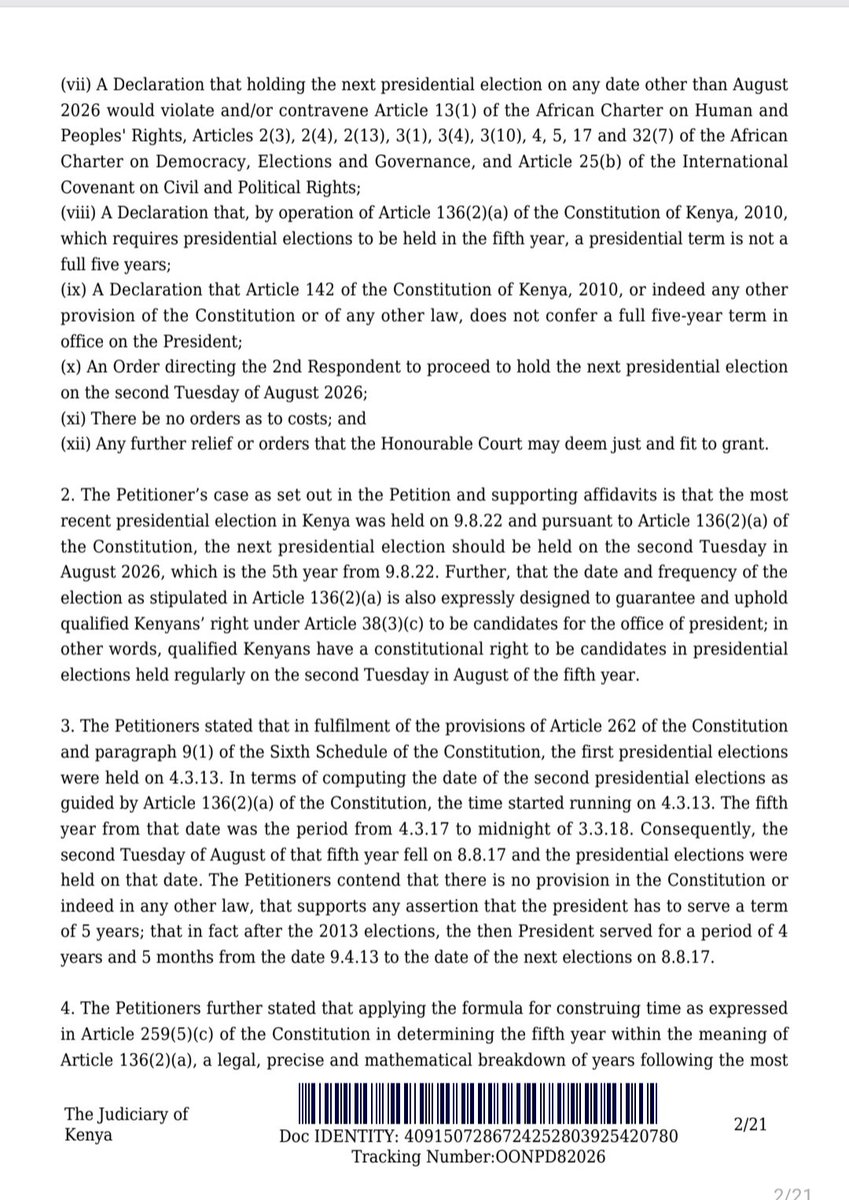
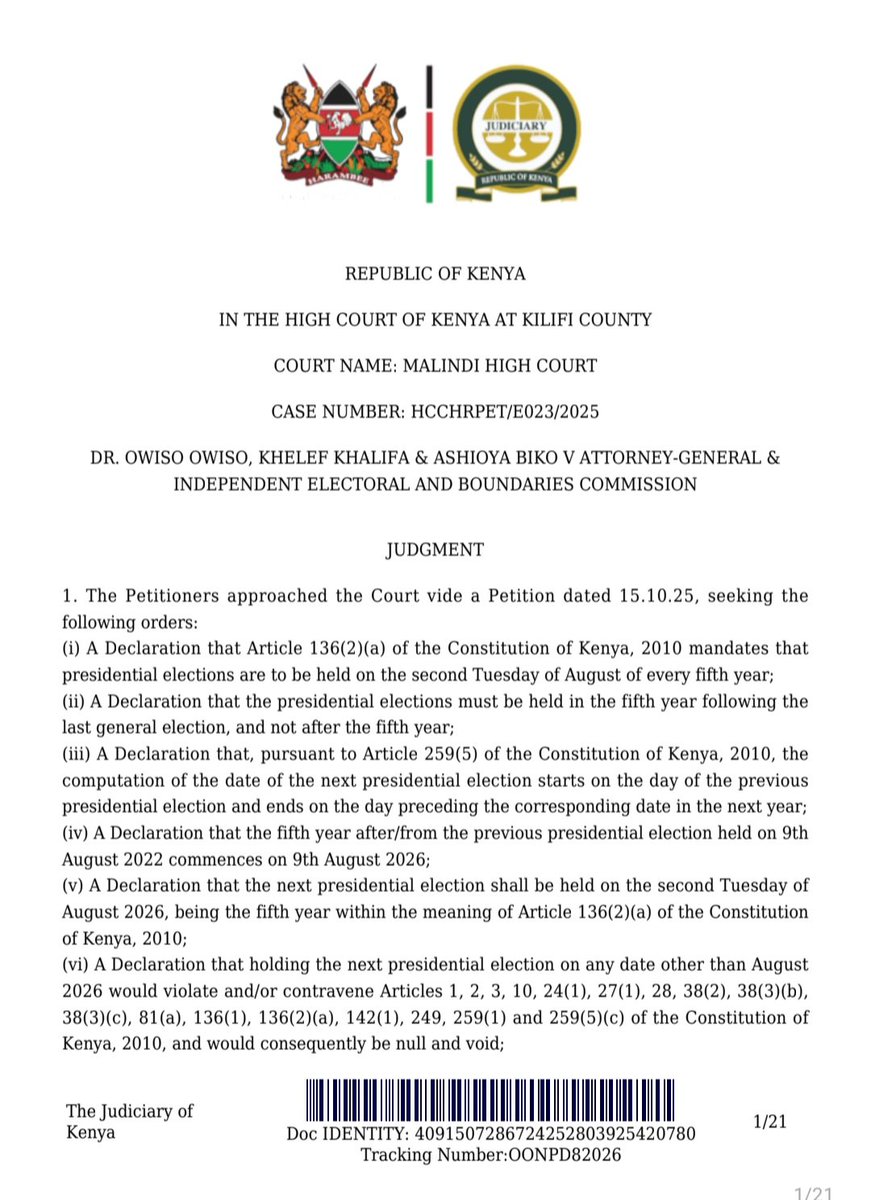
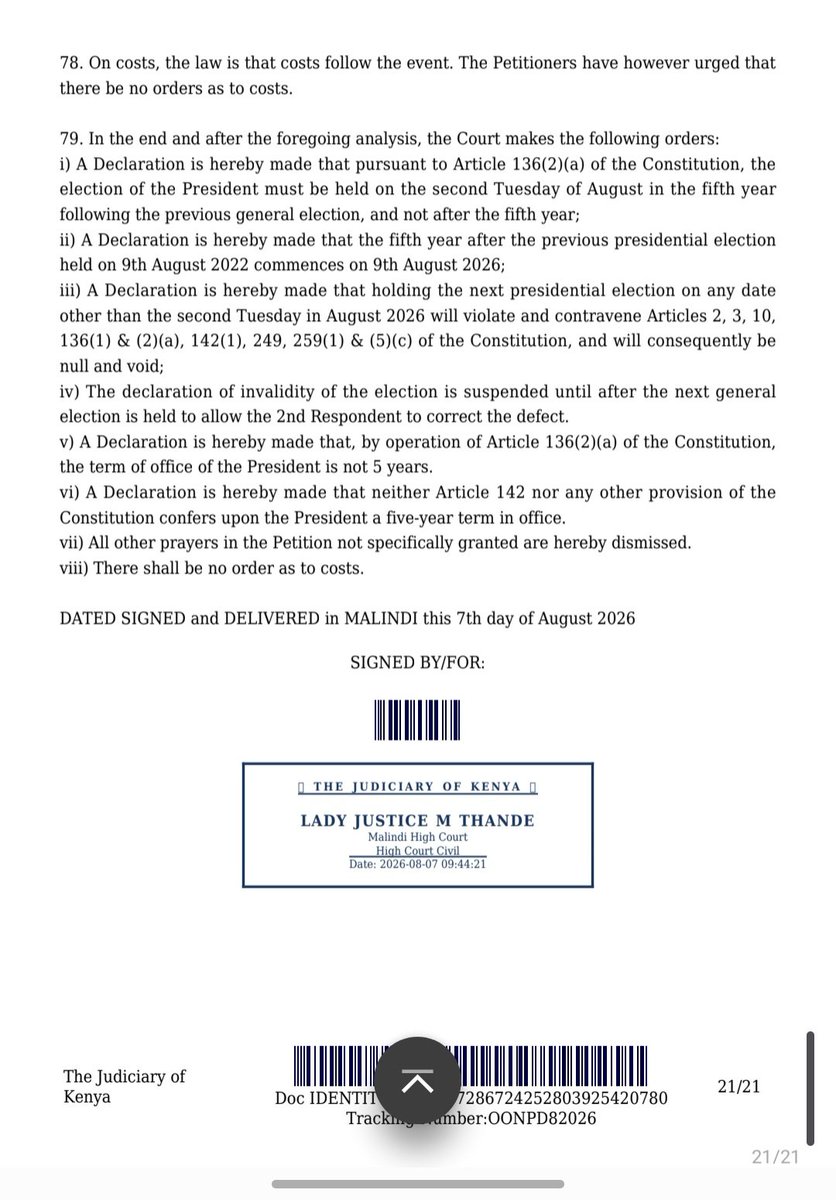
The Malindi High Court judgment is not a call for constitutional panic. It is a serious declaration on electoral timelines and it must be read in its entirety, including the remedy the Court deliberately refused to grant. The Court held that Article 136(2)(a), an election on the second Tuesday of August “in every fifth year” means in the fifth year, not after it. On its computation under Article 259(5)(c), that date was 11 August 2026.
The Court also rejected the view that Article 142 creates an express, guaranteed five-year presidential term. It held that the President’s term begins on swearing-in and ends when the next President, elected under Article 136(2)(a), is sworn in. But that is not the end of the matter. The Court did not order IEBC to conduct an election next week. It declined the mandatory order because it found an immediate poll logistically impossible and likely to produce national instability.
More importantly, the Court suspended the declaration of invalidity until after the next general election, expressly so that IEBC may correct the defect. A suspended remedy is not an invitation to manufacture a vacuum in government. No part of the judgment removes the President from office, converts the presidency into a caretaker arrangement, or restricts any enumerated presidential power. Constitutional authority cannot be diminished by inference where the Court made no such order.
Article 142 itself supplies continuity. The President remains in office until the next President is sworn in. The constitutional order does not collapse merely because a court identifies a contested interpretation of an election timeline. The Court was equally clear that declaratory relief clarifies the law. It does not, without more, compel a specific act or make disobedience contempt. That distinction matters. A declaration is not a mandatory order in disguise.
The judgment raises profound questions on the relationship between fixed election dates, computation of constitutional time, the terms of Parliament and county governments, and the need for simultaneous elections. Those questions deserve calm, principled appellate resolution and not partisan improvisation.
The rule of law requires fidelity to both the Court’s reasoning and its actual orders. We must reject two temptations. Treating the judgment as irrelevant, or overstating it as having already displaced the constitutional government. The enduring constitutional principle is simple. Elections cannot be left to political convenience neither can constitutional remedies be administered in a manner that creates avoidable disorder. The Constitution is not self-destructive but designed to secure both accountability and continuity.
This judgment should prompt an urgent, sober and institutionally responsible legal response. But until varied, stayed or overturned, it remains a High Court interpretation subject to the remedies it granted, the limits it imposed and the appellate process provided by law.
@joshuamalidzo You're talking as if the place has never had leaders since independence. What was Noah Katana Ngala doing in all those years he was representing the area in parliament?
WhatsApp is gearing up for its biggest change ever!
Soon, you won’t need to share your phone number to chat or call anyone. Just create a cool username like @ your name . Your real number stays hidden and safe.
This update is coming in 2026 and will make WhatsApp much more private — just like Instagram or Telegram.
Businesses will also get a special unique ID. But these businesses should not be allowed to send us WhatsApp messages without our consent!
What do you think? Will you make a username right away?
#WhatsAppUpdate #Usernames #PrivacyFirst #NoSpam