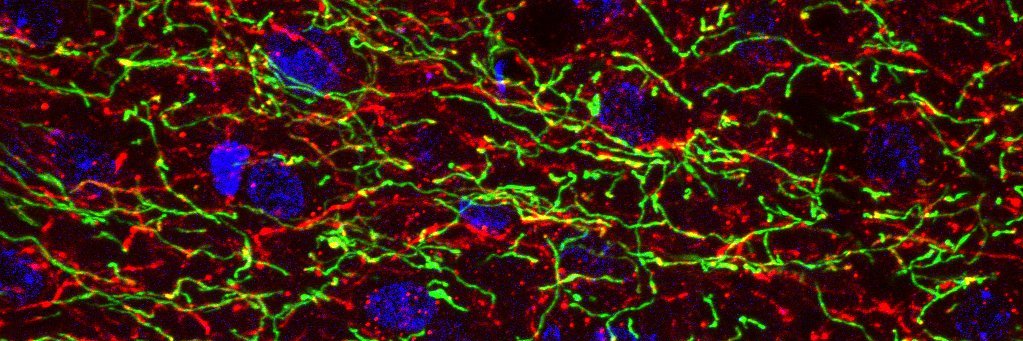
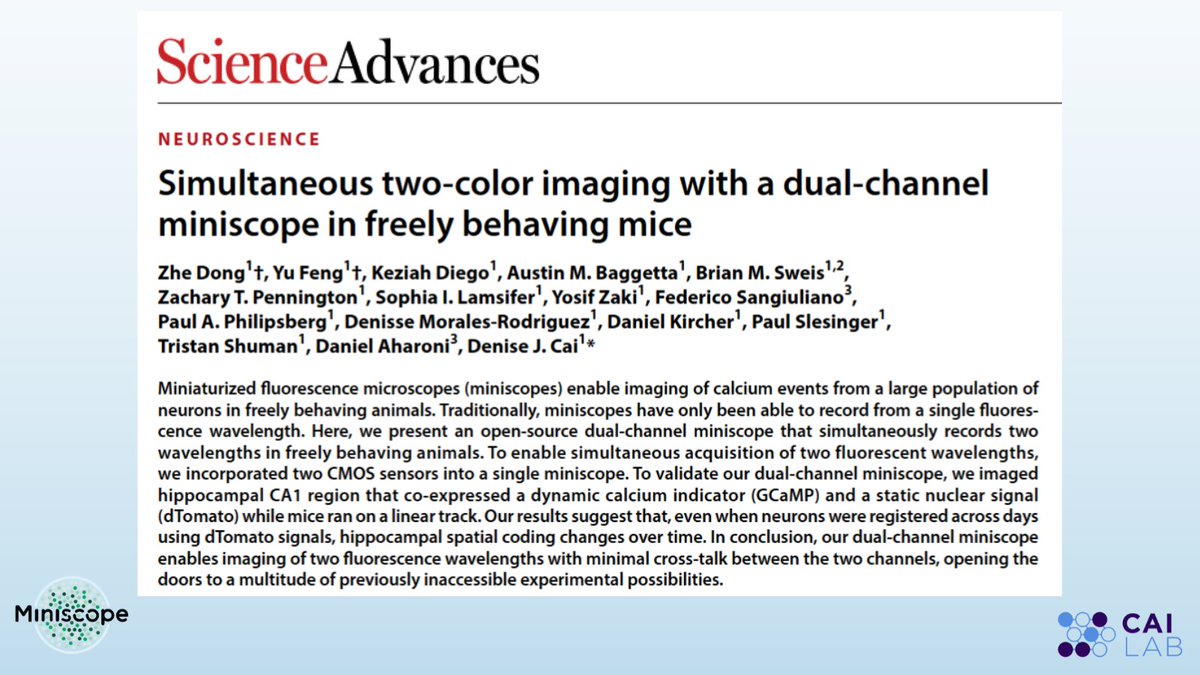
What’s better than a one-channel #Miniscope? 🥁 A TWO-CHANNEL Miniscope!
Our new Miniscope2C is a dual-channel, open-source Miniscope that lets you record 2 fluorescent signals simultaneously in freely moving animals.
Read the paper here:
https://t.co/LchmY020Rw
(1/9)
Seriously, this message has to get out there. Without academic research we can’t produce the PhD and MS level scientists that drive scientific innovation in the private sector.
Many in biotech/private sector are boasting about their ways of funding and doing science
But they are staffed with PhDs and postdocs we train in our @NIH and @NSF funded labs in universities
With uni labs lacking funds to train, the private sector will be profoundly harmed
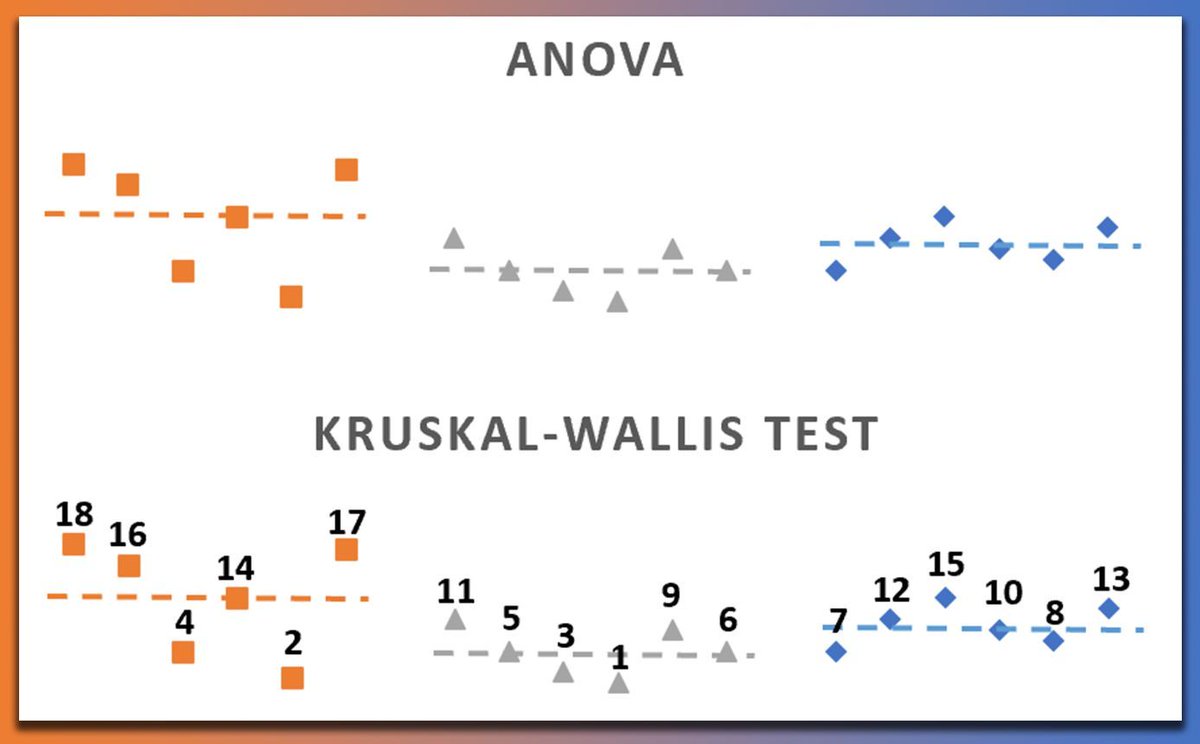
The Kruskal-Wallis test is a non-parametric method used to determine if there are statistically significant differences in the distributions of three or more independent groups based on ranks. Unlike ANOVA, it does not assume a normal distribution, making it versatile for analyzing non-normally distributed data sets.
Advantages of Proper Use:
✔️ Suitable for ordinal data or non-normally distributed data sets.
✔️ Does not assume homogeneity of variance, offering more flexibility.
✔️ Can be used with small sample sizes, increasing its applicability in various research settings.
Challenges If Not Handled Correctly:
❌ Interpretation can be complex, especially if the test is mistaken for a direct comparison of medians when specific conditions aren't met (e.g., independent samples, symmetric distributions).
❌ Less powerful than ANOVA when data is normally distributed, which can lead to less accurate results.
❌ May require post-hoc tests to pinpoint specific group differences, adding complexity to the analysis.
How to Apply in Practice:
🔹 R: Use the kruskal.test() function from the base package to perform the Kruskal-Wallis test.
🔹 Python: Utilize the kruskal() function from the scipy.stats module for the analysis.
Visualization Explanation:
The visualization accompanying this post compares ANOVA and the Kruskal-Wallis test by ranks. This visualization is adapted from a Wikipedia source: https://t.co/1hRzGEFOjY
For those interested in learning more, consider joining my online course on Statistical Methods in R, where we explore this topic and related methods in greater detail.
Take a look here for more details: https://t.co/7YQCRDKSPO
#DataAnalytics #RStats #Rpackage #DataScientist
Just did my once a semester demonstration of how quickly I can get information by calling tech support, not texting or emailing them but actually having a conversation…I don’t think I convinced my students 🙃
Grad school apps are EXPENSIVE....💸
So, which #STEM PhD programs have WAIVED their application fee this year?!
We have compiled a list of programs that you can apply to for FREE. Please let us know if you’ve heard of others! Thank you!!💜
https://t.co/d6SwodFpSR
Each month an #egg is ovulated from the #ovary, starting the journey of reproduction. But how does ovulation occur?🥚
Our latest work in @NatureCellBio led by @LastChrisThomas and @Tabea_Marx, describes the control of #ovulation using live imaging.
https://t.co/EYjwLfdAdy (1/7)
A few years ago I was in a position to do something unique in neuroscience. I had been working with the phenomenal @emilyjacobs on menopause and inspired by @laura_pritschet's menstrual study, and I was planning a pregnancy. What if we scanned my brain??
https://t.co/mTLfToPhru
🔥New Paper from the lab! Led by @mtaira_723 and our awesome team, we reveal the learning components signaled by dopamine release in the Nucleus Accumbens core (NAcC): https://t.co/T6n1TUaFoK
Congrats to my friend and colleague Guosong Hong for his stunning and original discovery, published today in Science, on clearing tissues *in living animals* with a common food dye!
The dye is tartrazine, used in Doritos!
https://t.co/fqVivyH0kI