Dear Mr. Polzin,
I read your column on “Wisconsin football’s costly gamble,” and while I agree it is fair to question this staff — clock management, timeout usage, and the Air Raid experiment among them — I thought the article approached both the quarterback situation and the roster with unnecessary skepticism and, at times, an unfair lens.
Specifically, I would respectfully push back on the broader implication that Luke Fickell and his staff have shown an inability to evaluate quarterbacks or effectively allocate resources. The fuller record complicates that story.
It is worth remembering how college rosters are built now, in the era of NIL and the Wild West of the transfer portal. NFL front offices routinely miss on first-round draft picks despite having two or three years of film, months of interviews, the combine, private workouts, and entire scouting departments devoted to evaluating players. The transfer portal offers nothing close to that. It is often a 72-hour sprint, closer to speed dating than traditional scouting, with dozens of moving pieces and seven-figure decisions made against competing offers and deadlines.
Measured against that reality, Colton Joseph was not simply a “costly gamble,” as you suggest. Whether he ultimately reaches the ceiling the staff envisioned for him or not, I do not see enough evidence to reach the conclusion that his recruitment reflects an inability to evaluate the position.
Writing off Joseph’s profile and his “lack of accuracy” as an obvious red flag also ignores important context. The 2025 Sun Belt Offensive Player of the Year completed just under 60 percent of his passes in a vertical offense built around pushing the ball downfield. He averaged 9.0 yards per attempt and 15.38 yards per completion, the latter ranking second in the FBS.
It was hardly unreasonable to believe that, in Jeff Grimes’ wide-zone, play-action system, an athletic, 1,000-yard rushing dual-threat quarterback could thrive in more defined throwing windows, with a stronger receiving corps, a better offensive line, and more talent at running back around him. That seems like a sound football premise, even if the result ultimately falls short of some expectations.
And with that being said, how many Wisconsin fans (or critics) would have signed up for the Badgers being 6-3 at this point, with Joseph leading a fourth-quarter comeback at Penn State, earning Co-Big Ten Offensive Player of the Week honors against MSU, and helping lead an upset of USC? Joseph and the Badgers have certainly had their lows as well, but the column seems to focus almost exclusively on the negative events when evaluating both the player and the staff.
The one-sided treatment of luck also struck me as unfair. The Penn State game-winner is characterized largely as the product of a blown coverage, yet the defender covering Jacob Harris was flagged for defensive holding on the play. Even accepting your hypothetical that Harris is tackled at the 37-yard line, Wisconsin still would have trailed by only three points, with approximately 1:15 remaining and timeouts in hand — firmly in position to play for the win or, at minimum, force overtime.
Meanwhile, the breaks that went against Wisconsin in its losses receive far less attention. At UCLA, 14 Bruin points came on drives extended by missed or questionable calls on key first down conversions, including a clear receiver pick, a (choke) hold on Mason Posa, another holding on Sebastian Cheeks, and a highly questionable pass-interference call. Reasonable people can disagree about individual calls, but if luck is going to be part of the analysis, it has to cut both ways.
The Badgers’ instability at quarterback, moreover, has been driven heavily by injuries rather than poor scouting. Tanner Mordecai had Wisconsin at 4-1 (31.4 ppg) before he was injured, and he was good enough to earn an NFL opportunity with the 49ers. Tyler Van Dyke tore his ACL early in the Alabama game, before anyone could fairly evaluate what a full season with him might have looked like. Injuries limited Billy Edwards Jr. to just 16 throws last season; and while I agreed with the decision not to assume the risk of bringing him back, a healthy Edwards proved talented enough for Bill Belichick at North Carolina, where he threw seven touchdowns against two top-five opponents.
Those outcomes look far more like injury misfortune than a consistent pattern of quarterback mis-evaluation.
I would make a similar argument about how the staff allocates its resources: that should be judged across the entire portfolio, not through the lens of a single asset.
Wisconsin wisely used its resources to retain the core of its defense in Mason Posa and Cooper Catalano, along with its most productive pass rusher in Sebastian Cheeks. The staff then added one of the nation’s more highly regarded transfer groups: tight end Jacob Harris, receiver Malachi Coleman, offensive linemen Austin Kawecki and Stylz Blackmon, a replenished defensive line, and a greatly improved secondary with Javan Robinson, Bryce West, and Marvin Burks.
Just as importantly, the staff strengthened the entire quarterback room so that one injury — or one player failing to meet expectations — would not derail the season. That is part of roster management too.
Finally, the quarterback change itself may answer the criticism better than anything else. Benching arguably your highest-paid player for a freshman while sitting at 5-3 is not evidence of ego, stubbornness, or mismanagement. It is a staff willing to put winning ahead of sunk cost and saving face.
I write this as someone who follows the Badgers closely and wants the program held to a high standard. There are legitimate criticisms of the Fickell era, and after several disappointing seasons, skepticism is understandable. But skepticism should not become a thumb on the scale.
The Badgers have had enough bad breaks over the past few years; there is no need to manufacture another by grading every good decision as luck and every bad outcome as an indictment of the staff.
I am not suggesting that Luke Fickell and Wisconsin should be viewed only through rose-colored glasses. But when the conclusion is that the “optics aren’t good despite a win that made the Badgers bowl eligible,” perhaps the problem is not only what is being viewed, but the lens through which it is being seen.
Thank you for the work you put into covering the team.
On, Wisconsin! @BadgerFootball@UWBadgers@CoachFick@BadgerExtra
@OptimumHelp Any update on timing? It would be very helpful to post more regular updates here considering the long wait time for calling in. Please and thank you.
Bravo, Spectrum, for supporting NYC educators during this very difficult time of COVID-19. Their enterprising and imaginative strategies to engage and teach our children depend on internet access. On behalf of @SuccessCharters teachers, THANK YOU! https://t.co/Lo8HlvLgR4
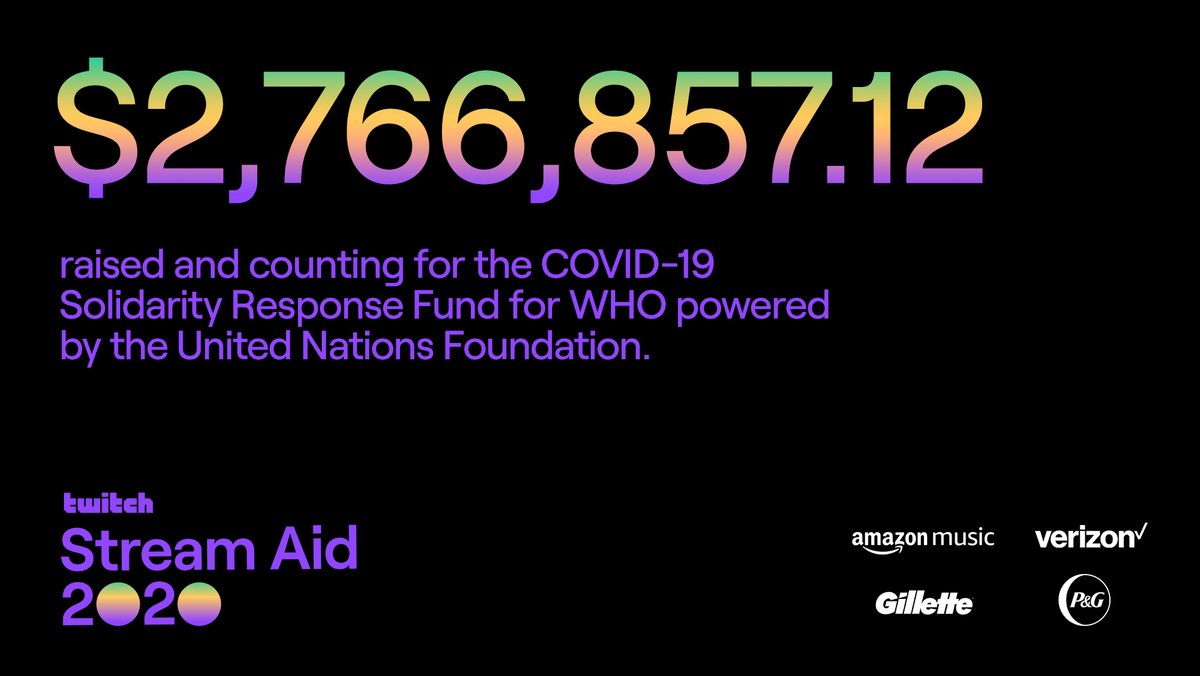
Thank you to everyone who helped #TwitchStreamAid raise $2,766,857.12 and counting for the COVID-19 Solidarity Response Fund for WHO powered by the United Nations Foundation.
If you haven’t added your support yet, there’s still time to donate: https://t.co/AjSupCmx7K