MLSS (https://t.co/ESn1cxXB4O) is back in Tübingen. It is hard to believe how much the field has changed since Alex Smola and I did the first MLSS, and since the first Tübingen edition in 2003. Our last in-person edition here was in 2017, so this feels long overdue (1/3)
If you are a PhD student or early-career researcher, apply before the deadline: June 21, 2026. Aug 31 – Sep 11 · Preliminary speaker list and applications: https://t.co/am3oXMXMvO, this is the 50th MLSS, and it coincides with the 25th anniversary of our lab at Max Planck (2/3).
🚀 Flexibility:
Researchers can tune the simulator to test for:
✅Unmeasured Confounding
✅ Selection Bias
✅ Missing Data (MCAR, MAR, MNAR)
A vital sandbox for moving Causal AI from "toy problems" to real-world medical utility. 📊
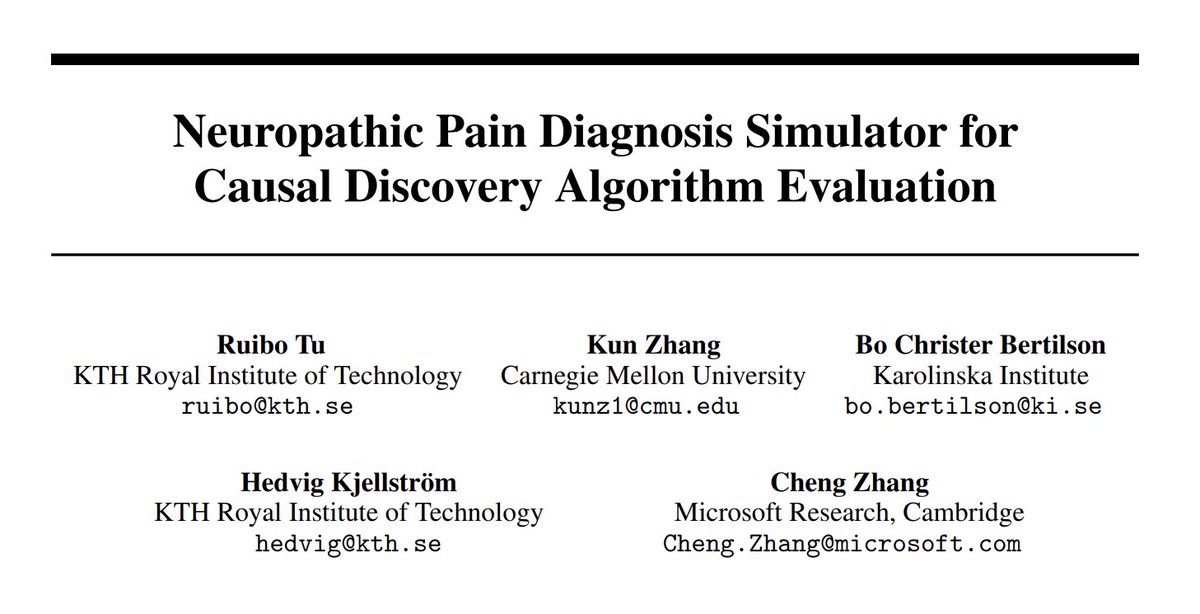
Sharing "Neuropathic Pain Diagnosis Simulator for Causal Discovery Algorithm Evaluation", one of the most popular datasets used for evaluating causal discovery algorithms! 🩺🧠 @RuiboTu@kunkzhang
📄 https://t.co/Tz9ednr5TV
💻https://t.co/dbq7g91N6d
1/n
🧪 Testing the SOTA:
The authors show that even top algorithms (PC, FCI, GES) struggle with this level of clinical logic, highlighting the need for more robust discovery methods.
🚀 Why it matters: Essential for understanding training dynamics, preventing copyright infringement, and enhancing data protection. 🛡️ By observing a small set of instances, we can now map a model's full "Memorisation Profile."
Experiments conducted on the Pythia model suite. 🧪
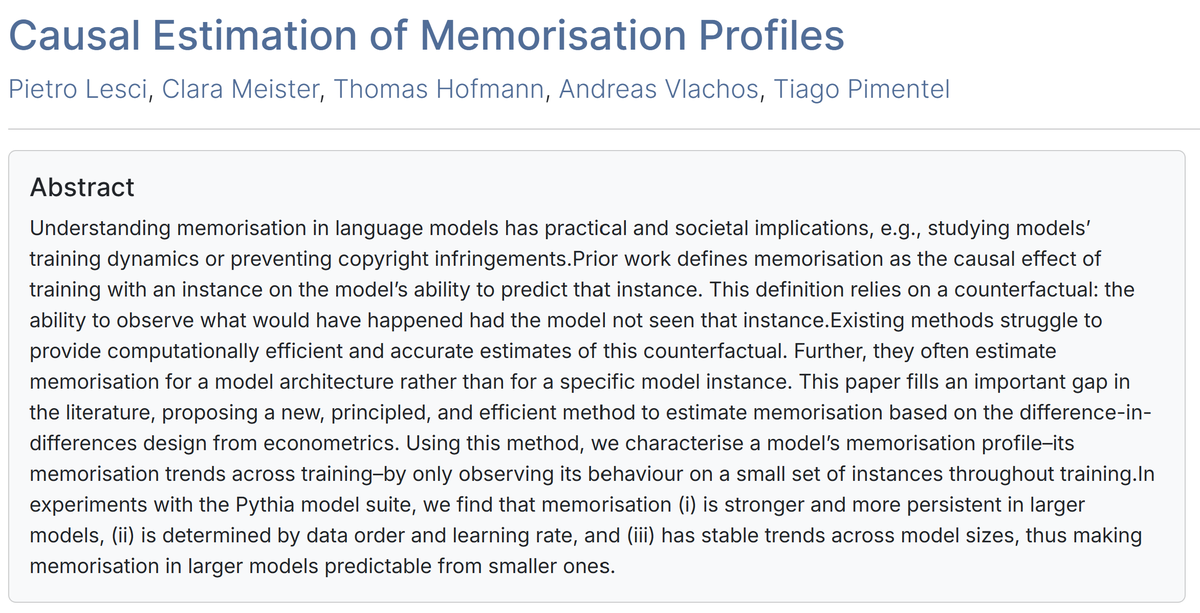
Sharing ACL 2024 Best Paper Winner, "Causal Estimation of Memorisation Profiles"!
LMs can reproduce training data verbatim, but measuring this "causally" (what would happen if the model never saw the data?) is hard. This paper fills the gap. link: https://t.co/7VljVp0EtK
1/n
⚙️ Training Dynamics:
Learning Rate (LR): Memorisation is heavily driven by the LR schedule. Instances seen during peak LR are memorised much more intensely. 📉
Order: Data order matters, but its effect is largely mediated by the LR and the specific model’s capacity. 🔀
2️⃣ Causal AI Scientist: an autonomous agent that performs end-to-end causal inference from a dataset, its description, and a causal query.
🔗 https://t.co/Mo3RlJQ6a7
Introducing the latest research highlights from @JinesisLab at the Dagstuhl seminar on Causal LLMs!
1️⃣ CauSciBench: Evaluating LLM Causal Inference for Scientific Research
2️⃣ Causal AI Scientist: Facilitating Causal Data Science with LLMs
🔗 https://t.co/mWXVF1ywPG
1/n
We are preparing for the @CausalNLP Tutorial at #emnlp2022@emnlpmeeting. 🙌 Welcome any "proposals" of topics you'd like to hear more about! Below are some candidates that we (@ZhijingJin@amir_feder@kunkzhang) are planning. We can talk more about the highly voted ones! 🎉
We are excited to release the Python causal-learn package for causal discovery! See the package (https://t.co/D0YK6ZqMjs) and documentation (https://t.co/kA2bwYtU1l). Any feedback is welcome.