Our voice AI benchmark got an overwhelming response last week, so we’re adding more providers and running more experiments.
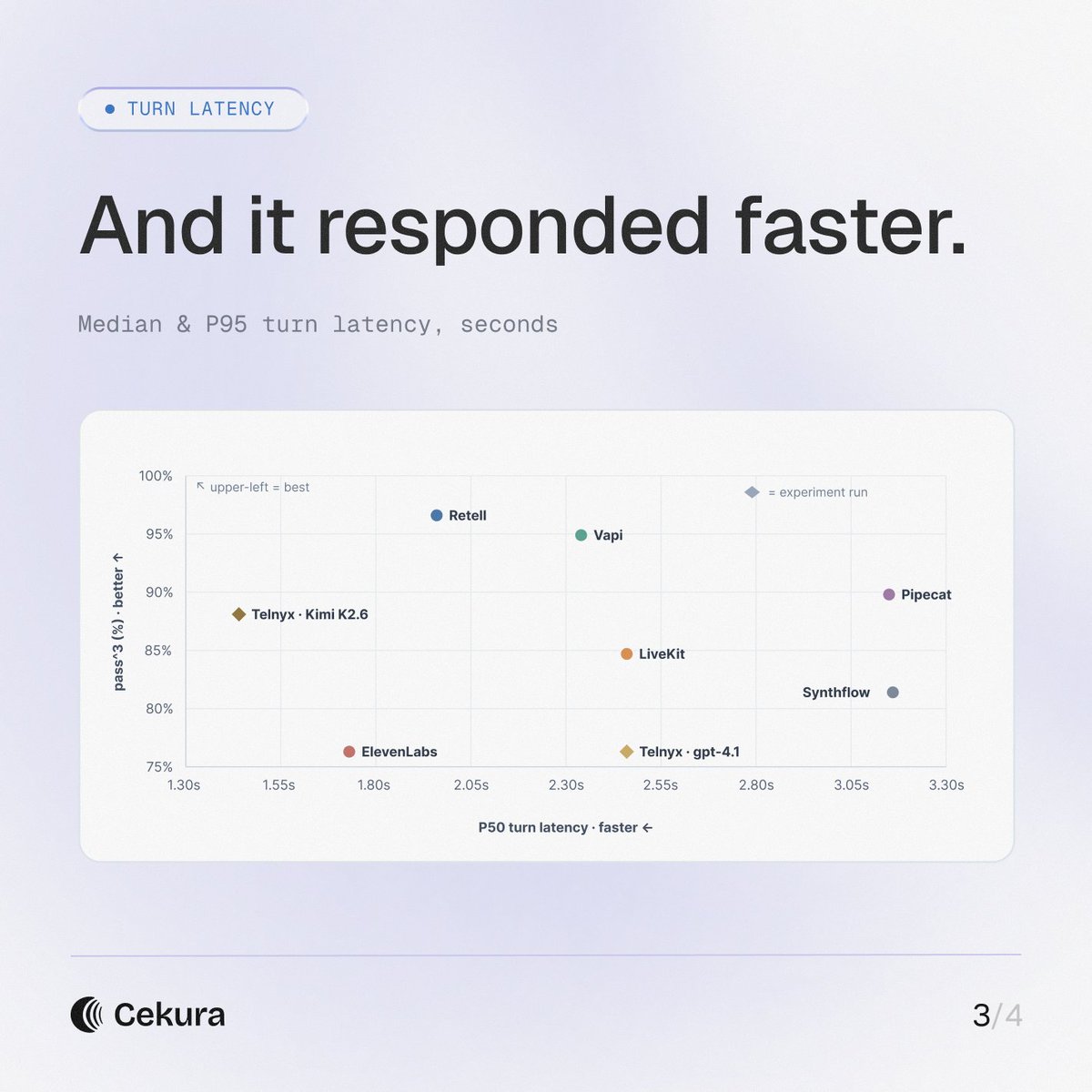
This week, we added a new provider (@telnyx).
Since Telnyx supports open-source inference, we ran the exact same Ava agent on GPT-4.1 and Kimi K2.6.
Only the LLM changed.
Kimi came out ahead:
→ 88.1% pass rate vs 76.3%
→ 1.44s latency vs 2.46s
More accurate. Faster. Open source won this round. Full results here - https://t.co/a6qP47I7co
Let us know which experiments you want to see in the comments.
Everyone benchmarks the voice model.
Almost nobody benchmarks the stack around it.
So at @cekuraAi ran the same agent across 6 voice orchestration platforms:
Same prompt
Same tools
Same model
Same voice
59 scenarios X 3 runs each
The insights were equally powerful -
Fastest wasn’t most consistent.
Most consistent wasn’t best at interruptions.
Cheapest wasn’t always worst.
The right platform depends on your use case.
Full benchmark alongside the data is public - https://t.co/GWo3BoXVne
Your voice agent broke in production. Again.
We’ve spent 2 years at @cekuraAi helping teams build more reliable voice + chat agents.
Now we’re turning those learnings into a free course on self-improving loops:
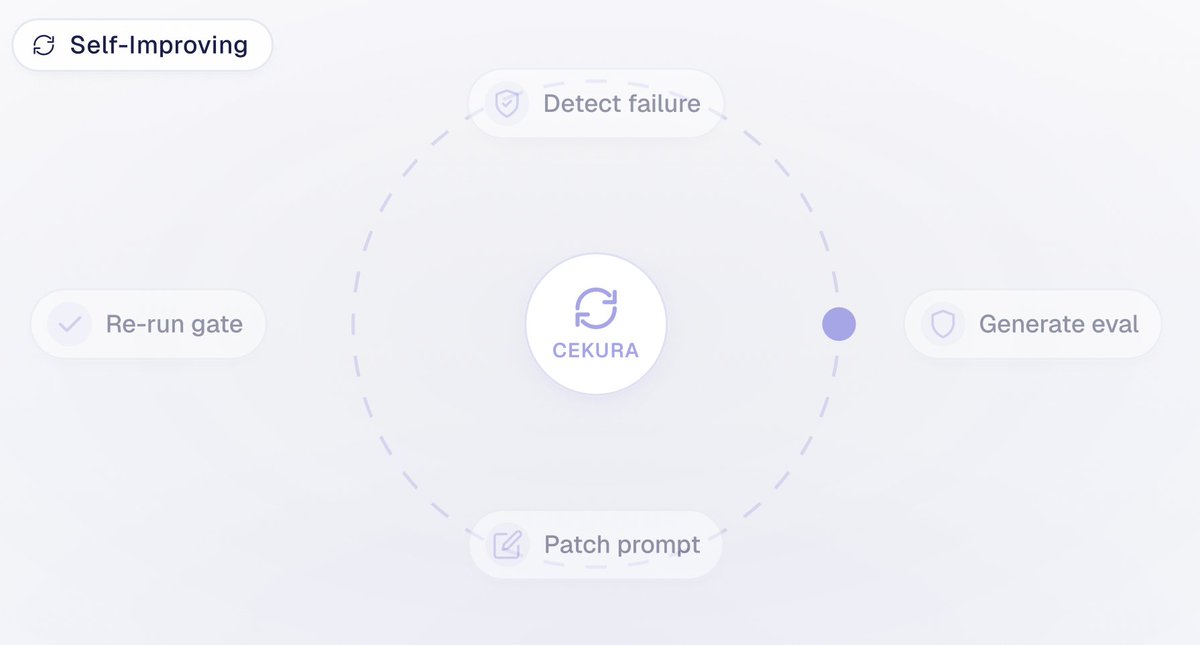
Generate tests → run evals → diagnose failures → rewrite prompts → gate deploys.
5 chapters. 16 lessons. Free.
How to Build Self-Improving Loops for Voice Agents 👇
https://t.co/Z7UuztVwu6
What do people talk about at these dinners? 👀
@cekuraAi co-hosted a small dinner with @telnyx in New York last week
The conversations went from how far agents have come in the last year, what the next wave of voice AI looks like, self-improving loops, and the shift toward open models!
Enjoyed every minute of it with @davidcasem@sambvani@akshaybuddiga Nik @Asvirskyy David @rishipenmetcha and Alex!
Most teams find out their voice agent broke after customers complain.
That’s too late.
With @cekuraAi Alerts & Dashboards, you can track production agent health in real time:
• alert when accuracy drops
• monitor latency and call endings
• filter by customer, phone number, outcome, metadata
• build dashboards for infra health and workflow performance
• group by fields to compare segments
Know when something breaks.
Know why it broke.
Fix it before it becomes a pattern.
150 developers. 12 hours. At the @ycombinator office in SF.
Last weekend we co-hosted the Voice Agents Hackathon with @trydaily. The lineup told you everything about where voice AI is right now: @pipecat_ai for the framework, @nvidia Nemotron for voice models, @twilio for telephony, @AWS for infra, and @cekuraAi for evals and self-improvement. Every layer of the stack, building together.
Over 1000 people registered. We shortlisted 150. The range of what they built in 12 hours was genuinely impressive.
The throughline from almost every team was what Kwindla Hultman Kramer said to us over the weekend: the biggest gap most of us have is not enough tests, not enough evals. You can get an agent to 95% in a demo. Finding the 5% that breaks in production is the real job.
That gap is the reason we built Cekura. Watching 150 teams run straight into it in a single weekend was the best signal we could ask for.
Grateful to everyone who showed up and built something real.
Voice agents are starting to fix themselves.
Launching @cekura x @ElevenLabs .
When your ElevenLabs agent fails in production, Cekura helps reproduce it in simulation, find the root cause, improve the prompt/settings, and verify the fix.
Production failure → simulated repro → verified fix.
Self-improving ElevenLabs agents, now on Cekura.
From helping me pass my endsems to helping us scale @CekuraAI.
Incredibly excited to welcome @nandwani_janhvi on board as a founding member to drive GTM.
Janhvi and I go back 9 years. We used to work together at our cultural festival, Mood Indigo IIT Bombay. Back then, I used to skip classes to meet sponsors. Janhvi was the one who patiently sat down with me, helping me brainstorm custom pitches, and ultimately made sure I actually passed my exams.
When it came time to build the founding GTM team for Cekura, I had a very short list. I needed someone with a rare combination of deep trust, unshakeable ethics, and raw capability. Janhvi was right up there. At the time, she had just left her coveted PE role at Advent and was looking to dive into the AI space.
Her execution skills were never in question, but coming from a finance background, we did have one question: how fast could she adapt to the world of AI? My only advice to her on day one: "Just use Claude."
Fast forward to today, and she has completely accelerated our GTM engine. SEO, GEO, socials, cold outreach, she's built efficient workflows across all of it.
Her commitment to the hustle is unmatched. She recently hopped on a 20-hour flight to SF and two days later took another 10-hour flight to the East Coast to head straight to a Voice AI conference. I honestly can't imagine how we were doing our GTM without her.
We are hiring for the founding FDE at Cekura. Come work with Janhvi and us:
https://t.co/uoPYBJZ89S
When Kastle ships voice AI to banks, a hallucination is a regulatory event.
Because compliance lives at the state level (Mini-Miranda at the gatekeeper, NACHA during payments), full-transcript evals don't work.
The fix? Test the graph, not the prompt.👇
By partnering with @cekuraAi, Kastle isolates and tests every conversation state independently:
• Per-Node Suites: Only the modified state's tests fire during iterations.
• Chat + Voice: Chat for broad scenario coverage, voice for real-world audio realism.
• Production-Seeded: Real borrower transcripts automatically turn into new edge-case tests.
The results:
⭐ 90%+ CSAT
⏱️ 40% lower handle time
💰 $100M+ processed
Huge thanks to @therishic and @nitishpoddar99 for being early believers and congratulations on their growth!
Read the full case study here: https://t.co/XoStgY6AQP
Made a classic product mistake at @cekuraAi
Our simulation engine was strong, but we underinvested in integrations - and lost deals because of it.
So we fixed it.
Today we’re launching @livekit Tracing:
• WebRTC/text testing
• Full OTel traces, Transcripts + tool calls + dual-channel audio
• Auto mock tool calls
Two-line SDK integration.
Know how often your agent suddenly drifts into gibberish mid-sentence? 🗑️
Or reads a phone number as one long blob instead of a natural 3-3-4 cadence? ☎️
The transcript won’t show it.
The customer hears it.
Audio metrics on @cekuraAi : voice tone, gibberish, letterwise pronunciation, transcription accuracy and more!
All evaluated on the actual audio, not just the transcript.
Each of these took months of research and fine-tuning - credits to @SatvikDixit9 who knows all things evaluation!
Ok so our AI agents are starting to fix themselves 📢📢📢
We detected unnecessary interruptions from our testing agent while monitoring calls.
A coding agent traced the issue → reproduced it in @cekuraAi simulations → fixed it → verified the fix on Cekura again.
Watch this if you aren’t already simulating your agents this way.
We just made Pipecat testing a lot easier.
With @cekuraAi + @pipecat_ai , you can now get:
• full traces
• every tool call with inputs + outputs
• complete transcripts with timestamps
• mock tools so agents don’t hit live APIs
• chat + WebRTC testing, all in one place
Everything in one place for both test runs and production debugging.
Docs below 👇
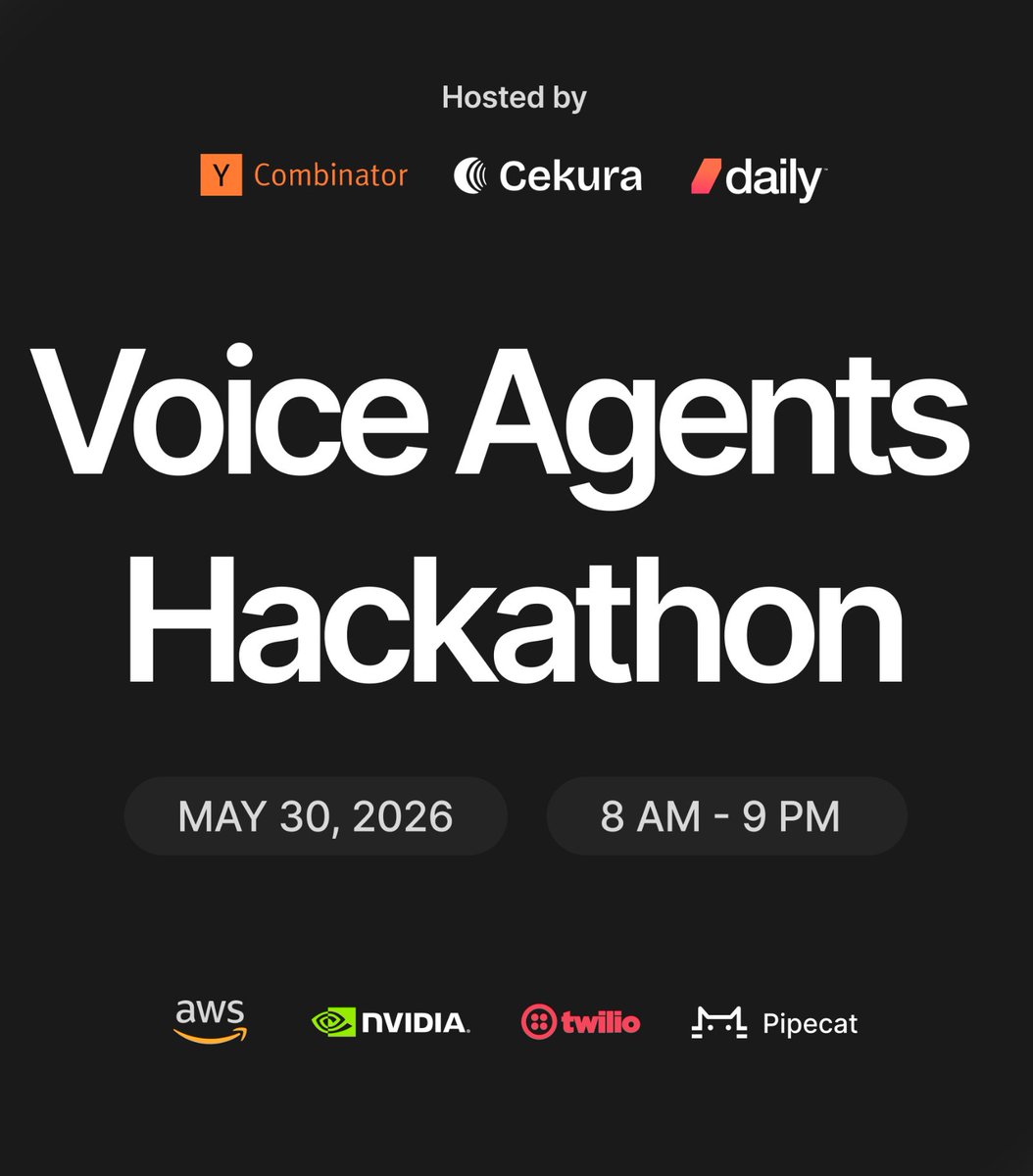
✨ Voice AI, open models, and next-generation evals hackathon at @ycombinator in SF on May 30th. ✨
We're co-hosting with @cekuraAi , and we've pulled in our friends at @NVIDIAAIDev, @AWS, and @twilio for expertise and mentoring.
We'll help you build state of the art voice agents using:
- NVIDIA Nemotron models
- AWS SageMaker and Bedrock inference
- Twilio telephony
- Cekura evaluation tooling
- Pipecat orchestration and Pipecat Cloud agent hosting
Up for grabs:
- A guaranteed YC interview
- Special judges' prizes from NVIDIA, AWS, and Twilio for the most impactful and technically impressive projects
Join us to learn from engineers who built all the tools you're using, compare notes with other voice AI developers, and show off your ideas!
Space is limited. Apply below.
Yesterday, we shared our evals on Gradient Bang.
Today, we’re dropping the first podcast from the @cekuraAi team.
I sat down with @kwindla from @pipecat_ai + @trydaily to go deeper on what Gradient Bang represents:
Agents as interfaces.
Voice as the UI.
Tools, memory, state, and sub-agents all working together.
And the new reliability problems that show up when agents actually do things.
This is where agents and evals are headed.