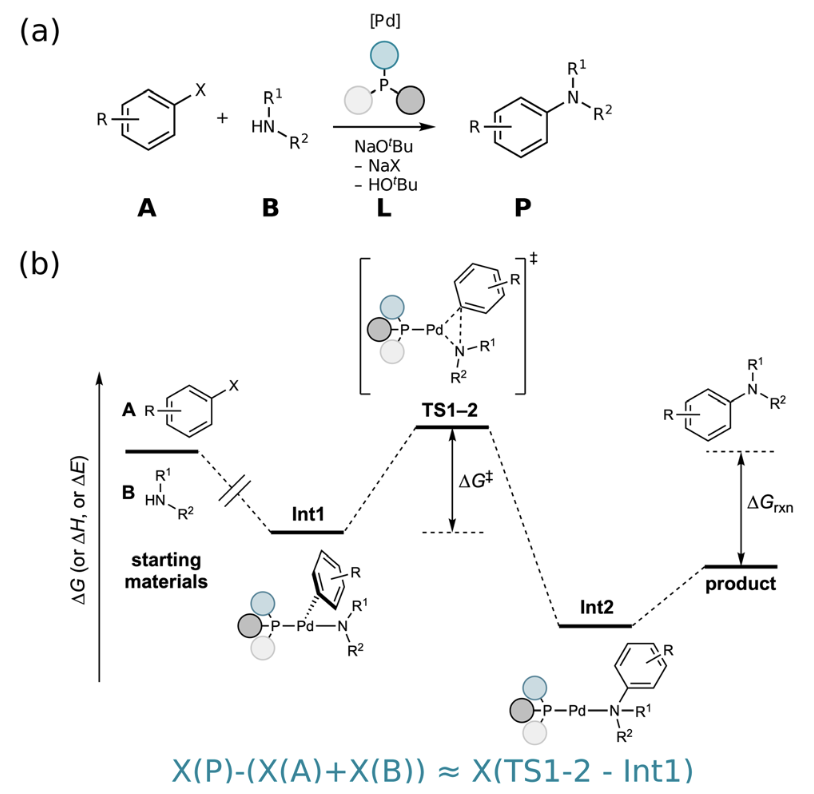
I will give a talk on EquiReact today at the MLCM conference: https://t.co/KiaMowg6ET (remote). If you are dialing in, I'll be speaking at 10:20 MDT (18:20 CET)!
Speaking today at the @isqbp 2024 conference about new important results that we obtained in #quantumcomputing for #compchem. Check out the new preprint:
"Shortcut to Chemically Accurate Quantum Computing via Density-based Basis-set Correction"
https://t.co/xU0Iv9MTJe
We present a new hybrid computing scheme for getting accurate energies and first-order properties of small molecules. The use of GPU-accelerated emulation allows us to obtain quantitative results at with ADAPT-VQE that would otherwise require brute-force quantum simulations using far more than 100 logical qubits. It is grounded on on-the-fly pivoted Cholesky-like adaptive basis sets (System-Adapted-Basis-Sets or SABS) and on a specific density basis set embedding of the quantum ansatz denoted density-based basis-set correction that allows recovering missing dynamical correlation effects due to basis set incompletess. Remaining missing basis effects can be included via a cheap Hartree Fock correction. We converge the ground-state energies of four systems (He, Be, H2, LiH) within chemical accuracy of the CBS full-configuration-interaction reference, while offering a systematic increase of accuracy beyond a double-zeta quality for various molecules up to the H8 hydrogen chain. We also obtain dissociation curves for H2 and LiH that reach the CBS limit whereas for the challenging simulation of the N2 triple-bond breaking, we achieve a near-triple-zeta quality at the cost of a minimal basis-set.
A nice feature of the approach is that it can be also used as "a posteriori" correction to any real QPU computation.
Stellar work by @Dr_DiataTraore@OlivierApp@ChemCesar I.-M. Lygatsika and great interdisciplinary work between chemistry, physics, #HPC and mathematics. Great collaboration between @LCT_UMR7616 (J. Toulouse, E. Giner), LJLL (Y. Maday), @qubit_pharma ( @alberto_peruzzo@EPosenitskiy) and @nvidia ( @khammernik). Funding from @ERC_Research (project EMC2) and PEPR Epiq @AgenceRecherche. Computer time @Genci_fr, @Scaleway_fr and NVIDIA.
The final program of the 2024 ISQBP President's Meeting is out! https://t.co/wCAaBgjHne.
The conference will open today at the @academyofathens with the Computational Biology Award Lecture presented by John Åqvist @UU_University
Experiment design, Bayesian optimization or Active learning -- all under one umbrella. The advent of self-driving labs is here. We need strategies to implement automatic information gathering! ML models are only as informed as the data they are trained on.
1/n)💡How can pharmaceutical companies collaborate without leaking confidential information?
How can you compute on encrypted data without a private key? Find out more in this article!
https://t.co/lW1ItFLffi
@aa_schoepfer and @WeinreichJan led this nice story on trying to make BO a bit smarter for real life: Cost-Informed Bayesian Reaction Optimization | ChemRxiv - https://t.co/7YnO0cihe4
Wake up BayBE new RAMBO is out! 💪
RAMBO is our project on Retrieval Augmented initialization for Bayesian optimization & the submission for the Chemistry & Materials #BOHackathon.
It leverages extensive available data to pick the best initial points for a new optimization task!
Yuri's paper extending cell2mols ability to process crystallographic files is now live: Automated Prediction of Ground State Spin for Transition Metal Complexes | ChemRxiv - https://t.co/exUop81zr1
Currently on @ChemRxiv, just accepted for publication in @JChemPhys! 🎉
👉 https://t.co/cYjWQkZCsh
In this paper, we test several neural network potentials for #water based on the DeePMD framework, which were derived by both us and other researchers, using our MB-pol #datadriven #manybody potential as a reference. We find that, independently of the specific training sets used, none of the existing DeePMD-based potentials represents a completely trustworthy surrogate model for MB-pol. Our results confirm the "short-blanket dilemma" for DeePMD-based potentials that we introduced here 👉 https://t.co/bxBwQttMwd. Our analyses indicate that the limited transferability of DeePMD-based potentials for #water (and possibly other molecular species) can be attributed to their inability to correctly capture the physics of #manybody interactions.
In this context, we believe that #datadriven #manybody potentials, like MB-pol, which integrate physics-based representations of many-body interactions with explicit #machinelearning representations of individual, low-order n-body terms, provide a more accurate, robust, and transferable representation of molecular interactions in #water.
Notwithstanding the limitations of DeePMD-based potentials in accurately reproducing MB-pol, our analyses also show that our DNN@MB-pol potential, a DeePMD-based potential developed by us, provides good agreement with MB-pol for the bulk properties of liquid water across a wide range of temperatures. Given its computational efficiency, DNN@MB-pol is thus particularly well-suited for investigating the properties of supercooled #water, which require both the realism of MB-pol and an extensive sampling of the underlying free-energy landscape. Stay tuned!
If you are interested in learning more about what makes MB-pol so special, please refer to:
👉 https://t.co/XIypYVrJyv
👉 https://t.co/cvvB6BjdTQ
👉 https://t.co/bLLCZgkLRT
👉 https://t.co/QQzVVEqONB
👉 https://t.co/ITPTtx4ZID
👉 https://t.co/jMx8Fbkzwg
👉 https://t.co/B3ZMqBhExm
@UCSanDiego@UCSDPhySci@UCSDChemBiochem@HDSIUCSD@SDSC_UCSD
#compchem New paper published in J. Phys. Chem B @JPhysChem: Incorporating Neural Networks into the AMOEBA Polarizable Force Field. Congrats to Yanxing Wang & @JaffrelotT, @leucinw. Another great collaboration with @prenbme. https://t.co/OVjauZG7bL
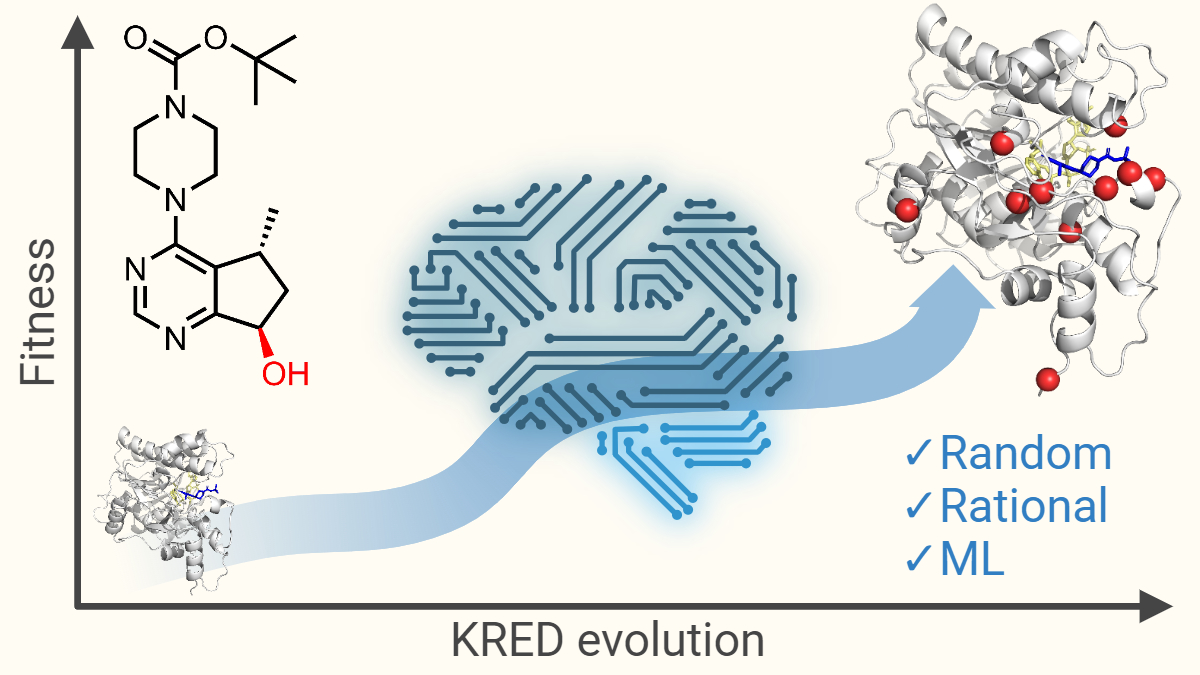
With smart engineering techniques, we boosted ketoreductase activity for ipatasertib precursor synthesis by 64-fold. Algorithmic help shrunk library size, ensuring efficiency. Result? ≥98% conversion rate with 99.7% de!🌿🧪
👉https://t.co/kOyF10ArlD
@CommsChem@NCCR_Catalysis
Join us to hear the latest research of Prof. @jppiquem from @Sorbonne_Univ_ as an invited speaker at #ISQBP2024 in Athens, Greece, from 19-23 May
Abstract submissions are now open: https://t.co/Yue7WDTBO9
Don't miss the Early-bird deadline on March 1, 2024
https://t.co/sMNmtJCSBl
Proud to present Denoising Diffusion Models, where we connect the learned score of a diffusion model with force fields to do sampling and simulations🎉 Work done during a wonderful collaborative internship @MSFTResearch@JCIM_JCTC https://t.co/B28kqTFvd2, https://t.co/KsVJgYjm7Z
This upcoming Virtual Special Issue from #JCTC will provide a platform for scientists to showcase how the convergence of machine learning and statistical mechanics can solve chemical problems of the future 🤖🌌
Learn more today 🔬 https://t.co/spSkpVyOOH 👽🌐👨💻🦾