250 years ago, the Founders taught us something simple: a tax system earns consent when it treats people equally, and it invites discontent when it doesn’t.
We’ve drifted a long way from that standard, argue @adamnmichel and Joshua Loucks.
https://t.co/2ZGhQuO9oH
@jstewartIndy The real takeaway - Hoosiers’ revealed preferences demonstrate a willingness to pay for travel time savings. We now know there’s at least $3.2M worth of demand for the ability to drive 11+ mph over the posted speed limit. Will the market respond?!?
I think one thing that doesn't get discussed enough is how much Magic's gameplay has changed in recent years. The effort to make the game more accessible seems good on its face, but the end result seems to be much less strategic gameplay and less player agency (i.e. your decision matter less today than in the past).
One thing doing the Best Standard bracket has reinforced to me is that the current version of Magic really is an aberration historically. The play pattern of two decks snowballing into each other and seeing who gets the better draw isn't how Magic was for most of its life.
Rather than being about Universes Beyond or the number of sets, I think this is actually a product of Wizards spending the last decade or two trying to remove "feel bads" from the game to make it more accessible or appealing to new players. Stax has mostly been eliminated, land destruction too, counterspells minimized.
As we've seen repeatedly on the Bracket, these "feel bad" cards actually do a ton of work balancing the game. Janky white weenie decks can compete thanks to Rishadan Port or Armageddon disrupting the opponent's resources. Sideboard hosers and color hate cards can swing matchups. This leads to, at least in my opinion, a lot of really interesting matches where you have to think about playing around sideboard cards, sequence plays to avoid the hate, sandbag lands to play around destruction, etc.
I feel like this strategic depth is often missing today.
When you add the elimination or minimization of "feel bads" to the spiraling power of creatures, you end up with a game that heavily incentivizes maximizing your gameplay rather than stopping your opponent's gameplan.
We've also seen a lot of steps taken to minimize variance - mulligan rule changes, card designs (like MDFCs), everything generating card advantage to make sure you rarely run out of cards (because being empty handed feels bad...) - which I think compounds the problem. Less variance also pushes you to maximize your gameplan rather than stopping your opponent's gameplan, since you'll execute your gameplan optimally more often.
The end result is an era of Magic that, at least to me, feels far less strategic than in the past. I still appreciate the game for what it is today, I still have fun playing it, but it's wild how good 1v1 Magic gameplay used to be. I wish there was a way more newer players could experience it, because it really is a lifechanging gaming experience and its super addicting.
The Declaration rests on a simple principle: we created government to protect our rights, which makes it our employee, not our parent. We pay its bills and are responsible for teaching it to be moral, not the other way around, says Cato’s @TimothySandefur.
The White House’s $87.6 billion Iran war supplemental includes more than military spending: $11 billion for farm subsidies, $1 billion for Penn Station, and hundreds of millions for other unrelated projects. Congress should reject this misuse of emergency spending—or require dollar-for-dollar offsets, writes Cato’s @LettDominik.
https://t.co/W3vnysnW2Z
@HouseGOP So why are we nationalizing companies? Because central planning is good when we do it?
• Intel 10%
• MP Materials 15%
• Lithium Americas 5%
• Trilogy Metals 10%
• U.S. Steel “golden share”
@meghanncuniff So unlike my 3 and half year old, you don't think the Morgan & Morgan backflip off the Morgan & Morgan backflip wall is a national treasure 😂🤣
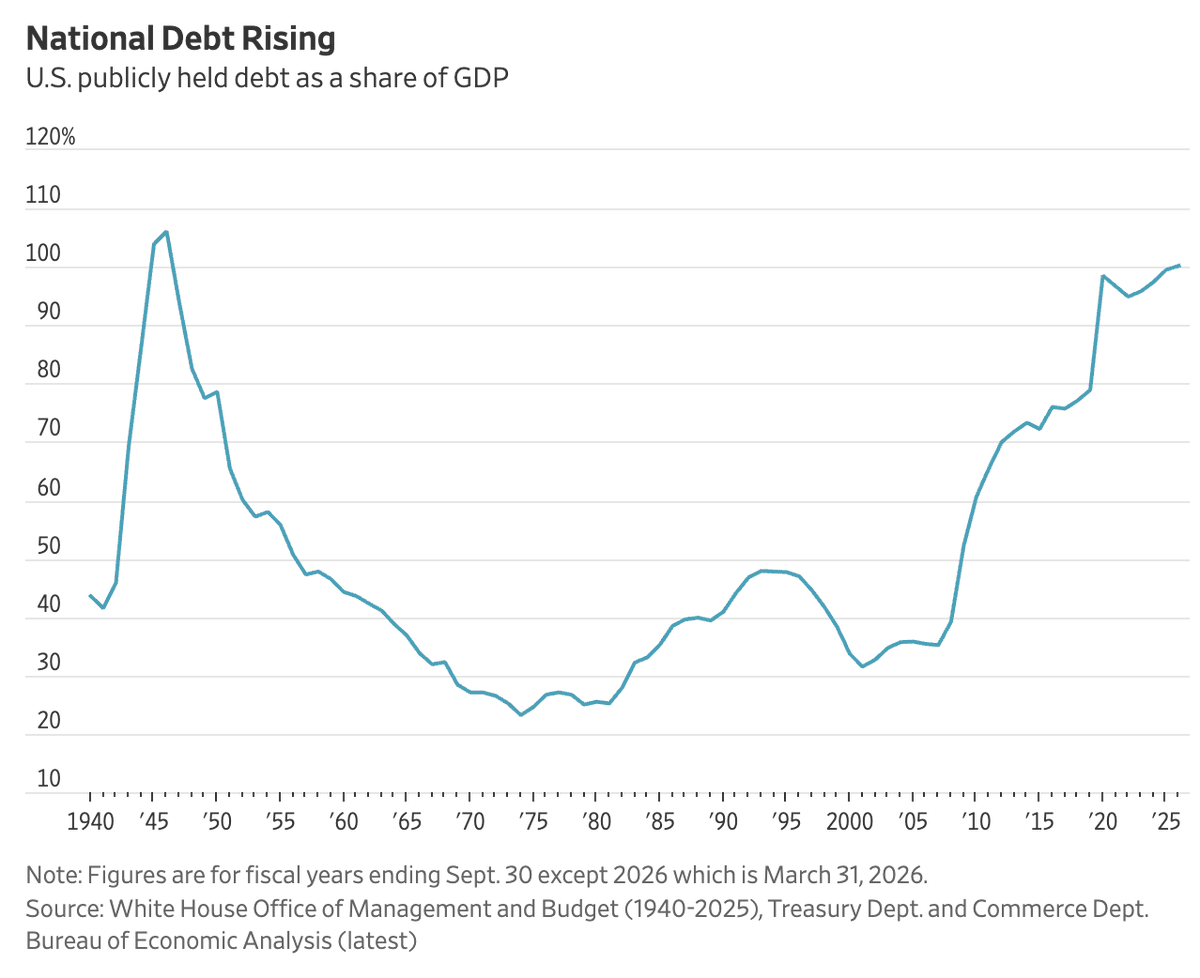
One thing many populist-driven tax “reform” ideas seem to have in common: they increase deficits and have negative dynamic effects, even before accounting for crowd-out, resulting in more national debt and less economic output.
Great to see Hunt-Kean Fellow @SecJennerIN leading Indiana’s work to strengthen high school outcomes.
“As we continue to scale the new Indiana diploma and readiness seals statewide, we will not only strengthen the value of high school and help more students graduate, we will ensure that they are prepared to succeed in whatever path they choose for their future,” said State Education Secretary Katie Jenner.
With nearly 92% of Indiana’s high school seniors graduating in 2025 — the highest graduation rate on record, Indiana is demonstrating how clear expectations and workforce-aligned pathways can drive real results.
https://t.co/uxah25FXEY
COMMANDER: We’re fighting for freedom. And part of that freedom… is the freedom to retire with dignity. So we’re going to start accounts called 401(k)s.
SOLDIER 1: What’s a 401(k)?
COMMANDER: It’s a retirement account. You put money in, it grows tax-free, you take it out when you’re old.
SOLDIER 2: So I don’t pay taxes on it?
COMMANDER: Well, you pay taxes later. When you withdraw.
SOLDIER 2: So it’s not tax-free.
COMMANDER: It’s…tax-deferred.
SOLDIER 2: What’s the difference?
COMMANDER: You pay taxes later instead of now.
SOLDIER 1: What if I want to pay taxes now?
COMMANDER: Then you do a Roth 401(k).
SOLDIER 3: What’s a Roth?
COMMANDER: You pay taxes now, and it grows tax-free.
SOLDIER 2: That’s what I thought the first one was.
COMMANDER: No, the first one you pay taxes later.
SOLDIER 1: Which one’s better?
COMMANDER: Depends on your tax bracket in retirement.
SOLDIER 1: …How would I…know that?
COMMANDER: You don’t. You just guess.
⸻
SOLDIER 4: What if I don’t have a 401(k) through my employer?
COMMANDER: Then you open an IRA.
SOLDIER 4: What’s the difference?
COMMANDER: One’s through your job, one’s on your own.
SOLDIER 4: Can I have both?
COMMANDER: Yes.
SOLDIER 4: Should I?
COMMANDER: Maybe.
SOLDIER 3: Can I do a Roth IRA?
COMMANDER: Only if you make under a certain amount.
SOLDIER 3: What’s the limit?
COMMANDER: Changes every year.
SOLDIER 2: What if I make too much?
COMMANDER: Then you do a backdoor Roth by putting it in a Traditonal first.
SOLDIER 2: …Is that legal?
COMMANDER: Surprisingly, yes.
SOLDIER 1: What’s a backdoor Roth?
COMMANDER: You contribute to a traditional IRA, then convert it to a Roth…but watch out for “pro rata”.
SOLDIER 1: Why wouldn’t I just contribute to the Roth directly?
COMMANDER: Because you make too much money.
SOLDIER 1: But this way I can?
COMMANDER: Yes.
SOLDIER 1: That feels like a loophole.
COMMANDER: It is. But the IRS is cool with it.
⸻
SOLDIER 5: I just changed battalions. What do I do with my old 401(k)?
COMMANDER: You roll it over.
SOLDIER 5: Into what?
COMMANDER: An IRA. Or your new 401(k). Depends.
SOLDIER 5: On what?
COMMANDER: The funds. The fees. Whether your new plan accepts rollovers.
SOLDIER 5: What if I just take the money out?
COMMANDER: You’ll pay taxes plus a 10% penalty.
SOLDIER 5: What if I’m 59?
COMMANDER: Penalty.
SOLDIER 5: 59 and a half?
COMMANDER: No penalty.
SOLDIER 5: …The half matters?
COMMANDER: The half matters.
⸻
SOLDIER 3: What’s a mega backdoor Roth?
COMMANDER: Okay. So. Your 401(k) has a limit of how much you can contribute.
SOLDIER 3: Right.
COMMANDER: But the total limit including employer contributions is higher.
SOLDIER 3: Okay…
COMMANDER: So if your plan allows ~after-tax~ contributions, you can put in more, then convert that to Roth.
SOLDIER 3: Does my plan allow that?
COMMANDER: I don’t know. You have to ask Betsy.
SOLDIER 3: Will Betsy know?
COMMANDER: Probably not.
⸻
SOLDIER 2: Can I deduct my IRA contribution on my taxes?
COMMANDER: Are you covered by a retirement plan at work?
SOLDIER 2: Yes.
COMMANDER: Then only if you make under a certain amount per year.
SOLDIER 2: What’s the amount?
COMMANDER: Depends if you’re married.
SOLDIER 2: What if my wife has a plan but I don’t?
COMMANDER: Different limit.
SOLDIER 2: What if neither of us has a plan?
COMMANDER: Full deduction.
SOLDIER 2: So it’s better to not have a 401(k)?
COMMANDER: No…
⸻
SOLDIER 1: Can I just keep my money in a sock?
COMMANDER: You could. But inflation will slowly destroy it.
SOLDIER 1: What’s inflation?
COMMANDER: (sighs)…