Stateside, a gas station. I drank a frozen blue beverage too quickly, and was struck down by a punishment this entire nation knows, and accepts, and has named.
The drink is called a slush. Ice, sweetness, and a blue that does not occur in nature. The day was hot. I was thirsty. I drank like a soldier at a river.
The pain arrived in my skull like a war horn.
Behind the eyes. Above everything. Total. I gripped the roof of my car. I may have made a sound.
"Brain freeze," said the cashier through the door, with no urgency whatsoever.
It has a NAME. The affliction is so common it has a household name, like a cousin.
"Tongue on the roof of your mouth," called a man at the pumps. He did not look over. He prescribed the remedy mid-pump, casually, the way one mentions weather.
I pressed my tongue to the roof of my mouth. The war horn faded. The healer nodded at his pump, finished, and was gone in a Chevrolet.
In my land, punishment follows crime by way of courts and seasons. Here, the sentence is instant. Drink with greed, and the ice strikes the mind directly. No trial. No appeal. Perfectly fair.
And here is what moves me. EVERYONE has felt it. The cashier. The healer. Children. Elders. An entire nation united by the same small lightning, all taught the same cure, all passing it on to strangers at gas stations, free of charge.
You cannot fully distrust a country once you know it shares one pain.
The freeze does not punish thirst. It punishes haste.
I finished the slush slowly, like a scholar. Blue tongue. Clear mind.
Then at the door I forgot everything, drank deeply, and was struck down again.
"Tongue, hon," said the cashier, without looking up.
Discipline is a journey.
Yesterday the paratroopers took Carentan. On June 13, 1944, the Germans came to take it back, and the men of Easy Company found themselves minutes away from being wiped off the map.
This is the fight the survivors remembered as Bloody Gulch.
A quick recap. Carentan was the town that linked the two American invasion beaches, Utah and Omaha. Without it, the D-Day landings stayed a set of separate, vulnerable pockets. The 101st Airborne had bled to capture it on June 12. But capturing a place and holding it are two different things, and the Germans were not willing to let it go.
On the morning of June 13, the Germans counterattacked southwest of the town with a serious force, the 17th SS Panzergrenadier Division reinforced by the tough paratroopers of the 6th Parachute Regiment, supported by assault guns and armor. The exhausted, lightly armed American paratroopers, who had no tanks of their own, were holding a thin line across open hedgerow country.
The blow landed hard. The German armor and infantry pushed the American line back toward Carentan. Paratroopers fought from hedgerow to hedgerow with rifles, machine guns, and bazookas against vehicles that outgunned anything they carried. Ammunition ran low. The position grew so desperate that men were preparing for the possibility that the town would be lost again, and with it the link between the beaches.
Then came the rescue, and it came on tracks.
Unknown to the Germans, the Americans had just managed to get armor across into the beachhead. Combat Command A of the 2nd Armored Division, Shermans and mechanized infantry, had been rushed toward Carentan overnight. At the critical moment they hit the German flank with tanks and a storm of artillery and mobile gunfire.
The counterattack that had been about to break through was itself broken. The German force, lacking the strength to trade blows with American armor, was thrown back with heavy losses. Carentan stayed in American hands for good.
That was the real significance of June 13. June 12 won the town. June 13 was the day the Germans tried to erase that victory and failed. From that point on, Utah and Omaha were permanently joined, and the Normandy beachhead was one solid, continuous front that Germany could no longer split apart.
Two things stay with you about this fight.
The paratroopers were never supposed to be fighting tanks at all. Airborne troops are meant to seize objectives and be relieved within days. Instead they were holding the line against a panzer division with whatever they could carry on their backs, and they held just long enough.
And the timing of the armor's arrival was so close that veterans talked about it for the rest of their lives. A few hours later and Carentan might have fallen. The war in Normandy was decided in places like this, by men who never knew if help would arrive before they were overrun.
It did. Just barely.
That is what June 13, 1944 looked like on the ground.
On the morning of June 6, 1944, Lt. Dick Winters had already survived one disaster before the sun came up.
His C-47 roared over Normandy through a wall of flak, flying too fast and too low. He jumped anyway. The prop blast ripped his leg bag clean off, taking his rifle, his ammo, and most of his gear. He hit the ground in occupied France armed with a knife in his boot.
Most men in that situation hide. Winters started walking toward the sound of the war.
By dawn he had scavenged a rifle, collected a handful of scattered paratroopers, and learned that his company commander's plane had gone down with everyone aboard. Just like that, a quiet lieutenant from Pennsylvania who didn't drink, didn't curse, and wrote letters home about wanting to find a peaceful farm someday was in command of Easy Company.
A few hours later a battalion officer gave him one of the great understated orders in military history. German fire was coming from a farm called Brecourt Manor, hammering the troops coming off Utah Beach. The order was basically: there's fire along that hedgerow, take care of it.
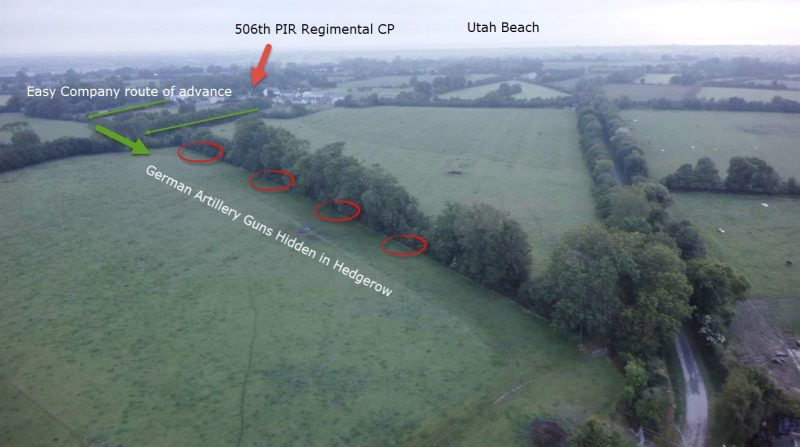
What was actually there: four 105mm howitzers dug into a hedgerow network, connected by zigzag trenches, covered by machine guns, and defended by roughly 60 German troops. The guns were dropping shells directly on causeway exit 2, where thousands of Americans were trying to get off the beach. Every minute those guns fired, men died in the sand.
Winters had 12.
He did not charge. He crawled forward alone to study the position, then briefed his men like he had all the time in the world. Machine guns here to pin the defenders. Compton, Guarnere, and Malarkey crawling along the flank. Hit the first gun with grenades and speed from a direction the Germans never expected.
It worked almost exactly as drawn. The first gun fell in minutes. Then his men used the German trenches as a highway, rolling up the battery one gun at a time, beating back counterattacks, and dropping blocks of TNT down the barrels to destroy them for good.
In the middle of the firefight, Don Malarkey spotted what he thought was a Luger on a dead German and sprinted into open ground to grab it. The German machine gunners held their fire, apparently deciding that anyone that reckless had to be a medic. He made it back alive. It wasn't even a Luger.
At the second gun, Winters found something better than a pistol: a German map showing every artillery and machine gun position covering Utah Beach. He sent it up the chain immediately. On the most important morning of the war, a 26-year-old lieutenant had just handed the Allies the enemy's entire defensive layout for the sector.
When reinforcements under Lt. Ronald Speirs arrived, they stormed the fourth and final gun. About three hours after it started, the battery was silent and the exits off Utah Beach were open for thousands of men who will never know his name.
The cost: one American killed, a few wounded. The Germans lost around 15 dead and a dozen captured. Winters received the Distinguished Service Cross and later said the best decoration he ever got was a sergeant telling him years later that his men trusted him with their lives.
The assault on Brecourt Manor is still studied at West Point as a textbook example of a small unit destroying a fixed position.
Around 60 defenders. Four guns. Twelve paratroopers and a lieutenant who started D-Day with nothing but a knife.
If it sounds familiar, it should. This is the same Easy Company from Band of Brothers. The difference is that none of it was fiction.
And when Winters was asked decades later if he was a hero, he gave the answer that still gets quoted at his statue in Normandy: "No. But I served in a company of heroes."
An engineer from Charlotte, North Carolina sat down in the spring of 2000 to write software for guided missile destroyers in the United States Navy. The ships needed a database that did not require a system administrator on board.
So he wrote one himself. 26 years later that database, SQLite, runs inside every iPhone on Earth, every Android phone, every Mac, every Windows machine, every major web browser, every airplane cockpit avionics system, and most of the cars built in the last decade. It is the most widely deployed software in human history. He still maintains it from his home in North Carolina.
His name is D. Richard Hipp. Most people call him Richard.
Here is the story, because the engineer behind the most replicated piece of code on the planet is a man almost nobody can name.
Richard was born in Charlotte on April 9, 1961. He grew up in the suburbs of Atlanta. He graduated from Stone Mountain High School in 1979 and went to Georgia Tech, where he earned both a bachelor's and a master's degree in electrical engineering by 1984. He spent three years at AT&T Bell Labs working in Unix and C. Then he went back to school at Duke University and earned a PhD in Computer Science in 1992. His dissertation was on spoken natural language dialog processing under Alan W. Biermann.
He could have stayed in academia. He told one interviewer the market for PhDs was saturated with better qualified candidates. He started a software consulting company instead. He married a musician and author named Ginger G. Wyrick in 1994 and renamed the firm Hipp, Wyrick and Company.
Then in 2000 he picked up a contract through General Dynamics to write software for the US Navy. The target was the Aegis class guided missile destroyer. The original system ran HP-UX with an IBM Informix database backend. The whole stack required a database administrator on board. The Navy did not want a database administrator on board. Richard's job was to make the database administrator unnecessary.
The design goals were simple. The database had to be self-contained. It had to run inside the application. It had to have zero configuration. It had to be transactional and reliable. It had to require no separate process. It had to be small.
On August 17, 2000 he released SQLite 1.0. He wrote it in C. The whole thing fit in less than a megabyte. The license he chose was the most extreme one possible. He released the source code into the public domain. No copyright. No royalties. No restrictions. Anyone could use it for anything forever.
The decision changed software history.
SQLite spread quietly. Mozilla adopted it for Firefox. Apple put it inside iOS. Google put it inside Android. Microsoft started shipping it inside Windows. Chrome, Safari, and Edge all use it. Photoshop uses it. Skype used it. Every major operating system you have ever touched runs SQLite somewhere underneath. The Airbus A350 uses it for flight software. Every Boeing 787 has SQLite onboard.
By 2026 SQLite was estimated to be running on more than 1 trillion devices. It is the most replicated piece of software ever written. Richard has personally turned down what is almost certainly hundreds of thousands of dollars in royalties over the past 26 years by keeping it public domain.
The SQLite team is tiny. Richard and a small group of core contributors. He maintains a separate version control system he wrote himself called Fossil. He maintains a parser generator he wrote himself called Lemon. He maintains a diagram language he wrote himself called Pikchr. He is a member of the Tcl core team and has been for over 25 years. He answers questions on Hacker News under the username SQLite.
The project's public commitment is to support SQLite through the year 2050.
A Christian engineer from North Carolina wrote a small database for missile destroyers and released it for free.
It is now running inside every device in your house.
June 8, 1940. Four days after Dunkirk, Britain lost 1,519 sailors in the Arctic Ocean. Almost no one talked about it. The government made sure of that.
Here's the full story, and it gets darker the deeper you go.
HMS Glorious was an aircraft carrier returning from Norway, where she had just pulled off something genuinely miraculous. RAF Hurricane pilots, flying planes never designed to land on a carrier, with no tail hooks and no training, somehow put their aircraft down on her deck anyway. It had never been done before. They saved the planes that would go on to fight in the Battle of Britain.
The ship should have been sailing home as a hero.
Instead, Captain Guy D'Oyly-Hughes had stripped her of her defenses.
D'Oyly-Hughes was a decorated WWI submarine legend, the kind of officer whose reputation had become a shield against criticism. But aboard Glorious, he had spent months feuding with his senior aviator, Commander Heath, who had refused to send his planes on a vague and suicidal attack run against German shore targets. D'Oyly-Hughes considered this insubordination. He had Heath arrested and thrown off the ship.
That decision had a consequence nobody predicted.
With Heath gone, Glorious had no combat air patrol flying. No planes in the sky watching for threats. And because D'Oyly-Hughes was in a hurry to get back to Scotland to personally oversee Heath's court martial, he requested permission to detach from the convoy and race home independently, with only two small destroyers for escort.
The Admiralty said yes.
On June 8, two German battlecruisers, Scharnhorst and Gneisenau, spotted a wisp of smoke on the Arctic horizon. They closed at full speed. Glorious had no radar. No aircraft up. No warning at all. By the time her crew understood what was happening, German shells were already tearing through the flight deck.
The battle lasted less than two hours. Glorious went down. Then Ardent. Then Acasta, though not before Acasta's crew, knowing they were dead, turned back toward the German fleet and fired their last torpedoes. One hit Scharnhorst. A final defiant act from men who had no chance.
1,519 men went into the Arctic water.
The sea temperature was just above freezing.
Norwegian vessels found survivors nearly three days later.
40 men were still alive.
The Admiralty convened a Board of Inquiry within days. Then they sealed the findings until 2041.
Not until the 1980s did naval historian Captain Stephen Roskill publish testimony suggesting the entire disaster traced back to one captain's personal vendetta against one officer, and to an institution too proud to question a war hero's judgment. The inquiry findings that could confirm or deny this remain classified for another 15 years.
1,519 people. A captain racing home for a court martial. A government that buried the story under Dunkirk's shadow.
We still don't know everything.
#Marines with 2nd Marine Aircraft Wing take part in a sundown ceremony for the AV-8B Harrier II at Marine Corps Air Station Cherry Point, North Carolina.
The “sundown” of the AV-8B Harrier II, an iconic aircraft that has supported joint and Marine Corps operations for over 40 years, also represents the dawn of a new era; it paves the way for 2nd MAW’s full transition to the F-35B and C Lightning II.
VMA-223 is the U.S. Marine Corps' last operational Harrier squadron.
#USMC #Harrier #Sundown
For 250 years, Japan maintained an extraordinary peace by forcing the entire warrior class to live in the capital Edo, a city that was essentially a giant consumption machine that produced nothing.
Half its population were samurai pensioners doing busywork, while the daimyo (the ruling elite) were burning money on mandatory mansions and endless processions between their estates. The whole city ran on agricultural surplus extracted from the rest of Japan.
Some surprising facts:
1) The city functioned as a hostage system. The daimyo (regional lords) were required to leave their families permanently in Edo as de facto hostages. Most noblewomen never once visited the lands their husbands governed. Instead, they spent their entire lives in the capital as insurance against rebellion.
2) Half the city were warriors with nothing to fight. At any given time, nearly half of Edo's population were samurai, which were living as state pensioners in a country at total peace. Most did little beyond civil administration and calligraphy lessons, since most work was considered beneath them.
3) It was probably the world's largest city, centuries before Tokyo's modern fame. Edo likely exceeded a million people by 1700. London didn't hit that mark until 1800, New York did not until 1880.
4) It had very high population density, almost entirely in single-storey buildings. Some commoner districts hit twice Manhattan's current density.
5) The poor were taxed at up to 70% of their harvest. The agricultural surplus flowed up through public taxation rather than rent, making the state the direct intermediary between peasants and the elite.
On this day at Belleau Wood in 1918, when a French officer urged the #Marines to retreat before the German advance, Capt. Lloyd Williams—a #VirginiaTech Corps of Cadets alumnus and graduate—replied with words that became immortal: “Retreat? Hell! We just got here!” 🇺🇸
The Marines held the line, helped stop the German offensive toward Paris, and forged the legend of Belleau Wood. Semper Fidelis. #MarineCorps @usmc@VTCorpsofCadets #BelleauWood #WWI
246 years ago today, a 13 year old boy named Andrew Jackson watched his neighbors get hacked to death in a Carolina meeting house, and the future of American politics was decided in a single afternoon.
Colonel Abraham Buford had spent the morning marching his 350 Virginians north through the Waxhaws, a Scots-Irish settlement straddling the Carolina border. He thought he had a day's head start on the British. He was wrong by about an hour.
At 3 p.m. Tarleton's dragoons came out of the pine woods at a dead gallop. Buford formed a single line in an open field, ordered his men to hold fire until the cavalry was 10 yards away, and waited. It was the worst possible tactic against horsemen. The first volley emptied a few saddles. The second never came.
The British line crashed through. Buford ran up a white flag. A British officer rode forward to accept the surrender. Then a musket cracked from somewhere in the American ranks. The shot killed Tarleton's horse, pinning him beneath it.
His men thought their colonel was dead.
What followed is what the Continental Congress later called, with careful understatement, "an event without parallel in this war." For 15 minutes the British Legion went down the American line with sabers and bayonets, killing wounded men where they lay. An American surgeon counted an average of 16 saber wounds per body. Some men were stabbed so many times the wounds ran together.
113 dead. 150 too badly cut up to move. 53 prisoners. British losses: 5 killed.
The survivors were dragged to the Waxhaw Presbyterian Church, where the local women turned the pews into hospital beds. One of the nurses was Elizabeth Jackson. Her 13 year old son helped her wash the wounds.
Andrew Jackson never forgot it. Forty years later, as President, he was still settling scores with the British Empire.
"Tarleton's Quarter" became the most effective recruiting poster in American history. Four months later, those same Scots-Irish farmers would corner a Loyalist army on top of Kings Mountain and shoot them to pieces. They yelled "Remember Buford" the whole way up the slope.
One afternoon in a hayfield lost Britain the South.
One thing that’s been lost culturally is the satisfaction of hanging up on someone. You’d slam this fucker down and if you were mad enough you might even get a little “ding” from the ringer. Trust me when I say it felt fucking great.
In the summer of 1920, Nebraska Governor Sam McKelvie pinned a federal Prohibition badge on a cowboy named Richard James Hart.
Hart's real name was James Vincenzo Capone. He was 28, an Italian immigrant from Brooklyn, and the eldest brother of a 21 year old up-and-coming bootlegger in Chicago named Alphonse.
He had left home twelve years earlier. At 16, he climbed out a Brooklyn tenement window and vanished. The family heard from him exactly once, a letter postmarked Wichita, Kansas. Then nothing for three decades.
In between, he had joined a traveling circus, drifted across the Midwest, fought in France in World War I, married a woman named Kathleen Winch in 1919, and settled in Homer, Nebraska, a Missouri River town of barely 500 people. He fathered four sons and named them Richard, William, Sherman, and Harry. He took his new surname from his hero, the silent film cowboy William S. Hart.
With the badge, he became a legend.
He led hundreds of raids. The Homer Star, the Sioux City Journal, and the Omaha World-Herald printed his exploits week after week. He smashed a still on a ranch off the Missouri. He rounded up dozens of drinkers in Martinsburg, Nebraska. He went undercover as a day laborer in South Sioux City. He disguised himself as a wounded war veteran to run a sting in Schuyler. He wore two pearl-handled revolvers, a ten gallon hat, and a cowboy outfit copied from William S. Hart himself. Newspapers nicknamed him "Two-Gun" Hart.
He killed at least four men in shootouts. After one 1924 raid, Justice Department investigators ruled his unit "guilty of careless indifference to consequences." His superiors let him keep the badge. He was too effective to lose.
In 1926, the Bureau of Indian Affairs reassigned him to the Cheyenne River Sioux reservation in South Dakota. He patrolled reservations across Nebraska, Wyoming, Idaho, and Washington and was credited with arresting at least 20 wanted killers. In 1927, he served on President Calvin Coolidge's protective detail during the summer the White House operated out of the Black Hills.
His own sons did not learn their real last name was Capone until they were grown men.
In the early 1940s, broken, nearly blind, and out of work, Richard Hart finally took a train east. He met his brothers Ralph and John in a Sioux City, Iowa hotel. It was the first time he had seen any of them since 1908. They sent him money for the rest of his life.
In 1951, Ralph Capone was indicted for tax evasion and the defense called Richard Hart to testify. That is how America learned that "Two-Gun" Hart, the cowboy lawman of the Nebraska plains, had been born Vincenzo Capone.
He died the next year, at 60. He was buried in Homer under his chosen name.
Two brothers. Same blood. One built the empire. The other spent thirty years hunting men exactly like him and never once said his real name out loud.
In 1943, the Gestapo finally caught Raymond Aubrac — one of France's most wanted Resistance leaders. He was sentenced to death. His execution was days away.
His wife Lucie was six months pregnant.
Most people would have hidden. Would have grieved quietly and prayed for a miracle. Lucie Aubrac did something else entirely. She obtained forged identity papers, constructed a cover story, and walked straight into the office of Klaus Barbie — the man history would remember as the Butcher of Lyon — and convinced him to grant her a visit with the condemned man.
She wasn't there to say goodbye.
She was memorizing guard positions. Counting minutes. Mapping the route the prison truck would take.
On October 21, 1943, that truck rolled through the streets of Lyon carrying Raymond and other prisoners toward what should have been the end. Lucie had spent weeks quietly assembling a team of Resistance fighters, planning an ambush with the precision of a military operation. When the truck reached the ambush point, the team struck — fast, coordinated, and without hesitation.
In the chaos of gunfire and confusion, Raymond Aubrac was pulled free.
Lucie — visibly, unmistakably pregnant — had organized every detail of his liberation.
They went into hiding. Weeks later, Lucie gave birth to their daughter in a safe house while German forces searched for them across France. When liberation finally came, the Aubracs didn't merely survive — they rebuilt.
Raymond became a celebrated engineer and entered public life. Lucie became a historian, pouring decades into ensuring that the women of the French Resistance — so often unnamed, so easily forgotten — were written permanently into the record. They raised three children. They traveled the world. They argued and laughed and grew old together.
When journalists asked Lucie, years later, what had compelled her to risk everything that October day, she didn't hesitate.
"He was my husband. What else would I do?"
Lucie Aubrac passed away in 2007 at the age of 94. Raymond — who had once needed a commando team to be freed from a German prison — lived on until 2012, reaching 97 years old. In his final years, he continued speaking publicly about the Resistance, about memory, about the obligation to tell the truth.
They had been married for 64 years.
Not a love story built on grand gestures or perfect circumstances. A love story built in occupied France, in safe houses and forged documents and a prison truck ambush on a Lyon street — forged in fire, and never broken.
True love doesn't wait for rescue. Sometimes, it does the rescuing
Maureen O'Hara on what she whispered into John Wayne's ear in the final scene of John Ford's "The Quiet Man" (1952):
"No matter what part of the world I’m in, the question I am always asked is: “What did you whisper into John Wayne’s ear at the end of 'The Quiet Man'?” It was John Ford’s idea; it was the ending he wanted. I was told by Mr. Ford exactly what I was to say. At first I refused. I said, “No. I can’t. I can’t say that to Duke.” But Mr. Ford wanted a very shocked reaction from Duke, and he said, “I’m telling you, you are to say it.”
I had no choice, and so I agreed, but with a catch: “I’ll say it on one condition—that it is never ever repeated or revealed to anyone.” So we made a deal. After the scene was over, we told Duke about our agreement and the three of us made a pact. There are those who claim that they were told and know what I said. They don’t and are lying.
John Ford took it to his grave—so did Duke—and the answer will die with me. Curiosity about the whisper has become a great part of the Quiet Man legend. I have no doubt that as long as the film endures, so will the speculation. 'The Quiet Man' meant so much to John Ford, John Wayne, and myself. I know it was their favorite picture too. It bonded us as artists and friends in a way that happens but once in a career. That little piece of 'The Quiet Man' belongs to just us, and so I hope you’ll understand as I answer:
I’ll never tell."
("Tis Herself A memoir", Maureen O'Hara & John Nicoletti, 2004)
P.S: Remembering John Wayne on his 119th birthday!
What do you think she whispered into the Duke's ear?
In 1921, the USS R-14 left Pearl Harbor on a straightforward mission: find a missing tugboat somewhere in the vast Pacific Ocean.
About 100 miles out, the submarine ran out of fuel.
The diesel engines shut down. The batteries began draining. Radio communication went silent. The vessel sat in open ocean with limited food, no mechanical power, and no realistic prospect of anyone knowing exactly where to look for them.
Most crews in that situation would have done one thing: wait and hope.
The crew of the R-14 decided to try something else.
They looked at what they had. Mattress covers. Blankets. Spare canvas from the boat's interior. Poles. The periscope supports mounted on the deck. None of it was designed for what they were about to attempt. None of it needed to be. They were not building something elegant. They were building something that worked.
They fashioned makeshift sails from the fabric, mounted them onto poles and rigged them to the periscope supports, and turned a vessel specifically engineered to operate underwater using mechanical propulsion into something that had not existed before and has not existed since: a sailing submarine.
The wind caught the sails.
The R-14 began to move.
It was not fast. It was not graceful. A submarine is not built with hydrodynamics in mind for surface sailing, and the improvised rigging would not have impressed anyone who knew anything about seamanship. But it moved. Slowly, steadily, in the right direction.
The crew took turns managing the sails and navigating their course back toward Hawaii. They did this for five days. Five days of coaxing a submarine across the Pacific using nothing but wind, ingenuity, and the stubborn refusal to accept that they were stuck.
On the fifth day, the USS R-14 returned to Pearl Harbor under sail power.
The mission to find the missing tugboat had not been completed. But every man on board had come home, and they had done it using mattress covers and determination in roughly equal measure.
The incident was logged, reported, and largely forgotten outside of naval history circles, which is a shame, because it contains something worth remembering. The R-14 was a machine built for a specific purpose, operating in conditions it was never designed for, crewed by people who looked at what they had available and asked not whether it was adequate but whether it was enough.
Mattress covers are not sails. Periscope supports are not masts. A submarine is not a sailboat.
But 100 miles from Hawaii, with the engines dead and the radio silent and the ocean stretching out in every direction, close enough turned out to be exactly enough.
They sailed home.
Five days. One improvised rig. No fuel required.
The USS R-14 remains, by any reasonable measure, the only submarine in the history of naval warfare to return to port under sail. It is unlikely to be surpassed.
before you waste a lot of time in therapy trying to understand men, consider that Napoleon got volunteers to man a battery position with an almost 100% casualty rate by simply renaming it "the battery of not being a little bitch"
Monet painted The Magpie when he was 28. No one knew him.
He had just become a father and was living in extreme poverty.
He presented it at the Paris Salon and they laughed at him. They told him it was unfinished.