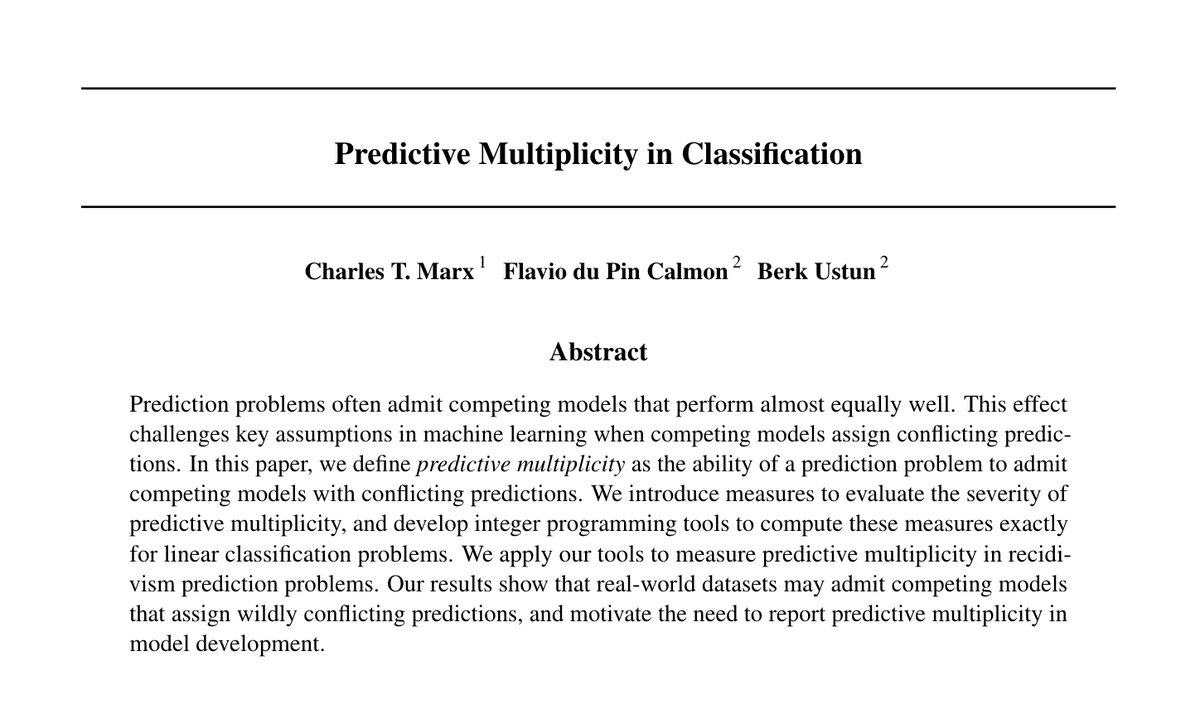
Denied parole by an ML model? The next best model might have decided otherwise
In our #ICML20 paper w @berkustun@FlavioCalmon, we study the ability for an ML problem to admit competing models with conflicting predictions, which we call "predictive multiplicity"
THREAD ⬇️
I want to offer some unsolicited advice to computer vision researchers jumping into robotics. Don't focus too much on VLMs, VLAs etc. That's fine, but the real action is at the sensorimotor level. Most of the open problems in robotics are in manipulation, which is about hand-object interaction, and contacts and forces are central. Proprioception and tactile sensing are as important as vision. Don't get seduced by cherry-picked demos. You can't do robotics without doing robotics.
I think it’s pretty clear that simulation is the next frontier for AI.
The most impressive feats of AI to date are when we have a clear environment + reward, whether it be beating Le Sedol at Go, winning an IMO gold medal, or writing entire apps from scratch. In these cases, the RL algorithm can try different actions, and observe the well-defined consequences in the safety of a docker container.
But what about messy real-world situations involving people? The rewards are unclear, the stakes are high, and you can’t experiment in the real world. But these situations are precisely where the next big opportunity in AI is. To crack this, we need to *simulate* society (“put society into a docker container”). Concretely, this means building a model that can predict what will happen in any given situation (real or hypothetical). If we can do this, we are only limited by our imagination: predict the future, optimize for better outcomes, answer hypothetical (“what if”) questions. Ultimately, this goes beyond making better decisions, but it’s about giving us a better understanding of ourselves and the world.
Simulation is the whole enchilada. And this is exactly the research that @simile_ai is working on. Read more here:
https://t.co/eBMW2beHdT
Tired of chasing references across dozens of papers? This monograph distills it all: the principles, intuition, and math behind diffusion models. Thrilled to share!
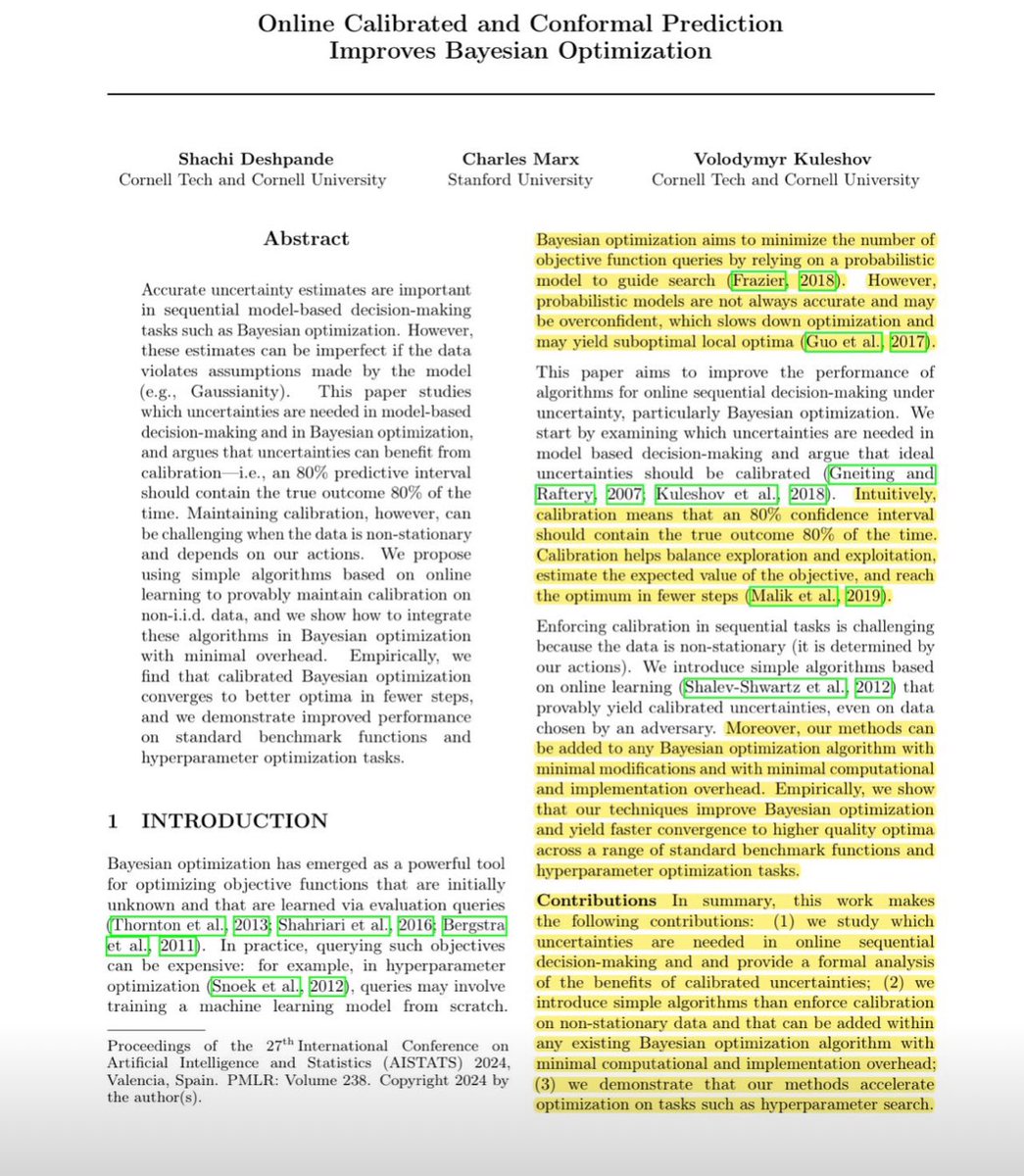
I have been talking for years in multiple LinkedIn about significant benefits of calibration. It is interesting to see a new paper “Online Calibrated and Conformal Prediction Improves Bayesian Optimization” from Cornell University and Stanford University by @ShachiDeshpande, @CharlieTMarx and @volokuleshov looking at calibration in the Bayesian optimisation domain.
Very interesting results:
1) same as in classifier calibration relying on unrealistic assumptions such as normality can result in inaccurate and overconfident probabilistic models which slows down optimisation and may result in incorrect local optima. The paper provides formal analysis on the benefits of calibration in optimisation setting.
2) conformal prediction based method that can be added to any Bayesian optimisation technique to improve optimisation via faster quality convergence.
These findings are in line with papers I have shared previously, see Amazon Science paper “Optimizing Hyperparameters with Conformal Quantile Regression”
Conformal prediction can significantly improve optimisation methods and is an interesting research domain.
#conformalprediction #optimisation
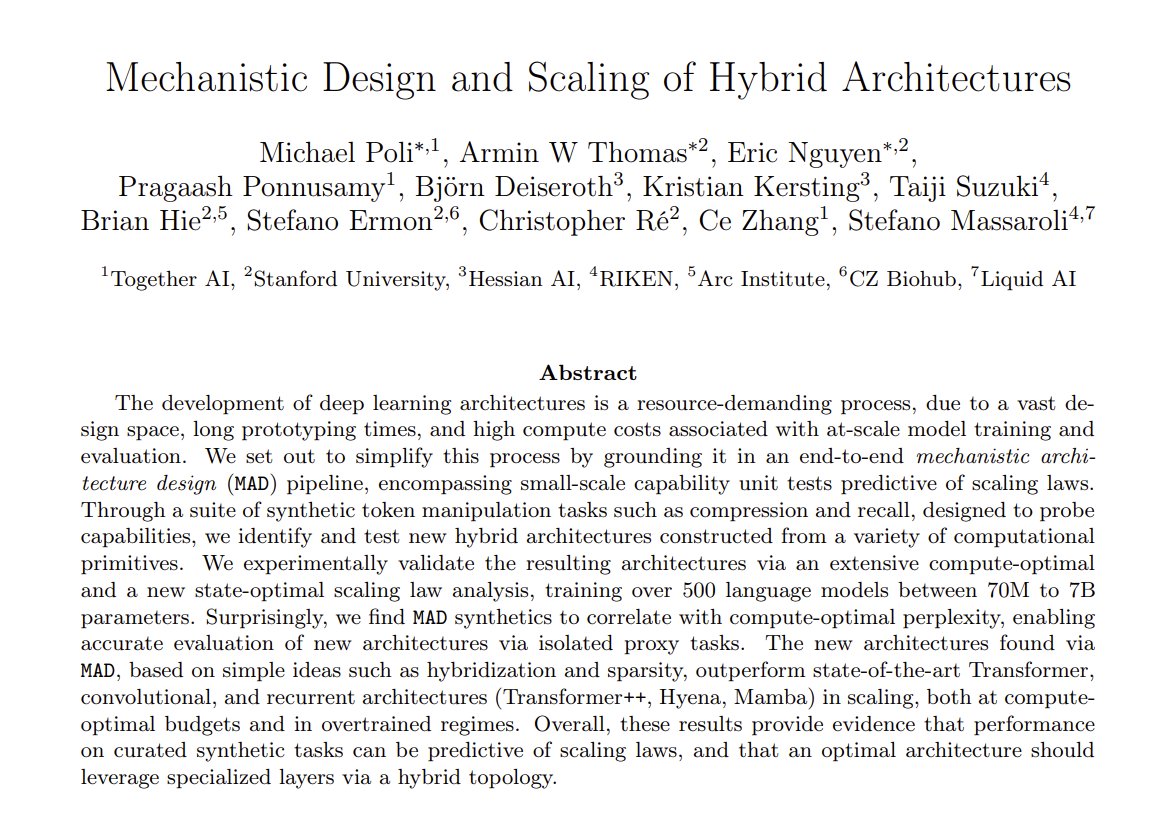
📢New research on mechanistic architecture design and scaling laws.
- We perform the largest scaling laws analysis (500+ models, up to 7B) of beyond Transformer architectures to date
- For the first time, we show that architecture performance on a set of isolated token manipulation tasks is correlated with metrics of interest at scale, such as compute-optimal loss. Say hello to fast architecture improvement!
- Striped architectures consistently outperform homogeneous architectures, as they benefit from specialization of each layer type to particular subtasks
An avalanche of other findings in the paper:
📝Paper: https://t.co/mtZ2HVSpv9
🖥️Repo: https://t.co/7mt1GogBgQ
Personalized models should let users consent to the use of their personal information!
In our latest, we describe how to build models that let users consent to the use of group attributes like sex, age, race, HIV status
Spotlight Poster @NeurIPSConf: Tues 10:45-12:45 PM
Link: https://t.co/GpEGImBjeT
Thread 👇
📢 Diffusion models (DM) generate samples from noise distribution, but for tasks such as image-to-image translation, one side is no longer noise. We present Denoising Diffusion Bridge Models, a simple and scalable extension to DMs suitable for distribution translation problems.
A founder of FAT/ML, Sorelle Friedler (@kdphd) led key OSTP efforts that placed equity, rights, and innovation TOGETHER at the center of tech policy, and illuminated the potential of automated science. Thank you for your incredible service! https://t.co/r2r3yL9ZNq #AIBillofRights
@unsorsodicorda Hi Andrea! More than happy to chat -- still figuring out how https://t.co/phloDytMGM works so also feel free to DM me or shoot me an email to find a time. :)
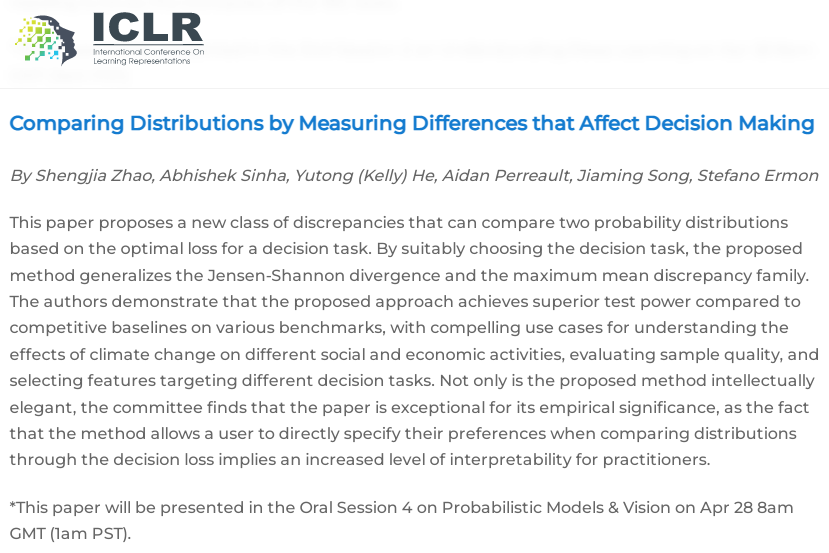
Thrilled to share that our paper "Comparing Distributions by Measuring Differences that Affect Decision Making" wins #ICLR2022 Outstanding Paper Award🎉https://t.co/OsqNJzoutx
Congratulations to my awesome students @shengjia_zhao@a7b2_3@electronickale Aidan @baaadas👏
The secret heart of academia is... Wikipedia.
In an experiment, this paper found that a single quality Wikipedia article written by chemistry experts influenced the content of 250 published peer-reviewed academic papers! Articles referenced in Wikipedia also become more cited.