Presenting✨CLIPT✨(Complex I induced protein turnover), a novel form of #mitochondria protein regulation! Thru CLIPT, Complex I impairment stabilizes the mitochondrial calcium uniporter to compensate & preserve bioenergetics. Out now @NatureComms https://t.co/jd85ybZBHC A🧵 1/10
Congratulations to Dr. Jennifer Ho on her promotion to Professor of Medicine @harvardmed! As Director of Research in our Division of Cardiovascular Medicine, she has been instrumental in empowering collaborative research to advance cardiovascular health 🌟
https://t.co/pLhRpdIfyq
What's especially cool is that the flagellar motor exploits the indivisibility of 5 by 2 to run on a fuel of rising entropy as protons diffuse into cells. For me as a physics and math person, this is biology at its best. https://t.co/TBAP5H3vR3
Innate immune mechanisms that bacteria evolved billions of years ago — cGAS-STING, gasdermins — are still operating, nearly unchanged, in human cells. Great piece by @vcallier in @QuantaMagazine unpacking how. Two thoughts struck me while reading:
And these systems aren't uniformly expressed across tissues. Hepatocytes lack STING entirely — a gap hepatitis B exploits to evade detection. The "ancient weapons" of innate immunity are deployed very differently depending on where you look.
Years in the making: a detailed aging gene signature in mice and rats. >30 tissues, high Ns, multi-time points throughout the lifespan. >5000 samples in total. The data is accessible, so you check to see if your favorite gene is age-regulated.
https://t.co/5heN6ixvt1
Presenting a short talk at the @KeystoneSymp MASH meeting on our work on EFHD1 and how a pathway your liver normally uses to fight viruses ends up driving liver injury in MASH
Thanks to organizers @dnachicken, @PajvaniLab & Ariel Feldstein!
#MASH#LiverDisease#KeystoneSymposia
This is an impressive study but not for the reasons most are discussing about.
This is a beautiful example of a pharmacogenomics study.
- A GWAS of drug response in individuals taking GLP1R agonists reveals a strong signal emerging from the very target of the drug itself--GLP1R
- A GWAS of drug response in those taking GLP1R + GIPR agonists reveal second signal in GIPR!
- A GWAS of drug adverse effects (nausea and vomiting) reveal a super strong signal near GLP1R
Some might say that these are expected, but that's not true. You don't often see such clear findings pinpointing the molecular target of the drug.
These findings validate the mechanism of action of the drug's main effect (weight loss) and adverse effects (nausea and vomiting). And importantly make the case of genetics as a valuable tool to understand molecular targets of drugs. Imagine doing this study when knowing nothing about the mechanism of the drug (that'd be groundbreaking)
This also stands as a proof of concept for continuing pharmacogenomic studies to understand other genes and pathways involved in GLP1R agonists effects.
Then there's a question about how useful this finding is for treating patients, which, as many pointed out, is not that useful. It's a common variant with a tiny effect size, which becomes irrelevant when compared to the main effect of the drug on weight loss. Knowing whether you have this variant has no use; you'll lose weight no matter whether you are a carrier or not.
In future work, it'll be interesting to see how carriers of loss of function variants in GLP1R experience weight loss, particularly the knockouts (if those exist)
Then there is one other perspective that makes this study extremely interesting. I've discussed this previously (https://t.co/Ei6hpa6UHS)
Despite the extraordinary effect GLP1R agonists have on weight loss, there is minimal genetic evidence linking GLP1R gene and obesity. If you try hard, you might find GWAS signals near GLP1R for BMI or related traits, but none of them are convincing. There are are no rare variant signals linking GLP1R with BMI. In other words, just genetics alone could have never ever led to the development of the miracle obesity drug that is GLP1R agonist.
This disconnect between genetics and drug effect highlights a bottleneck of using genetics for drug discovery.
Many of the drugs today act by inhibiting proteins or their gene expression in which case modeling them using genetics is easy. Individuals carrying homozygous loss of function variants serve as natural experiments to predict the maximal efficacy one can achieve by inhibiting the protein.
On the other side, the using genetics to model drugs that activate proteins is tricky. There is no limit to how much you can agonize a protein pharmacologically, but modeling such supraphysiological activation using genetics is difficult as genetic variants leading to such extreme activation are non-existent or extremely rare.
GLP1 is perfect example. Physiological levels and half life of GLP1 is extremely low. But GLP1 analogues are designed to extremely high levels (1000x) and high half life (hrs to days vs minutes). Naturally occurring variations in GLP1 receptors cannot mimic that level of activation, hence we don't we see genetic variations in GLP1R with dramatic effects on BMI.
However, GLP1R genetic variations start to express once the physiological limits of GLP1 concentrations are exceeded, which is what we see in the current pharmacogenomic study. The missense variant that the authors identify seem to have no association with BMI but it has strong association with weight loss, nausea and vomiting that humans experience in response to GLP1R agonists. That's a beautiful illustration of GxE interaction where G expresses in the right environment.
Hopefully, there will be more such studies in larger sample size will happen soon, which will reveal even more interesting genes and pathways that GLP1 touches in our body.
Thanks to @JamesCFangMD & the @NEH_CVRTI for hosting the annual Matthew A. "Matty" Movsesian Memorial Lecture this afternoon & to @patrick_ellinor for delivering a talk on AFib. Matty devoted his career as a physician-scientist to cardiology research and I'm grateful his legacy can continue this way.
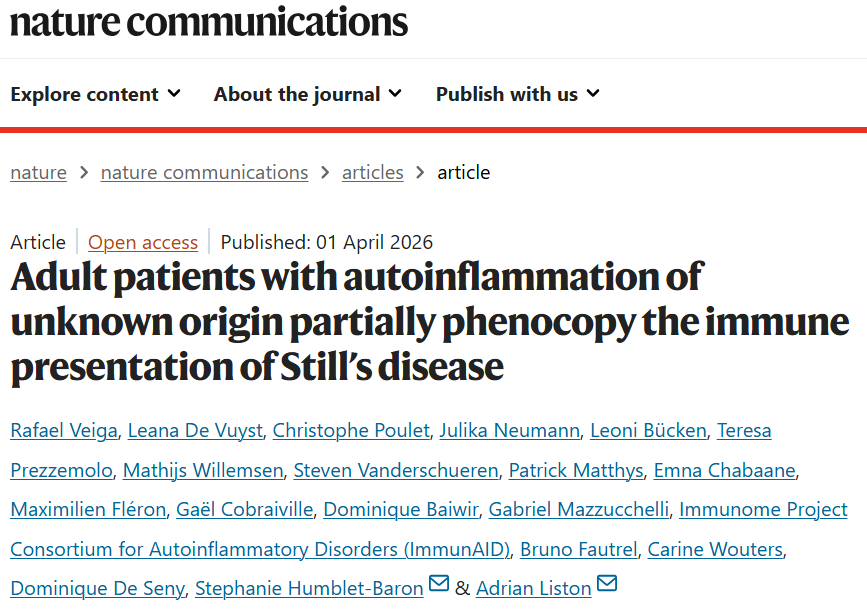
We have a new story out at @NatureComms! This time our lab tackled the enigmatic "autoinflammation of unknown origin". These #autoinflammatory patients don't fit the classical criteria. It wasn't even clear they were a single group, to be honest
https://t.co/nlqqGywrnt
Great visit to the Moss Heart Center @UTSWMedCenter yesterday — grateful to @AmandaTong2013 for the invitation and for being such a generous host. Wonderful to discuss our work on mitochondrial physiology in the heart and liver with an outstanding group of scientists.
We are thrilled to announce that Dipayan Chaudhuri, MD, PhD, has been appointed Section Chief of General Cardiology! A dedicated physician-scientist and leader, Dr. Chaudhuri will guide the section’s next phase of growth in clinical care and research. @UofUInternalMed@NEH_CVRTI