Diagnosis of primary CNS lymphoma through molecular and immune biomarkers in cerebrospinal fluid (PRICELUS): a multicentre, prospective, cohort study - The Lancet Haematology https://t.co/klJbWpMKBD
What if the key to CAR-T success is not simply how many cells expand, but how fast they move?
In patients with diffuse large B-cell lymphoma treated with CD19 CAR-T therapy, investigators found that the velocity of lymphocyte expansion early after infusion was one of the strongest predictors of long-term outcomes. Patients whose lymphocytes expanded rapidly had deeper responses, more durable remissions, and significantly longer overall survival.
Interestingly, the total number of lymphocytes or peak expansion mattered far less than the replication rate itself.
There was a tradeoff: faster expansion was also associated with higher rates of cytokine release syndrome and more frequent tocilizumab use. But those same patients experienced markedly improved survival, with median overall survival exceeding 3 years.
This study reframes how we think about CAR-T biology. The critical question may not be how big the immune response becomes, but how quickly the immune system accelerates after infusion.
https://t.co/NjphZXIxMM
There are 2 types of DLBCL who relapse in CNS
MCD
MYC-R
Thats why all trials will be negative.
What I would do?
IBTK for all MCD
IT + HDMTX for MYC-R
https://t.co/puQOx4mTk8
@AshAlizadeh Can’t compare to this curve but did treat a lady with concurrent high grade ovarian carcinoma and Anaplastic ALK+ DLBCL with Lorlatinib Carbo Taxol and she has been in remission for almost a year so far! 🤞🏽🤞🏽🤞🏽
Deepak is one of my best friends and so passionate about GI onc! He will be a great mentor and likely a life coach for you (as he is for me!) @HemOncFellows@HemOncWomenDocs
We’re hiring at our expanding cancer program at #christianacare. If you’re attending #ASCO26 please reach out to me or @SchwaabieMD to connect about opportunities. Look forward to seeing everyone in Chicago.
UMMC is growing, and Dr. Das will be a great and supporting mentor. Plus, I was recently in Jackson, MS and it’s such a nice “big little city” with one of the best children’s playgrounds I have seen (yes, that’s how I judge cities now). @HemOncWomenDocs@HemOncFellows
So excited to head to #ASCO26@ASCO
Flights running late but hoping to make it in time for the first panel! 😅
Looking forward to
📍 Connecting and networking with colleagues and friends 😍🎉
📍excited about #lcsm presentations 🫁
📍 We are hiring - so reach out to learn more about opportunities! 💪🏼
I used to be a vocal skeptic of Hans and a key GEP fan, some say as an OG for GEP. I used to lament Hans IHC as the only tool available for my patients, when many trials used GEP instead.
But I have been surprised by learning how IHC has dramatically improved over the last decade or so with availability of standardized antibody clones, use of auto strainers, and interpretation consistency.
How was I convinced?
We did a systematic meta-analysis of >2200 patients from 19 studies. We used the PRISMA diagnostic test accuracy framework for comparing Hans to GEP.
https://t.co/qHJvtE7aFQ
Remarkably, this analysis now clearly shows that Hans is consistently non-inferior to GEP across current modern studies at a 10% NI margin for Accuracy, Precision, and Specificity.
This solid performance of Hans IHC is very much in line with current CAP benchmarks for diagnostic tests, and within the margins of NanoString GEP using FFPE vs original frozen GEP as the original elusive gold standard.
Long live Hans as the best currently available SOC for COO across the globe.
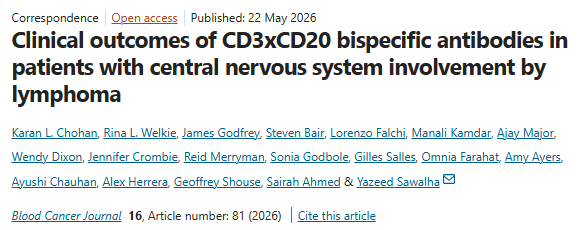
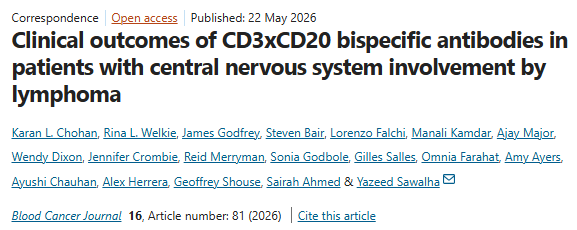
Our @CULymphoma program is a member of the Collaborative U.S. Bispecific Consortium (CUBIC), an ongoing multicenter center of real-world outcomes of bispecific antibodies in various lymphoma subtypes.
Our latest collaborative paper has been published @BloodCancerJnl. #lymsm
How are clinical trial leaders picked?
No one can or will hand you a principal investigator role on a platter. You have to work for it.
Some things you can do if you are interested in leading a clinical
trial.
1) Become a disease expert. Really understand the disease well. When you speak or write colleagues should recognize your talent and depth. The more you speak and write the more you will be noticed and sought out. Social media helps raise your visibility but it has no value if others think you are superficial. You must be credible. This is the most important step. There are no short cuts except to really understand the disease, what is known, and what remains to be known. It’s hard work.
2) Volunteer to be co-investigators on trials and help with trial design, development, and accrual.
3) Network. Most senior investigators will be more than happy to help you succeed.
4) Study trial protocols in depth to understand the elements and how it’s formatted. Better still write out protocol concepts and protocols. Clinical trial workshops help. There is an awful lot of detail.
5) Identify important questions that others are not thinking of. The question should be original, authentic, and important. If you have a great question, and you are credible, you are on your way to leading a trial. (The process from that point on is still very long and arduous — see second tweet in thread. But you have made it to being the PI).
Clinical trial leadership is not transferable. When you are asked to be a lead investigator it’s not in your power to hand it over. If you don’t want it, that spot will go to the next most credible person not the one you anoint. As it should be.
@drsairahahmed@UTMDAnderson There has also been a large multi center study of Glofit in PCNSL from China. Our study was largely post CAR-T but the cohort from China had 2 fatal ICANS when Glofit was sequenced pre-CAR-T so caution to be exercised there.
Functionomics in DLBCL 🏃♀️💪
Do you treat older pts with DLBCL?
If so, please consider taking this survey- https://t.co/GLuGveGlwv
15 min of your time will help us understand if/how fitness is being incorporated in decision making. 🙏
#geriheme#gerionc#lymsm