Astrophysicist | Postdoctoral Fellow @VanderbiltU | Black holes, gravitational waves, A.I. @LIGO I Enjoys sci-comm, reading, listening to rock & jazz music.
Thanks to @VanderbiltU for publishing a news article about two of my recent papers with @AstroKPJ! It was an exciting and rewarding project to work on and I am thrilled to keep developing this work further! 🙂
https://t.co/eSKzULB5hl
It is my distinct honor to invite the scientific community on behalf of Johns Hopkins Applied Physics Laboratory (APL) and the Vanderbilt University Lunar Labs Initiative to the International LILA Meeting, to be held 13–14 November 2025 at APL, Laurel, Maryland, USA.
This meeting continues community discussions on the Laser Interferometer Lunar Antenna (LILA) project - a proposed detector on the lunar surface to measure gravitational waves in the mid-band between ground-based detectors LIGO–Virgo–KAGRA and the future space mission LISA. The primary foci of this workshop will be on defining the science goals, instrument implementation, deployment timeline, and establishing the formal consortium structure for LILA.
Sessions will include series of talks and panels from experts in multi-messenger astrophysics, lunar geoscience, and aerospace industry.
This is the fifth annual meeting in the Lunar GW Workshop series, following Belle-Île-en-Mer, France (2024), Nashville, USA (2023), Bern, Switzerland (2022) and Cascina, Italy (2021).
Registration open till November 1, 2025:
https://t.co/cI5DIFYwcg
Last Sunday was the 10th anniversary of our first #GravitationalWave detection!
Join us for a thread of celebratory cakes enjoyed by members of our collaboration
First, a cake from @ARC_OzGRav Looks like plenty to share?
🖼️: J Powell (@JadePowell12)
🧵🎂 #GW10Years
Results from the first part of our fourth LIGO @ego_virgo@KAGRA_PR observing run are out today!
We're pleased to share the largest catalog of gravitational-wave observations with more discoveries of black holes and neutron stars
📰 https://t.co/CNNFSO0AxS
#O4IsHere#GWTC4
Excited to see @newscientist feature the Laser Interferometer Lunar Antenna (LILA) — a project I lead as Principal Investigator — in their story on how the lunar surface could transform our ability to study black holes and listen to the universe.
https://t.co/ekrAmh5XCH
No Glitch in the Matrix: Advancing AI for Gravitational-Wave Discovery and Fundamental Physics
Pleased to share my group’s latest research on applying deep learning transformers to detect gravitational waves from black holes and test Einstein’s General Relativity, now published in The Astrophysical Journal!
This study, led by postdoctoral fellow Dr. @ChayanChirps, represents a significant step forward in integrating modern AI methodologies with data-analysis for the LIGO experiment. It also marks our group's *fourth publication in the past nine months* on AI-driven astrophysical research, with three appearing in The Astrophysical Journal!
This work is part of the the 'AI For New Messengers' program at Vanderbilt University which I co-founded with Prof. @jbspence. Our goal is to build a foundational AI model that will gain insights into the very nature of space-time through various messengers of the Universe (electromagnetic, gravitational-wave, neutrinos, cosmic rays). You can learn more about the program here: https://t.co/qXXOZizLBa
Open access to the paper: https://t.co/G11y9B8xX3
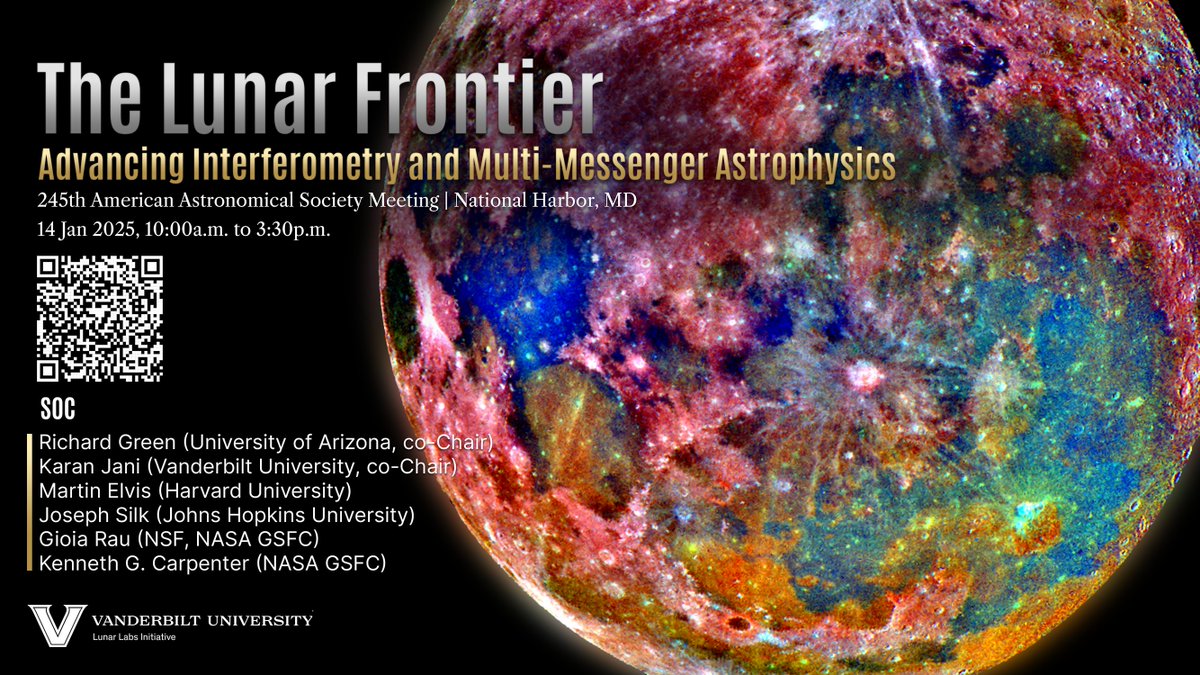
Join us next Tuesday at the American Astronomical Society Meeting in MD/DC for a full day event on Multi-messenger Astrophysics from the Moon!
We have great line up of speakers and panelists from NASA, academia, government and industry:
https://t.co/IMItgCbYTT
Presenting GW data analysis using foundational AI! The preprint shows how breakthroughs in AI/ML research on unrelated domains can help advance GW astronomy.
Privileged to have led this study with incredible mentors @AstroKPJ, @jbspence and some wonderful postdocs and students!
Newest study from the Jani Lab @VanderbiltU in collaboration with the @VUDataScience Institute.
We demonstrate for the first time that open source large language models, specifically @OpenAI’s Whisper trained on 680,000 hours of audio data, can remarkably interpret the ripples on the space-time fabric.
This is the most direct application of emerging Generative AI towards Einstein’s General Theory of Relativity - bridging scientific revolutions spread over a century.
Like learning the nuances and multiple tasks within a human language (poetry, prose, metaphors), we find that our foundational AI model GW-Whisper learns the “grammar” of gravitational waves. This initial model can detect all kinds of black holes in the @LIGO data and can discard detector noise that mimic cosmic ‘sounds’
The work lays the foundation for a single AI tool that will perform end to end gravitational-wave astrophysics this decade, and perhaps one day pave the way in our search for a theory beyond Einstein’s.
This was a multi-year effort from a dream team - Postdocs Dr. @ChayanChirps, Dr. Petulante, DSI director Prof. @jbspence, cohort of incredible DSI students and PhD student Suyash.
The preprint is now available at https://t.co/qrefwd70gy
Can large transformer models, trained on human speech data, be applied for detecting ripples in spacetime? We show that @OpenAI's Whisper can get the job done!
@FiPanther@PotatoAsad@FiPanther I have been thinking about the exact same thing! We have an expected BNS merger rate from the beginning of O4, does the non-detection of any BNS events so far imply the likelihood of observing one is going to increase as we move closer to the end of O4?
Congratulations to @VUArtSci's John Jumper, BS’07, who has been awarded the @NobelPrize in Chemistry for his groundbreaking work on protein structure prediction! 🎉
This year’s physics laureates’ breakthroughs stand on the foundations of physical science. They have showed a completely new way for us to use computers to aid and to guide us to tackle many of the
challenges our society face.
Thanks to their work humanity now has a new item in its toolbox, which we can choose to use for good purposes. Machine learning based on artificial neural networks is currently revolutionising science, engineering and daily life.
The field is already on its way to enable breakthroughs toward building a sustainable society, such as identifying new functional materials. How deep learning by artificial neural networks will be used in the future depends on how we humans choose to use these incredibly potent tools, already present in many aspects of our lives.
#NobelPrize
🎉 If you missed last night's announcement, we’re over the moon to share that Professor Matthew Bailes has been awarded the 2024 Prime Minister’s Prize for Science! ✨
Join us in celebrating this incredible achievement! 👏
Read more here: https://t.co/jCU0O6EZOn
#PMPrizes
@VanderbiltU just published a news article about two of my recent papers with @AstroKPJ! It was an exciting and rewarding project to work on, and I'm thrilled to keep developing this work further 🙂
https://t.co/eSKzULBD6T
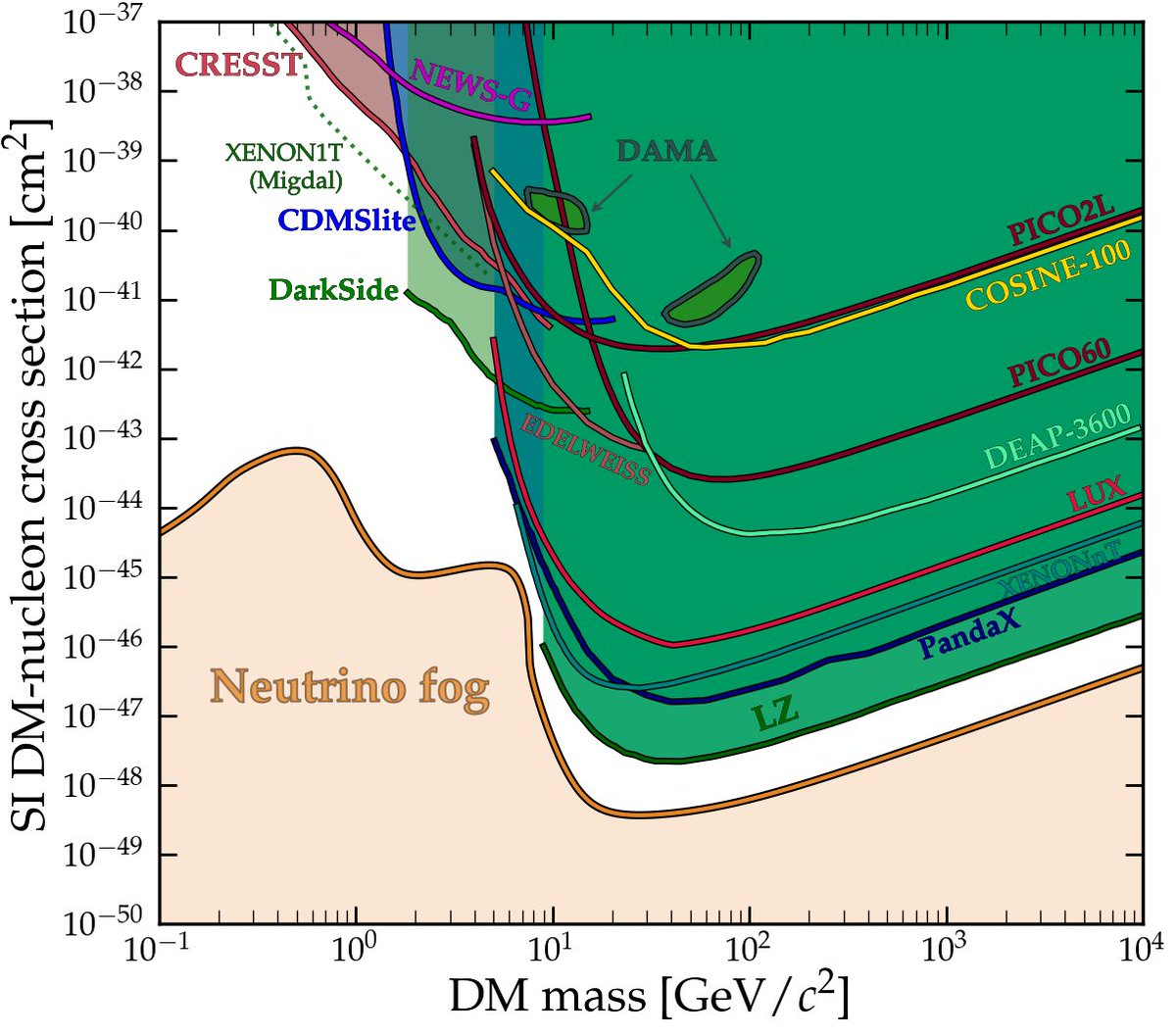
Congratulations to @lzdarkmatter on their huge advance in the search for WIMP dark matter... very little white space left before we hit the neutrino fog!
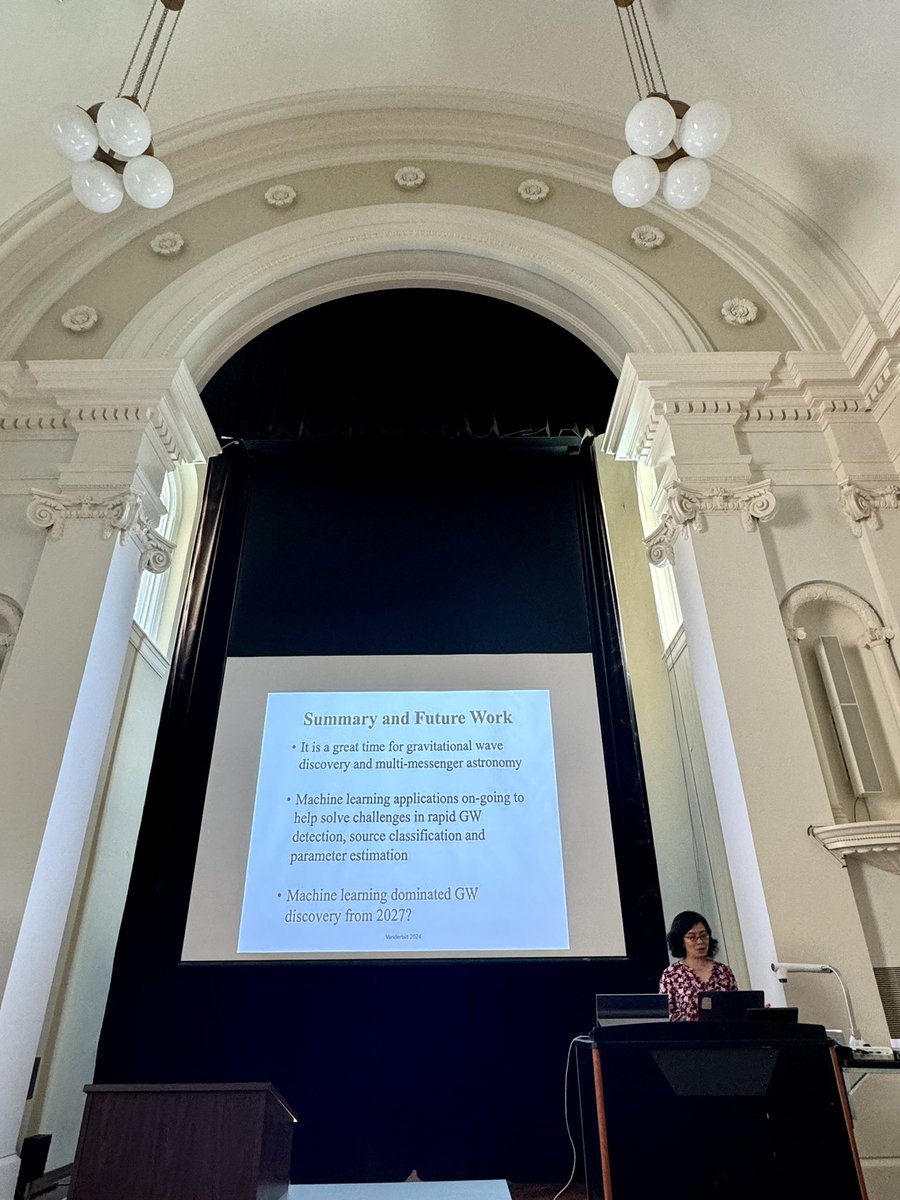
Very happy to announce the new ‘DSI-LIGO Seminar’ series hosted by @VUDataScience & LIGO group at @VanderbiltU.
It will showcase foundational ML/AI research in gravitational waves.
Our inaugural speaker is Prof Linqing Wen from the University of Western Australia.
@VU_Provost