Every day, ships leave this russian owned factory in Ireland straight for St Petersburg carrying thousands of tonnes of raw alumina for the war machine.
There’s corruption everywhere. Locals tell me politicians are bought by oligarchs.
Ireland is no longer militarily neutral.
A historic video showing a russian multiple rocket launcher Grad firing at the positions of the Armed Forces of Ukraine, while another is firing exactly in the opposite direction, at Donetsk.
And there's your answer to the question of who "bombed Donbass for eight years."
I strongly believe there are entire companies right now under heavy AI psychosis and its impossible to have rational conversations about it with them. I can't name any specific people because they include personal friends I deeply respect, but I worry about how this plays out.
I lived through the great MTBF vs MTTR (mean-time-between-failure vs. mean-time-to-recovery) reckoning of infrastructure during the transition to cloud and cloud automation. All those arguments are rearing their ugly heads again but now its... the whole software development industry (maybe the whole world, really).
It's frightening, because the psychosis folks operate under an almost absolute "MTTR is all you need" mentality: "its fine to ship bugs because the agents will fix them so quickly and at a scale humans can't do!" We learned in infrastructure that MTTR is great but you can't yeet resilient systems entirely.
The main issue is I don't even know how to bring this up to people I know personally, because bringing this topic up leads to immediately dismissals like "no no, it has full test coverage" or "bug reports are going down" or something, which just don't paint the whole picture.
We already learned this lesson once in infrastructure: you can automate yourself into a very resilient catastrophe machine. Systems can appear healthy by local metrics while globally becoming incomprehensible. Bug reports can go down while latent risk explodes. Test coverage can rise while semantic understanding falls. Changes happens so fast that nobody notices the underlying architecture decaying.
I worry.
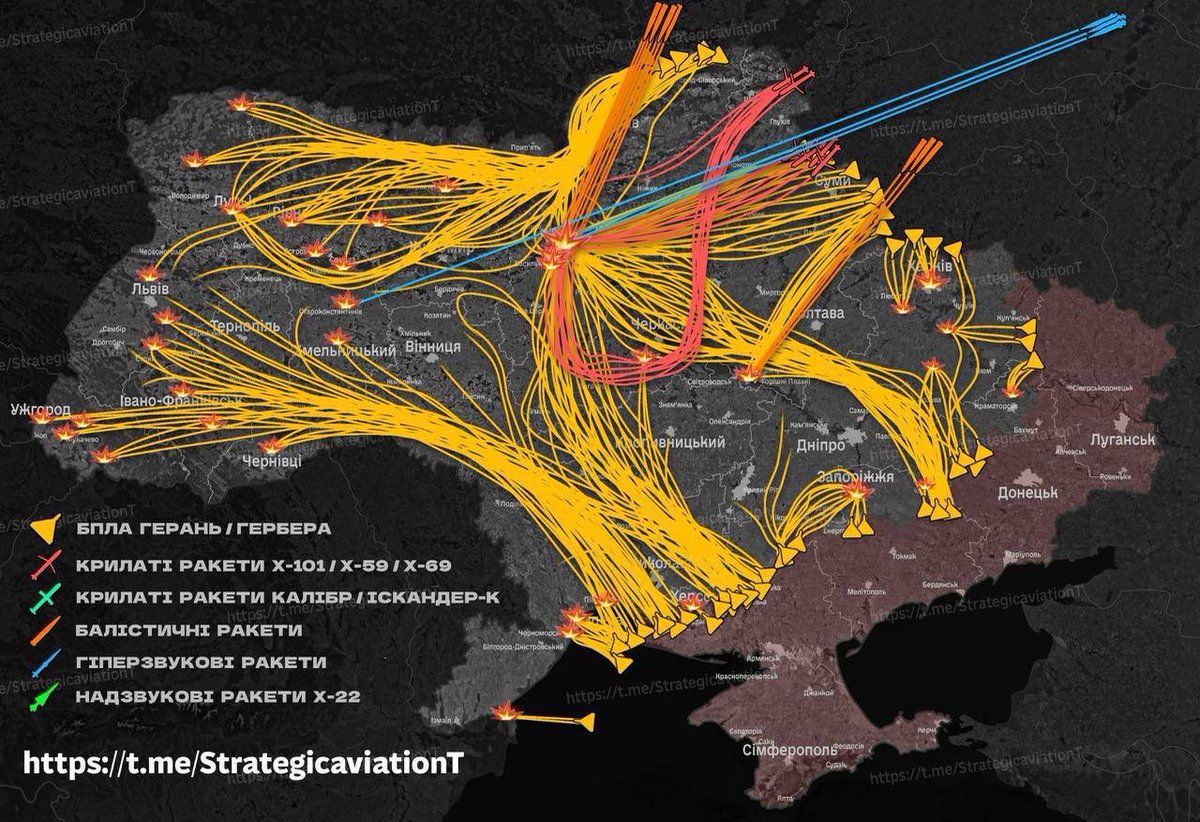
A knitting pattern?
No. These are the attack routes of approximately 1,600 Russian drones and missiles within a 24-hour period.
For over four years, Ukraine has been defending Europe—alone—against the Russian murderers.
I’m not anti-AI.
I like MRI machines. I like collision avoidance systems in airplanes. I like software that can detect cancer before a doctor can. I like machine vision systems that stop factory workers from getting their hands crushed in hydraulic presses.
That’s what computers are supposed to do.
Cold. Precise. Mechanical.
I don’t need a technology to “express itself.”
The problem started when Silicon Valley decided the machine should paint. The machine should write poetry. The machine should compose symphonies and generate films and imitate the human soul like a skinwalker wearing a beret.
Now every ad, every song, every image online has this faint chemical aftertaste to it. Like the entire culture is being slowly replaced with synthetic substitutes because executives realized audiences consume slop at the same rate they consume art.
And the worst part is they call this “democratizing creativity.”
No. Creativity was already democratized. A guy with a guitar and 3 friends in a garage could make something beautiful. A college kid with a cracked copy of Photoshop could make an album cover that changed someone’s life.
What they actually democratized was content production.
Factories. Throughput. Infinite generation.
A machine can diagnose my low testosterone. Fine.
I just don’t want it writing the eulogy.
Mariupol was a city of half a million people that was systematically erased.
The Uppsala Conflict Data Program high estimate sits at 88k deaths in under three months.
We must acknowledge that this single Russian operation likely claimed more lives than the whole war in Gaza
My students asked me if it was true that the entire Internet was really coded by hand. All those kernels, protocols, router firmware, browsers, databases, etc. Somebody coded these and debugged them by hand?!?!? They used BBEdit?!?!??! The idea that this was even possible seems amazing to them. I can imagine some future Moon Landing like conspiracy theory that says it never happened.
Why is the AI backlash growing?
Outside of coding (where there is clear value), and a handful of other domains (e.g. brainstorming), Generative AI has been a net negative for society.
GenAI has been undermining secondary and college education, opening up mass surveillance, increasing disinformation, delusions, impersonation, phishing, and other forms of cybercrime, nonconsensual deep fake porn, bias in employment and other domains, and economic disparity, drowning the world in slop and unwanted, over-leveraged environment-damaging data centers that risk causing a recession.
Simultaneously it has empowered a bunch of people who want to privatize almost all the gains while leave all the downsides to society, taking almost zero responsibility.
I don’t think we are better off than we were four years ago.
Some of this is technical (LLMs aren’t reliable), some of it is political/economic (such as the utter lack of responsible regulation). Most of this was predictable.
Almost none of it is good.
All that said, I honestly believes some future form of AI might be great. But Generative AI has hurt more than it has helped, and been managed irresponsibly.
It’s no wonder many people have had enough.
This is why.
When some russian in a hotel asks me why I do not want to talk to him, when some European asks me why I am not "tolerant" – the answer is in this photo.
There are thousands of such kids in Ukraine whose parents were killed simply because russians followed their crazy tsar instead of stopping him.
The russian army is 2.4 million. Most of them have been to Ukraine. The police is about 1 million. There are also smaller forces – FSB (200 thousand), National Guard (340 thousand) and others. So we are already at more than four million people involved.
And then count those who work as subcontractors for the army. Those who work in weapons factories. Count the government and everyone working for it. You get every 10th adult russian working for the war. 30% of russia's budget is spent on it.
This is not "Putin's war," this is "every russian's war."
So when I meet a russian man in some hotel, I know there is a 10% chance he is directly involved. And the remaining 90% support it –
by action or inaction.
So how should I treat them?
If he wants a conversation, he should start by asking for forgiveness and condemning their army and their regime. In all other cases, I won't even talk to such a person.
Search is full of ads and wrong answers. Every other email is an ad. Prime Video charges you and shows ads. Paramount? Ads. Peacock? YouTube? Hulu? Ads followed by more ads. Netflix full of ads. Meta and X, every other thing is an ad. Pinterest is nothing but ads. AI is in everything. AI finishes sentences incorrectly and won’t stop. AI reads your email and search history to target you with more ads. Every time you open an app or visit a site there’s an update making it worse. In a hurry? First, click here to agree to terms you don’t have time to read and must accept. You need an account to do that. Change your temporary password. Enter your 2FA code. Check your email and enter that code. Now use a passkey. Your password is too simple to remember. Change it. No, not like that. Now log on. Enter your 2FA code. Check your email for a code… Welcome back! We’ve updated our terms of service and privacy policy (you have none). Subscribe to the site. Subscribe to Netflix. Subscribe to toilet paper. Subscribe to these groceries. Pay a membership fee for the right to subscribe then tip your driver who delivers the subscriptions your membership lets you subscribe to. Time to work? We’ve got to update your laptop and will slow down everything you do until you agree to update. But first, click here to agree. Update installed — your laptop’s broken now. It doesn’t matter, since your boss just replaced you with AI. Go to your phone to complain on social media. Wait, your phone needs an update so we can add more AI. Click here. Oh sorry, your phone can’t handle this update. Now it’s useless. Go get the newest phone. Here’s a text from a friend, an email, a voice mail they left three days ago but you didn’t see until now because of sync problems with the cloud. It’s their GoFundMe. Their MLM. Their Patreon. Never mind, you didn’t respond to their text within 9 minutes and now you’re no longer friends. They blocked you. Make new friends. Download this app to find people in your area. In your neighborhood. On your street. Two doors down from you. Do you know this person yet, we think you’d get along. You need an account to use this app. That username is taken. Enter a password. Not that one, you used it on another site. You need to be connected to WiFi to download the app. Allow the app to connect to other devices on your network. Allow the app to access your contacts, know your precise location, store your credit card details. Oops, sorry, we got hacked now all that info is available on the web. There’s a class action suit. You can join. It’ll take a decade to get your $3.73 share of the ten billion settlement. We’ll send it via PayPal or deposit it to your bank, just tell us those details. Oh no, another hack. That info is circulating now, too. Here’s a spam call, a spam email, a spam text. Why are you angry? Why are you talking about getting rid of your phone? Why don’t you like AI, it lets us make all of this easier? Do you know how ridiculous that sounds? This is progress. You’ll be left behind. Do you want to be left behind? Do you???
A fundamental division between schools of thought in programming is (a) the elimination through simplifying of cruft, boilerplate, and extra abstraction layers, and (b) the automation of maintaining cruft, boilerplate, and extra abstraction layers.
One of the reasons I drifted away from C++ and newer languages with adjacent philosophies towards a subset of C is that I found myself in the first camp. Some problems were simply not as hard as I was making them. Memory management, threading, UI, and so on could be simplified such that not only the high level C code became simple, but the actual machine code also became simple.
This is starkly different from modern C++ and Rust programming culture, where the philosophy is simply that dealing with the complicated lower level details is a matter of *automation*. The compiler needs to generate something extra, it needs to check extra things, and so on.
“Agentic programming” falls into the latter camp, and this is also why I don’t employ it in my workflow (other than search engine usage and so on). I don’t need it to generate 10s of 1000s of lines of code. The requirement of 10s of 1000s of lines of code—for implementing something derived from the information content inside a tiny prompt—is an architectural red flag.
Perhaps a substantial portion of that code simply shouldn’t exist. I find that my programs become much better when I do that simplification pass first. After that, there’s drastically less boilerplate, less maintenance, and less busywork to begin with.
If you don't understand this, you will not understand why LLM-based agents are irreparably failing for a general-purpose problem solving.
An agent (by the way it was the topic of my PhD 20 years ago) to be useful, must be rational. Being rational means to always prefer an outcome that results in the maximal expected utility to its master/user.
Let’s say an agent has two actions they can execute in an environment: a_1 and a_2.
If the agent can predict that a_1 gives its user an expected utility of 10, and a_2 gives an expected utility of -100, then a rational agent must choose a_1 even if choosing a_2 seems like a better option when explained in words. The numbers 10 and -100 can be obtained by summing the products of all possible outcomes for each action and their likelihoods.
Now here is the problem with LLM-based agents.
The LLM is not optimizing expected utility in the environment. It is optimizing the next token, conditioned on a prompt, a context window, and a training distribution full of examples of what helpful answers are supposed to look like.
Those are not the same objective.
So when we wrap an LLM in a loop and call it an “agent,” we have not created a rational decision-maker. We have created a text generator that can imitate the surface form of deliberation.
It may say things like:
“I should compare the expected outcomes.”
“The best action is probably a_1.”
“I will now execute the optimal plan.”
But the internal mechanism is not selecting actions by maximizing the user’s expected utility. It is generating a continuation that is statistically appropriate given the prompt and prior context.
This distinction matters enormously.
For narrow tasks, the imitation can be good enough. If the environment is constrained, the actions are simple, and the success criteria are close to patterns seen in training, the system can appear agentic.
But for general-purpose problem solving, the gap becomes fatal.
A rational agent needs stable preferences, calibrated beliefs, causal models of the world, the ability to evaluate consequences, and the discipline to choose the action with maximal expected utility even when that action is boring, non-linguistic, or unlike the examples in its training data.
An LLM-based agent has none of that by default.
It has fluency. It has pattern completion. It has a remarkable ability to compress and recombine human text. But fluency is not rationality, and a plausible plan is not an expected-utility calculation.
This is why these systems so often fail in strange, brittle, and irreparable ways when given open-ended responsibility.
They are not failing because the prompts are insufficiently clever.
They are failing because we are asking a simulator of rational agency to be a rational agent.
Wow. Several years ago, it would be hard to imagine a story like this. Now, it's not routine, but not anyhing out of the ordinary.
A ground robot evacuated a 77 year old Ukrainian lady from Lyman. Her home of 53 years was destroyed by Russians.
She was walking along a shelled road when pilots of the 60th Separate Mechanized Brigade spotted her.
They sent a ground robot to her rescue, covered with a blanket saying "Grandma, get in!"
Three other civilians who were also walking were escorted by drones to the evacuation point where an armored vehicle took them to safety.
The operation lasted four hours.
📹 Third Army Corps of the Armed Forces of Ukraine
Lest we forget.
April 24, 2025. While Kyiv slept, a North Korean missile — supplied to russia — killed at least 12 civilians, including children.
The world watches in silence. Ukrainians keep dying.
Never forget.