someone today said i had the best social team for the muse launch
bruh this is all me out here rawdogging these tweets. i don’t let the corposlops near my tweet cannon
Polish 26 year old guitar master Marcin Patrzałek respond to those who have made public comments claiming that his music is fake.
He made this video in a tutorial form showing how he manages to play so extraordinarily well in response. And yes, it's all played on one guitar.
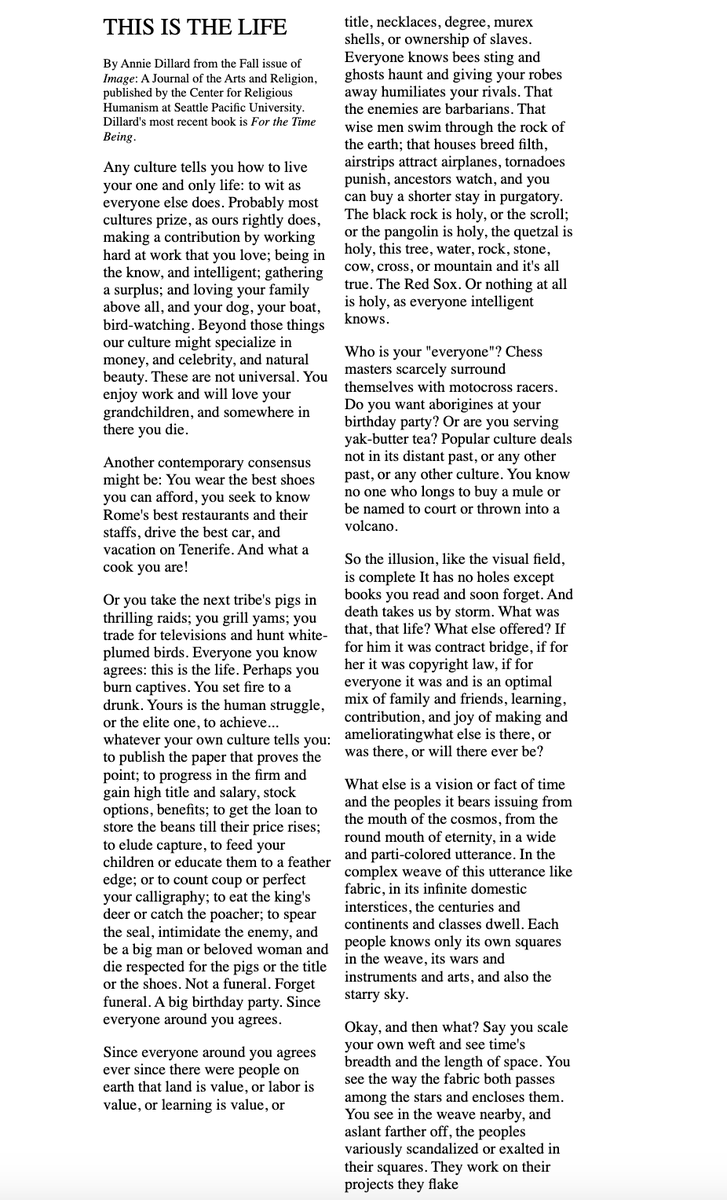
RIP to Annie Dillard, whose work frequently left me unable to speak sensibly for several minutes after reading it. This essay, This Is The Life, was my entry point to her work
There once lived a mathematician named Petrov.
Petrov was working on a problem.
The problem was very difficult, and so Petrov worked on it for twenty-three years.
At first Petrov was young and worked on the problem quickly. Then he grew older and worked on it more slowly. Toward the end, he hardly worked on it at all. He mostly just sat in front of it and looked.
The problem, meanwhile, wasn’t going anywhere either.
Every morning Petrov got up at half past seven, drank some tea, and sat down to work on the problem.
At twelve o’clock, Petrov would get up from the table and say:
“No.”
Then he would have lunch.
After lunch Petrov would sit down with the problem again, and at six o’clock he would say:
“No again.”
And so the day would pass.
One day Petrov’s wife asked him:
“Petya, what will happen when you solve the problem?”
Petrov was frightened.
He had never thought about it.
“When I solve it,” Petrov said, “then it will become clear.”
And he sat down to work on it again.
Five years later, Petrov’s wife asked him again:
“Well?”
“What?”
“Has it become clear?”
“Not yet.”
That was the end of the conversation.
Petrov’s colleagues treated the problem with great respect.
One professor would say:
“A very important problem.”
Another professor would say:
“An exceptionally important problem.”
A third professor said nothing, because he himself did not understand the statement of the problem.
But whenever anyone asked him about it, he would frown and say:
“There’s something considerably subtler going on there.”
For this, the third professor was held in especially high regard.
Petrov wrote seven papers about the problem.
The first was called “Some Remarks on the Question.”
The second was called “Some Further Remarks on the Question.”
The third was called “On the Impossibility of Certain Remarks on the Question.”
Petrov wrote the fourth in English, which made it seem especially serious.
Nobody read the fifth.
The sixth was read by one man in Canada, but it later turned out that he had confused Petrov with another Petrov.
Petrov decided not to publish the seventh.
It was the best one.
Several more years passed.
Petrov developed gray hair.
Then he developed more gray hair.
Then he developed less hair.
The problem did not change in the slightest.
One day, a computer appeared at the institute.
The computer was installed in a separate room.
At first Petrov paid no attention to it.
“A machine,” Petrov would say.
Then the computer began writing papers.
Petrov became interested.
Then the computer began proving theorems.
Petrov became concerned.
“What sort of theorems?” he asked.
“Various ones,” he was told.
Petrov did not like this.
“My problem is beyond it anyway,” Petrov said.
And, just in case, he closed the door to his office.
A week later, a young researcher named Sidorov knocked on Petrov’s door.
“Come in,” said Petrov.
Sidorov came in.
“Pyotr Nikolaevich,” Sidorov said, “the computer has solved your problem.”
Petrov looked at Sidorov.
Then at the window.
Then at Sidorov again.
“Which problem?”
“Yours.”
“I have lots of problems.”
In fact, Petrov had only one problem.
“That one,” Sidorov said.
“Impossible.”
“Possible.”
“It solved it incorrectly.”
“We checked.”
“Who did?”
“The computer.”
“The computer checked the computer?”
“Yes.”
Petrov thought about this.
“That’s not serious,” he said.
Sidorov then placed a printout in front of Petrov.
The printout was four hundred and eighty-three pages thick.
Petrov looked at the first page.
Then at the second.
Then at page four hundred and eighty-three.
On page four hundred and eighty-three there was a little square.
Petrov became very angry.
“I could have put a square there too,” he said.
“The square isn’t the point,” Sidorov said.
“Then why is it there?”
Sidorov did not know.
The next day there was a seminar.
The computer did not attend.
This reassured Petrov somewhat.
Sidorov gave the talk.
For two hours he explained the proof.
Petrov shook his head the entire time.
After the first hour, he said:
“There’s a mistake here.”
“Where?” Sidorov asked.
Petrov pointed.
It turned out to be the page number.
Twenty minutes later, Petrov said again:
“There’s a mistake here.”
This time it turned out to be a paper clip.
After that Petrov was silent for a while.
At the end of the seminar, the director of the institute stood up and said:
“Colleagues, an extraordinary event has taken place.”
Everyone applauded.
Petrov applauded too, because at first he had not understood what the director was talking about.
Then he understood and stopped.
The director continued:
“A problem that remained open for more than forty years has been solved.”
“Twenty-three years,” Petrov said.
“What?”
“I worked on it for twenty-three years.”
“Very good,” said the director. “Then you must be especially pleased.”
Petrov was not pleased in the slightest.
After the seminar, everyone went to have tea.
The computer was not given any tea.
Petrov saw a certain justice in this.
The next morning Petrov came to the institute as usual.
At half past eight he entered his office, took off his coat, sat down at his desk, and took out a notebook.
Then he remembered that the problem had been solved.
He closed the notebook.
A minute later, he opened it again.
Then he closed it again.
At ten o’clock Petrov went out into the corridor.
“Sidorov!” he shouted.
Sidorov came over.
“What am I supposed to do now?”
“What do you mean?”
“The problem is solved.”
“Take another one.”
Petrov was astonished.
“What do you mean, another one?”
“Another problem.”
Petrov looked at Sidorov as though Sidorov had suggested that he take another surname.
“That was my problem.”
“Now it’s solved.”
“That is exactly why it was mine.”
Sidorov did not understand and walked away.
Petrov returned to his office.
Twenty-three notebooks lay on his desk.
In the first notebook, it said:
“Let us try to prove the following.”
In the last notebook, it said:
“Let us try another way.”
Petrov stared at those words for a long time.
Then he turned the page.
The page was blank.
It was the first completely correct page in twenty-three years.
At noon, out of habit, Petrov said:
“No.”
But this time nobody had asked him anything.
A month later, the director summoned Petrov.
“Pyotr Nikolaevich,” the director said, “we need to talk.”
“About the problem?”
“No.”
Petrov immediately understood that the conversation was going to be bad.
“You see,” said the director, “computers solve a great many problems now.”
“I’ve noticed.”
“And they do it quickly.”
“That is their weakness.”
“Why?”
“They don’t have time to understand what they’re doing.”
The director wrote this sentence down on a piece of paper.
Petrov brightened.
But the director was only testing his pen.
“In any case,” the director said, “your position is being eliminated.”
“Why?”
“Optimization.”
“What does that mean?”
“It means your position no longer exists.”
Petrov thought about this.
“And me?”
“You still exist.”
“Without a position?”
“Yes.”
For a long time Petrov could not understand how a person could exist without a position.
Then he remembered that the problem had existed for twenty-three years without a solution, and this reassured him somewhat.
On his last day at work, Petrov packed his books into a box.
There were too many books.
So he left half of them behind.
Then he thought about it and left the other half behind too.
As a result, Petrov left the institute carrying an empty box.
At the door he met Sidorov.
“Pyotr Nikolaevich, where are you going?”
“Home.”
“What’s the box for?”
Petrov looked at the box.
“I don’t know.”
And he gave it to Sidorov.
At home his wife asked:
“Well, what happened today?”
“Nothing.”
“And the problem?”
“Solved.”
“Congratulations.”
“There’s nothing to congratulate me for.”
“Why?”
“I didn’t solve it.”
“Who did?”
“The computer.”
His wife thought for a moment and said:
“Then it’s a good thing you’re finally free.”
Petrov was frightened again.
He had never been free before.
The next day Petrov woke up at half past seven, drank some tea, and sat down at the table.
There was nothing in front of him.
He sat there until twelve.
At twelve, Petrov said:
“No.”
Then he had lunch.
After lunch he sat down at the table again.
At six o’clock he said:
“No again.”
This continued for another three days.
On the fourth day, his wife asked:
“What are you solving now?”
Petrov wanted to answer, but could not.
So he took a blank sheet of paper and wrote:
“Problem. Find a problem that a computer will not be able to solve.”
Petrov looked at what he had written and, for the first time in a long while, felt good.
At that moment, the telephone rang.
It was Sidorov.
“Pyotr Nikolaevich,” he said, “the computer has just come up with a list of seventeen such problems.”
Petrov put down the phone.
Then he walked over to the window.
The window was closed.
Petrov thought for a moment and decided not to open it.
It was the first decision the computer had not taken away from him.
Source: translation of Boris Bilich
There once lived a mathematician named Petrov.
Petrov was working on a problem.
The problem was very difficult, and so Petrov worked on it for twenty-three years.
At first Petrov was young and worked on the problem quickly. Then he grew older and worked on it more slowly. Toward the end, he hardly worked on it at all. He mostly just sat in front of it and looked.
The problem, meanwhile, wasn’t going anywhere either.
Every morning Petrov got up at half past seven, drank some tea, and sat down to work on the problem.
At twelve o’clock, Petrov would get up from the table and say:
“No.”
Then he would have lunch.
After lunch Petrov would sit down with the problem again, and at six o’clock he would say:
“No again.”
And so the day would pass.
One day Petrov’s wife asked him:
“Petya, what will happen when you solve the problem?”
Petrov was frightened.
He had never thought about it.
“When I solve it,” Petrov said, “then it will become clear.”
And he sat down to work on it again.
Five years later, Petrov’s wife asked him again:
“Well?”
“What?”
“Has it become clear?”
“Not yet.”
That was the end of the conversation.
Petrov’s colleagues treated the problem with great respect.
One professor would say:
“A very important problem.”
Another professor would say:
“An exceptionally important problem.”
A third professor said nothing, because he himself did not understand the statement of the problem.
But whenever anyone asked him about it, he would frown and say:
“There’s something considerably subtler going on there.”
For this, the third professor was held in especially high regard.
Petrov wrote seven papers about the problem.
The first was called “Some Remarks on the Question.”
The second was called “Some Further Remarks on the Question.”
The third was called “On the Impossibility of Certain Remarks on the Question.”
Petrov wrote the fourth in English, which made it seem especially serious.
Nobody read the fifth.
The sixth was read by one man in Canada, but it later turned out that he had confused Petrov with another Petrov.
Petrov decided not to publish the seventh.
It was the best one.
Several more years passed.
Petrov developed gray hair.
Then he developed more gray hair.
Then he developed less hair.
The problem did not change in the slightest.
One day, a computer appeared at the institute.
The computer was installed in a separate room.
At first Petrov paid no attention to it.
“A machine,” Petrov would say.
Then the computer began writing papers.
Petrov became interested.
Then the computer began proving theorems.
Petrov became concerned.
“What sort of theorems?” he asked.
“Various ones,” he was told.
Petrov did not like this.
“My problem is beyond it anyway,” Petrov said.
And, just in case, he closed the door to his office.
A week later, a young researcher named Sidorov knocked on Petrov’s door.
“Come in,” said Petrov.
Sidorov came in.
“Pyotr Nikolaevich,” Sidorov said, “the computer has solved your problem.”
Petrov looked at Sidorov.
Then at the window.
Then at Sidorov again.
“Which problem?”
“Yours.”
“I have lots of problems.”
In fact, Petrov had only one problem.
“That one,” Sidorov said.
“Impossible.”
“Possible.”
“It solved it incorrectly.”
“We checked.”
“Who did?”
“The computer.”
“The computer checked the computer?”
“Yes.”
Petrov thought about this.
“That’s not serious,” he said.
Sidorov then placed a printout in front of Petrov.
The printout was four hundred and eighty-three pages thick.
Petrov looked at the first page.
Then at the second.
Then at page four hundred and eighty-three.
On page four hundred and eighty-three there was a little square.
Petrov became very angry.
“I could have put a square there too,” he said.
“The square isn’t the point,” Sidorov said.
“Then why is it there?”
Sidorov did not know.
The next day there was a seminar.
The computer did not attend.
This reassured Petrov somewhat.
Sidorov gave the talk.
For two hours he explained the proof.
Petrov shook his head the entire time.
After the first hour, he said:
“There’s a mistake here.”
“Where?” Sidorov asked.
Petrov pointed.
It turned out to be the page number.
Twenty minutes later, Petrov said again:
“There’s a mistake here.”
This time it turned out to be a paper clip.
After that Petrov was silent for a while.
At the end of the seminar, the director of the institute stood up and said:
“Colleagues, an extraordinary event has taken place.”
Everyone applauded.
Petrov applauded too, because at first he had not understood what the director was talking about.
Then he understood and stopped.
The director continued:
“A problem that remained open for more than forty years has been solved.”
“Twenty-three years,” Petrov said.
“What?”
“I worked on it for twenty-three years.”
“Very good,” said the director. “Then you must be especially pleased.”
Petrov was not pleased in the slightest.
After the seminar, everyone went to have tea.
The computer was not given any tea.
Petrov saw a certain justice in this.
The next morning Petrov came to the institute as usual.
At half past eight he entered his office, took off his coat, sat down at his desk, and took out a notebook.
Then he remembered that the problem had been solved.
He closed the notebook.
A minute later, he opened it again.
Then he closed it again.
At ten o’clock Petrov went out into the corridor.
“Sidorov!” he shouted.
Sidorov came over.
“What am I supposed to do now?”
“What do you mean?”
“The problem is solved.”
“Take another one.”
Petrov was astonished.
“What do you mean, another one?”
“Another problem.”
Petrov looked at Sidorov as though Sidorov had suggested that he take another surname.
“That was my problem.”
“Now it’s solved.”
“That is exactly why it was mine.”
Sidorov did not understand and walked away.
Petrov returned to his office.
Twenty-three notebooks lay on his desk.
In the first notebook, it said:
“Let us try to prove the following.”
In the last notebook, it said:
“Let us try another way.”
Petrov stared at those words for a long time.
Then he turned the page.
The page was blank.
It was the first completely correct page in twenty-three years.
At noon, out of habit, Petrov said:
“No.”
But this time nobody had asked him anything.
A month later, the director summoned Petrov.
“Pyotr Nikolaevich,” the director said, “we need to talk.”
“About the problem?”
“No.”
Petrov immediately understood that the conversation was going to be bad.
“You see,” said the director, “computers solve a great many problems now.”
“I’ve noticed.”
“And they do it quickly.”
“That is their weakness.”
“Why?”
“They don’t have time to understand what they’re doing.”
The director wrote this sentence down on a piece of paper.
Petrov brightened.
But the director was only testing his pen.
“In any case,” the director said, “your position is being eliminated.”
“Why?”
“Optimization.”
“What does that mean?”
“It means your position no longer exists.”
Petrov thought about this.
“And me?”
“You still exist.”
“Without a position?”
“Yes.”
For a long time Petrov could not understand how a person could exist without a position.
Then he remembered that the problem had existed for twenty-three years without a solution, and this reassured him somewhat.
On his last day at work, Petrov packed his books into a box.
There were too many books.
So he left half of them behind.
Then he thought about it and left the other half behind too.
As a result, Petrov left the institute carrying an empty box.
At the door he met Sidorov.
“Pyotr Nikolaevich, where are you going?”
“Home.”
“What’s the box for?”
Petrov looked at the box.
“I don’t know.”
And he gave it to Sidorov.
At home his wife asked:
“Well, what happened today?”
“Nothing.”
“And the problem?”
“Solved.”
“Congratulations.”
“There’s nothing to congratulate me for.”
“Why?”
“I didn’t solve it.”
“Who did?”
“The computer.”
His wife thought for a moment and said:
“Then it’s a good thing you’re finally free.”
Petrov was frightened again.
He had never been free before.
The next day Petrov woke up at half past seven, drank some tea, and sat down at the table.
There was nothing in front of him.
He sat there until twelve.
At twelve, Petrov said:
“No.”
Then he had lunch.
After lunch he sat down at the table again.
At six o’clock he said:
“No again.”
This continued for another three days.
On the fourth day, his wife asked:
“What are you solving now?”
Petrov wanted to answer, but could not.
So he took a blank sheet of paper and wrote:
“Problem. Find a problem that a computer will not be able to solve.”
Petrov looked at what he had written and, for the first time in a long while, felt good.
At that moment, the telephone rang.
It was Sidorov.
“Pyotr Nikolaevich,” he said, “the computer has just come up with a list of seventeen such problems.”
Petrov put down the phone.
Then he walked over to the window.
The window was closed.
Petrov thought for a moment and decided not to open it.
It was the first decision the computer had not taken away from him.
Source: translation of Boris Bilich
@prathamkode@anur4gsharma “The first skill to learn is the art of letting go the human to judge ourselves and our performance as either good or bad”
— W. Timothy Gallwey, The Inner Game of Tennis
Here it is - the official, revised, peer-reviewed version of my Platonic Space paper. https://t.co/PXNpx5FgFN Of all the many unpopular positions I’ve taken over the decades - bitter controversies around the origin of left-right asymmetry in embryogenesis, bioelectricity and genetics, diverse intelligence, etc., this one has by far generated the most pushback: serious (grateful for those!) and energetic attempts to move me to other views, pleas to just drop it and not talk about it (for several different reasons), nasty emails and accusations, impacts on reviews of papers that have nothing to do with this, etc. Kind of amazing to me how incendiary this is. What can I say... Our job is to call it as we see it, and right now for me, this is it. Apologies to collaborators and colleagues for any shrapnel! Time will tell if this pans out or not; I've placed my bets. And btw, if you think this stuff is weird and uncomfortable, just wait… There’s much more on the way. The knob turns slowly but as long as the data keep coming, I'm going to say what I think it all means and follow it to the next steps it enables. Buckle up!