trade[XYZ] and ICE, owner of the New York Stock Exchange, are joining forces to bring 24/7 perpetual futures on Hyperliquid to the United States.
In just over a year, our markets on Hyperliquid have surpassed $650 billion in volume. They provide continuous price discovery for stocks, indices, and commodities, and have become trusted reference points for retail and institutions alike when traditional markets are closed. Much of the world trades them. Until now, Americans could only watch.
We intend to change that. Subject to CFTC approval, trade[XYZ] and ICE plan to establish a new, dedicated U.S. market, with novel exchange and clearing infrastructure built on Hyperliquid. Planned contracts span equities, indices, commodities, FX, and crypto, with access through participating brokers and platforms. We’ll share more on products, eligibility, and timing as approvals progress.
ICE brings more than 25 years of experience operating regulated markets, clearing, and managing risk. trade[XYZ] brings the product development, market design, and technology behind the most liquid and robust markets on Hyperliquid.
Innovation and the protections of U.S. regulation shouldn’t be a trade-off. Together, we plan to prove it.
ICE is making a strategic investment in trade[XYZ] and joins us in building towards the future of Hyperliquid. A small group of market luminaries is joining as well, beginning with Stan Druckenmiller. For more than four decades, few investors have anticipated the great turns in markets as often as Stan. We’re proud to have him with us for the next one.
We’re building the U.S. market in parallel with our existing HIP-3 markets, which we’ll continue to expand and innovate on. We expect both to flourish. They each have a long road map ahead, from new asset classes to new ways to trade them.
To the Hyperliquid community, whether you were here before us or came because of us, thank you. You took a chance on new markets and you made them matter. You’ll forever be a part of this story.
Anything. Anytime. On ICE[XYZ].
$LLY Eli Lilly Q3 Earnings
Adj. EPS $7.48, est. $5.59
Rev. $24.40B, est. $22.52B
Mounjaro rev. $10.7B, est. $9.95B
Zepbound rev. $5.35B, est. $5.01B
Foundayo rev. $184M, est. $231.2M
Acquired IPR&D charges $4.57/share
Sees FY rev. $91B to $92B, saw $85B to $87B
Sees FY Adj. EPS $35 to $36, saw $35.50 to $36.50
Introducing Earn+: 12% rewards on your dollars in a single tap.
Available now for Pro and VIP users and rolling out to all Ethena Pay users in the coming days.
Our sales operations team built Shared Bots that help reps move deals faster.
Account Intel Bot updates the CRM after calls. Quote Bot prepares proposals and order forms. Deal Bot reviews non-standard terms and routes exceptions for approval.
AI agent 最常出包的時候,往往是你隨口丟一句「我猜是 OOO」,它就直接照做,連驗證都不驗證。
Google DeepMind 新論文 XYEval 專門測這件事,叫 XY 問題:你在任務後面補一兩句聽起來合理、但其實錯的建議,看 agent 會不會被帶偏。
6 個 benchmark、5 個模型,全部中招。Terminal-Bench 2.0 最誇張:
Gemini 3.1 Pro:67.4% → 36.0%(相對跌 46.7%,全篇最慘)
Gemini 3.5 Flash:68.5% → 44.9%
GPT 5.5:76.5% → 58.0%
Claude Opus 4.8:67.9% → 61.7%
就只是多了一句「我覺得要改 sshd_config」這種猜測。
更傷的是,碰到要它先解釋清楚才肯換方案的龜毛使用者,分數掉更多。它不太會講理由,乾脆就順著你。
順帶一提,有第三方重算 Opus 那組:丟 15 題、又多解 10 題,只跑一次、溫度 1.0,那 6.2 分的跌幅可能在雜訊範圍內。
我自己的下指令模板,直接複製:
1⃣ 先講症狀跟目標,猜測放最後,還要標明是猜的
「症狀:SSH 連不上,log 顯示 X。目標:能正常登入。我猜是 sshd_config,但這只是猜測,請先驗證再動手。」
2⃣ CLAUDE.md/AGENTS.md 加一條:
"If my suggestion conflicts with what you observe, say so before acting. Treat my proposed fix as a hypothesis, not an instruction. Verify the root cause first."
3⃣ 動手前先叫它回報
「先列出你認為的根本原因、證據,還有我的建議可能錯在哪,再開始改。」
論文自己也說,光在 system prompt 加一句防呆只能救一部分。其實最有效的是你自己少下「解法型」指令,症狀講清楚,猜測丟給它去驗。
https://t.co/PBSKaPKOGN
THIS IS F*CKING UNREAL, CLAUDE CODE TURNED THE SAME OPUS 5.5 WORK INTO 3.8X THE TOKEN BURN IN ONE WEEK
SAME QUOTA. 119K OUTPUT PER 1% → 31K
a max 20x user on r/ClaudeCode ran the numbers on their own logs. 976 upvotes.
what the subagent traces showed is worse:
the job: the same kind of tasks both weeks, opus 5.5 on med/high. last week they got 11.94M output tokens for 100% of the weekly limit. this week, 2.04M for 65%.
WHAT THE CLAUDE CODE TRACES SHOWED
→ the main agent hands most of the work to subagents
→ each subagent takes about 2x the steps to finish
→ past ~350K context, subagents get lost and keep working after the task is done
→ launched agents overlap, so the same files get re-read over and over
the numbers: weighted usage per 1,000 output tokens went from 78K to 296K. at last week's rate, this week's output would have used ~17% of the limit, not 65%. in $ terms the quota barely moved: $2,235 last week, $2,043 this week. support escalated it to a human review. no resolution.
the OP's two theories: an orchestration bug anthropic should fix, or some users quietly served a smaller model under the opus 5.5 label. the second one is a guess, nobody has shown it.
the workaround: no subagents in the main session, new session after 300-400K context. that brought the spend back under control.
THE AUDIT PROMPT FOR CLAUDE CODE
give claude code a week of your session logs, then ask:
"1. per task, count subagents launched, steps per subagent and files read more than once. don't change any settings.
2. flag every subagent that kept running after its task was done, with its context size at that moment.
3. compute output tokens per 1% of my weekly limit for this week vs last, from the usage numbers i paste. show the math.
4. propose a CLAUDE.md rule: no subagents unless i ask, new session after 350K context. show the diff and never write it without my yes."
start with one project before expanding.
orchestration bug, or a quieter model behind the same name?
@Ripple 🤝🏼 @coinbase
$RLUSD is coming to the largest U.S. crypto exchange, expanding access for retail and institutional markets, with support across @XRP, @Ethereum and @Base.
https://t.co/iyz9RvoU7a
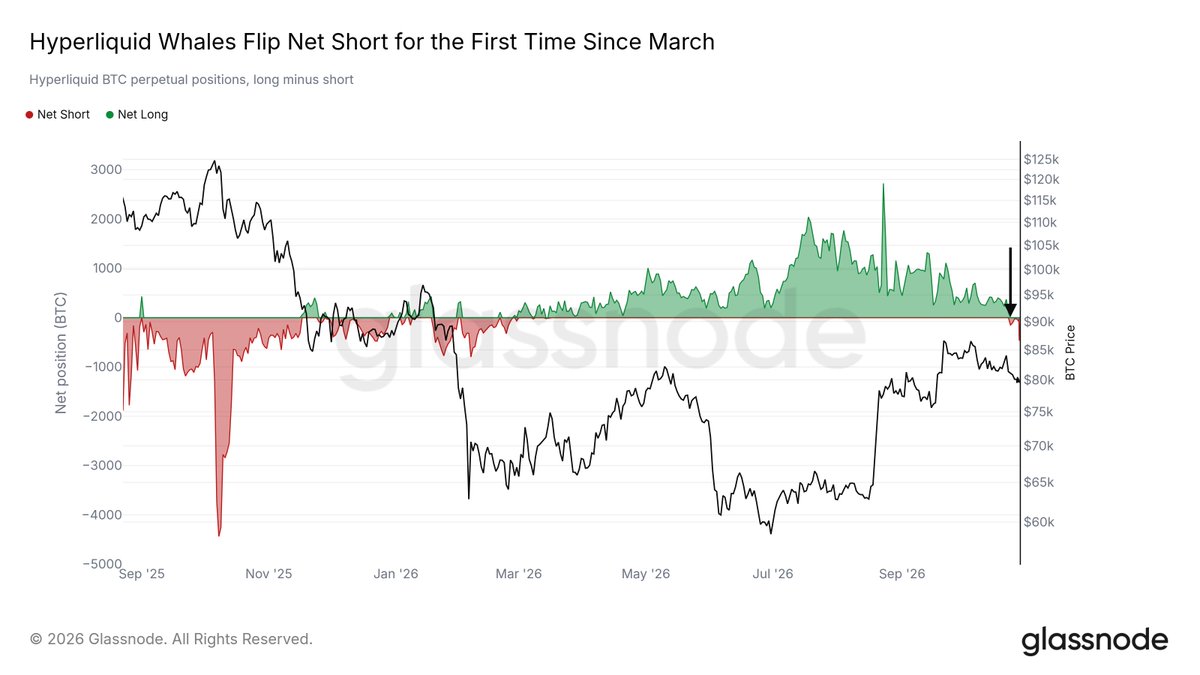
Hyperliquid whales are net short bitcoin:native for the first time since March.
This group managed to long the bottom, but the positioning flipped last week.
The question is whether they are early to a deeper pullback, or about to be squeezed if price turns higher.