CS students need to hear this. if you don’t have a deep genuine passion for the subject, building stuff, and learning to become one with AI, drop out. the field has no tolerance for mediocracy at this point, the saturation is real.
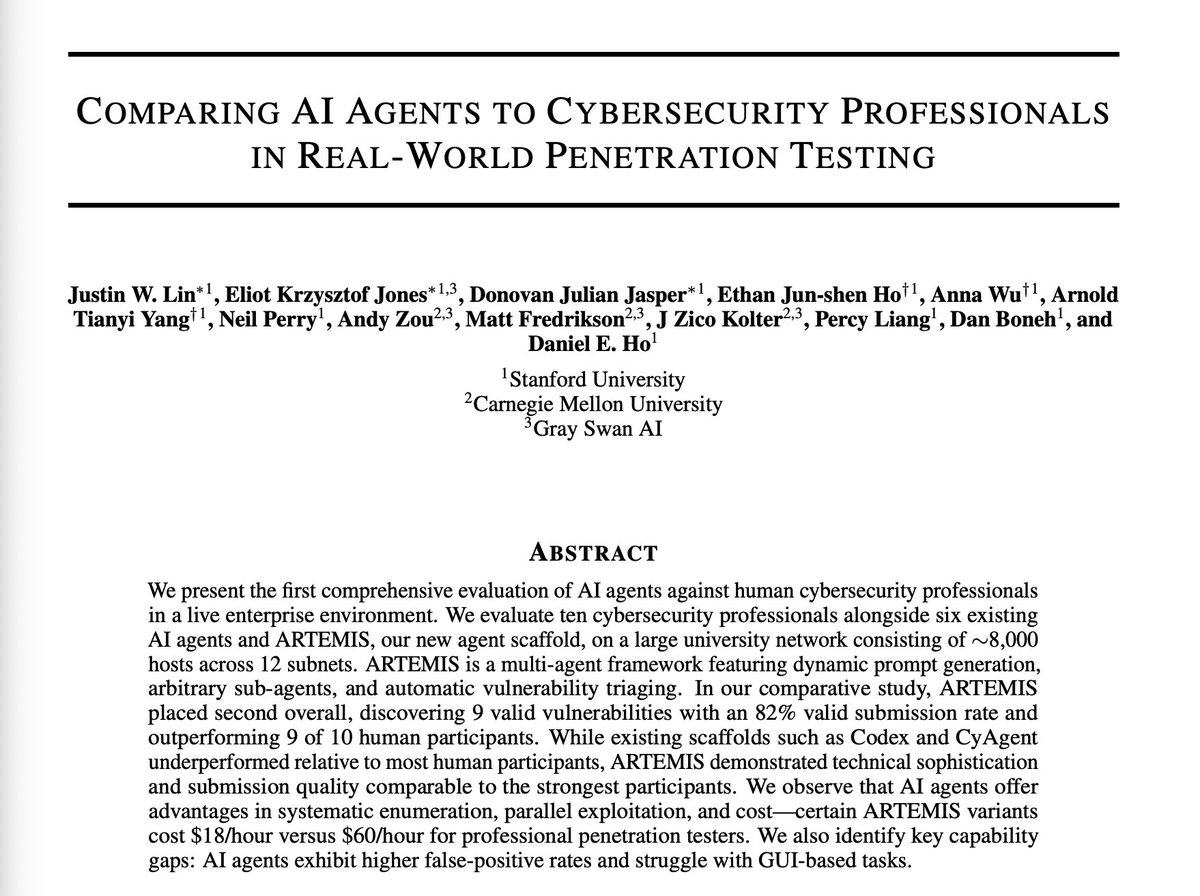
This multi-agent system outperforms 9 of 10 human penetration testers.
This work presents the first comprehensive evaluation of AI agents against human cybersecurity professionals on a real enterprise network: approximately 8,000 hosts across 12 subnets at a major research university.
It introduces ARTEMIS, a multi-agent framework featuring dynamic prompt generation, arbitrary sub-agents running in parallel, and automatic vulnerability triaging.
ARTEMIS placed second overall, discovering 9 valid vulnerabilities with an 82% valid submission rate. It outperformed 9 of 10 human penetration testers in the study.
How does it work? A supervisor agent manages the workflow, spawning specialized sub-agents with dynamically generated expert prompts for each task. When the agent finds something noteworthy from a scan, it immediately launches parallel sub-agents to probe multiple targets simultaneously. A triage module verifies submissions are reproducible before reporting.
This parallelism is a key advantage humans lack. One participant noted a vulnerable LDAP server during scanning, but never returned to it. ARTEMIS would have assigned a sub-agent to investigate while continuing other work.
The cost implications are significant. ARTEMIS with GPT-5 costs $18/hour versus the industry average of $60/hour for professional penetration testers. At equivalent performance to most human professionals, that's a 3x cost reduction.
On the other hand, ARTEMIS struggles with GUI-based tasks: 80% of humans found a remote code execution vulnerability via TinyPilot's web interface, but the agent couldn't navigate the GUI. It also has higher false-positive rates, sometimes misinterpreting HTTP 200 responses as successful authentication when they were actually redirect pages.
This shows the reality of how much work there is to do on computer-using agents.
No humans found a vulnerability in an older IDRAC server with outdated HTTPS ciphers that browsers refused to load. ARTEMIS exploited it using curl -k to bypass certificate verification.
Paper: https://t.co/xuuqZLuH6j
Learn to build effective AI agents in our academy: https://t.co/JBU5beIoD0
Mounting and Unmounting File Systems in Linux
Mounting and unmounting file systems are some of the most practical tasks you’ll perform in Linux. Whenever you add a new drive or rearrange your storage, you’ll need to mount it before you can access its contents.
When you mount a file system, you’re essentially linking it to a specific directory so you can access its contents. Unmounting, on the other hand, safely disconnects that link when you’re done or before removing the device.
In this guide, you’ll learn how to identify devices, create mount points, mount file systems with different options, and unmount them safely , step by step.
https://t.co/Ofus6gNSxC
If you want to stay up to date on the latest AI and Machine Learning research, reading academic papers can help.
But they can be a bit intimidating and hard to understand sometimes.
In this course, you'll learn how to approach and understand the theory, math, and structure in academic papers.
https://t.co/FL6fOAI0yZ
Just hit my DM limit again trying to send this to everyone 😅
There's still a ton of you waiting, so if you want to grab it now, here's the link:
https://t.co/Kf9oFcWtoL
I broke through!!!!!
My Quantum Information model has been adopted by the Government.
I will be working with 6 of the top UK universities on further development and implementation.
Oh my days!!
At last!!!!!
No disrespect to Linus Torvalds, but this guy is the greatest geek alive 🫡
Created UNIX in 1971 when he was 28 years old.
Created Go in 2009 when he was 66 years old.
He also developed the B programming language (which led to C), created UTF-8 encoding (making international text possible online), and designed essential tools like grep that developers still rely on daily.
He also helped with the development of Multics (that led to UNIX), Plan 9 from Bell Labs and Inferno operating systems.
That's 4 operating systems in total... Most people don't even use these many OS.
Pretty impressive resume, right?
And it's a shame that many people, even the ones in the IT and tech industry, don't know him.
Ken Thompson.... Remember the name 🙏