Artificial intelligences do not undergo experiences, do not possess a body, do not feel joy or pain, do not mature through relationships, and do not know from within what love, work, friendship or responsibility mean. Nor do they have a moral conscience, since they do not judge good and evil, grasp the ultimate meaning of situations, or bear responsibility for consequences. They may imitate or even simulate, but they do not understand what they produce, for they lack the affective, relational, and spiritual perspective through which human beings grow in wisdom. #MagnificaHumanitas
I think frontier AI labs should hire people who either:
- at least pretend to care about the people affected by their products
- can make good jokes?
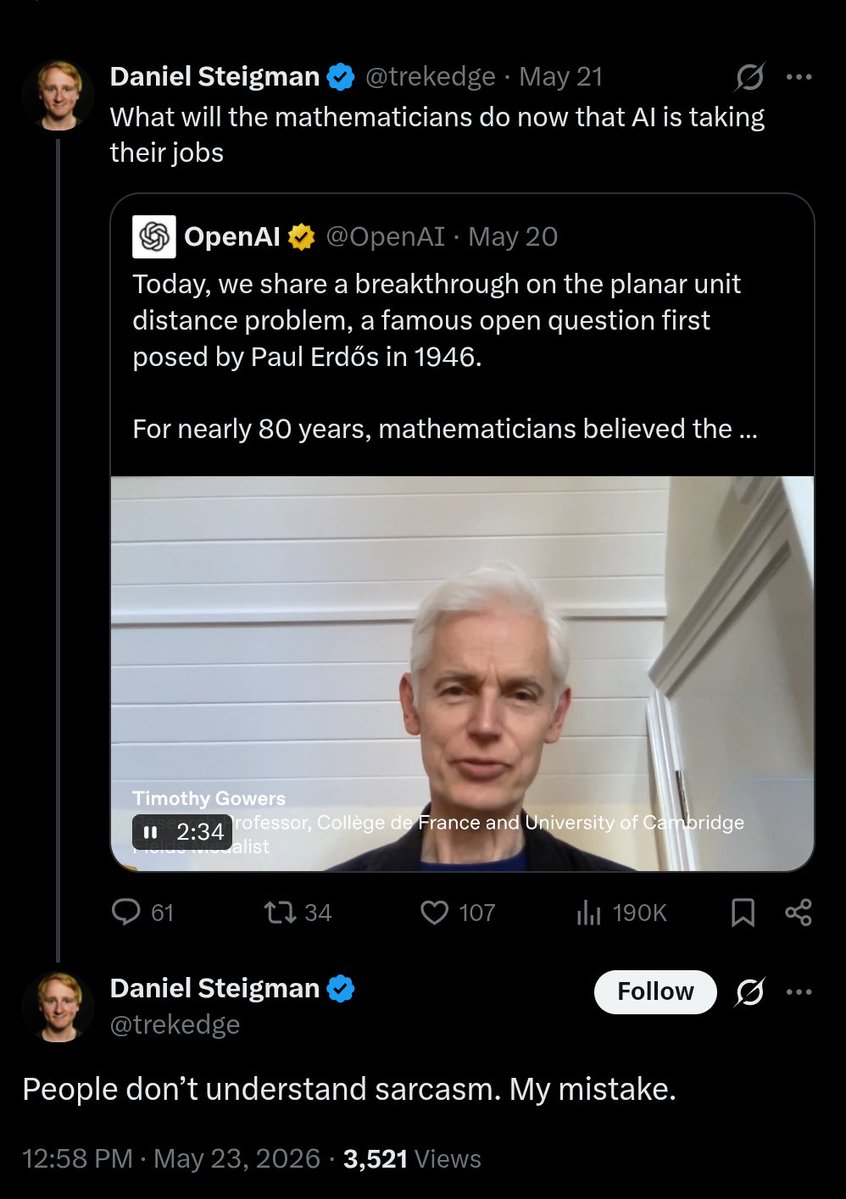
I talk to brilliant young people every day, terrified about the future. This callousness from those inside is sad.
There is a case to be made that the future of Mathematics is very bright. In my mind, proofs have always been a tool to achieve a goal.
The goal was and still is to understand, and reading/writing proofs (or just know that they exist) will remain part of it.
AI is getting great at math, but how good is it at solving real research problems in areas outside of those covered by Erdős problems? Towards gauging this, I have started putting together a list of unsolved research problems in mathematical statistics and machine learning, sourced from recent papers in a leading statistics journal, the Annals of Statistics (with some bonus COLT open problems: https://t.co/aT9kyozYsv.
Currently >100 problems.
In my view, much of the value of AI for researchers in the mathematical sciences stems from helping with their own research problems. These are problems without known solutions. There are many math benchmarks, but few with the following properties:
(1) of a realistic research-level, so that solving them can potentially lead to a publication in a top journal (problems discussed in papers already, not contest math, not Millenium problems, not problems created for a benchmark, not problems that have a known solution);
I'd say Erdős problems are the best example of this.
(2) cover problems outside of the usual focus (combinatorics, number theory, ... ) of Erdős problems. Especially under-represented are domains of applied math, along with statistics, operations research, etc.
I'm interested in statistics and ML, so that's where I started, but this could grow over time.
Hope this can grow into something useful to the community! Happy to hear your thoughts...
If you are a midcareer or senior level world class researcher in statistics or computer science interested in moving to the University of Toronto, DM me.
🚀 Call for Papers: Special Issue on Frontiers in Statistical Learning: Data, Networks, and Knowledge Transfer
Journal: Statistical Learning and Data Science (SLADS)
📅 Submission Deadline: March 31, 2026
👨🎓 Guest Editors: Yang Feng, Guangming Pan, Jiaming Xu, Emma Zhang
I'm hiring a Student Researcher to work on scaling laws at Google DeepMind! Project is for 16 weeks, starting spring/summer '26, in-person in SF (pic from the amazing office). If you're interested, fill out this form: https://t.co/nnRmY2hqeL
I am recruiting PhD students at @NYU_Courant to conduct research in learning theory, algorithmic statistics, and trustworthy machine learning, starting Fall 2026. Please share widely! Deadline to apply is December 12, 2025.
UC Berkeley Department of Statistics is hiring! We’re seeking applicants for up to three approved tenure-track positions at the Assistant Professor level in Statistics, Probability and AI.
Details & apply: https://t.co/tcail7NkAR
#AI#Statistics#Probability#UCBerkeley
Our team at FAIR is hiring PhD research interns for 2026 on the topics of multimodal multi-agent learning. If you are interested, feel free to DM me or directly apply using the link below!
https://t.co/JrHoDAPDnP
If you're a PhD student interested in interning with me or one of my amazing colleagues at Microsoft Research New England (@MSRNE, @MSFTResearch) this summer, please apply here
https://t.co/DIkXUuK4zc
(If you'd like to work with me, please include my name in your cover letter!)
Microsoft Research New York City is seeking applicants for multiple Postdoctoral Researcher positions in ML/AI!
These are positions for up to 2 years, starting in July 2026.
Application deadline: October 22, 2025
Given the recent loss of its $25 million NSF grant (amongst all UCLA grants), the Institute for Pure & Applied Mathematics is now fundraising. Donation link here: https://t.co/Ka3RIuYTXK