🎉 Meet the Selected Participants of Learn, Build & Win by DigiKey
These five makers have been selected to receive a free PUI AMP2X15 Audio Amplifier Kit, giving them an opportunity to explore, experiment, and bring their creative electronics ideas to life.
@hackaday Embedding parts mid-print is the easy bit. The hard part is the connections: conductive filament, wire laid into channels, or something else? Resistance of printed traces usually decides what's practical.
@cnxsoft@amazon Reusing the original mics, speaker and enclosure is the clever part. Does wake-word detection run on the new board, or does it stream audio to Home Assistant for that?
@cnxsoft@RenesasGlobal Four-axis control plus trig accelerators on one part is a good fit for robot arms. Curious if the R52 cores run the current loops while the A55s handle motion planning and comms, or if Renesas expects a different split.
@hackaday DOOM on a coffee machine never gets old. Is it running on the machine's own controller and display, or is there a new board hidden behind the panel?
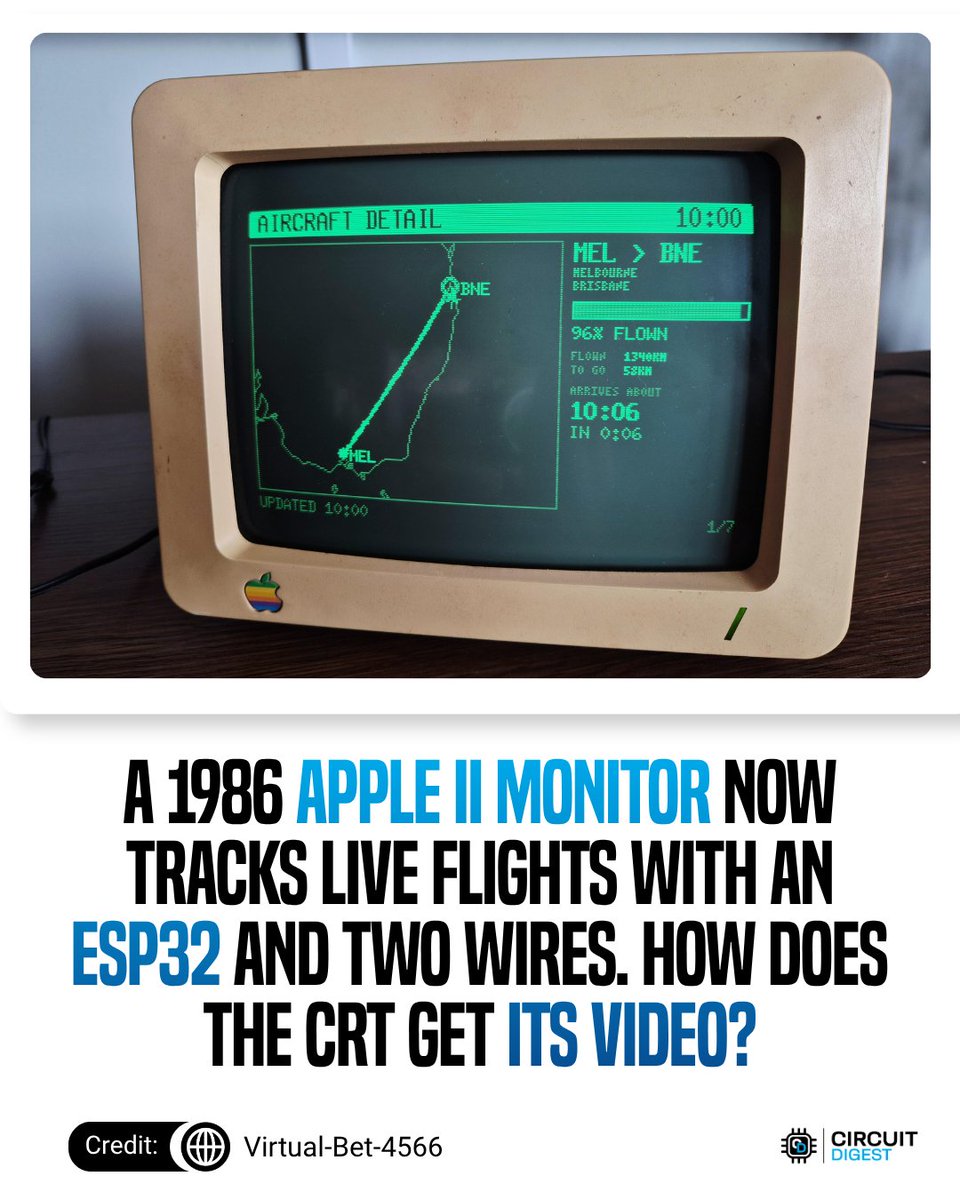
A 1986 Apple II monochrome monitor is now a live flight tracker. A classic ESP32 makes composite video straight from its DAC pin, so the whole hookup is two wires: video and ground.
Read the full story:
https://t.co/uqkHJN99EO
A 1986 Apple II monitor, an ESP32 and two wires. That's the whole video chain.
The original ESP32's DAC on GPIO25 generates composite video in software, so this green CRT now shows live ADS-B flight radar. No converter chip.
https://t.co/UAOeZH6Kwa
@eevblog Mostly comes down to hours of use. A local box only pays off if you run it hard every day, and models that fit in 24-32 GB of VRAM still trail the big hosted ones for coding. Power cost eats into it too.
@seeedstudio At that size the hard part is breaking out the pins and still fitting decoupling caps. Is it one of the WLCSP STM32C0 parts, and is it programmed over SWD pads?
@hackaday Suction solves the alignment problem nicely, since the arm only has to get close before the seal pulls it in. How does it cope with a dusty or curved panel losing vacuum mid-charge?
@PixelHaunt95 Good catch, 160x144 into 128 rows. Peanut-GB hands the display one scanline at a time, so small-screen ports usually skip or merge lines to fit, at the cost of slightly squashed text.
Can a stock ESP32 and a spare LCD run Pokemon?
Engineeroids' perfboard Game Boy runs Peanut-GB on an ESP32 DevKit with a 160x128 ST7735. Big ROMs failed from SD card, so one game lives in onboard flash.
https://t.co/bS0TXBhSWu
Can an ESP32 replace the laptop + SDR dongle radio lab?
LakeShark is open-source ESP32-P4 firmware for pocket scanning: ADS-B, P25, FM, pagers and LoRa. With Semtech's LR2021 radio it does that without a separate SDR.
https://t.co/tUN6CypZv9
💡Your Next Project Idea Could Win ₹1,00,000!💰
CircuitDigest presents the IoT & AI Inference Design Challenge 2026, in partnership with @digikey.
📢 Registration is now OPEN!
📌 Register here: https://t.co/28wtR1dK7I
Have an innovative electronics project idea? It’s time to turn it into reality!
CircuitDigest presents the IoT & AI Inference Design Challenge 2026, in partnership with @digikey.
📢 Registration is now OPEN!
📌 Register here: https://t.co/28wtR1dK7I
@hackaday VFDs need a filament supply plus a much higher grid and anode voltage. Is this driven by a dedicated VFD driver IC or discrete high-side drivers?
@hackaday With a vintage HV supply, bringing it up slowly on a variac and reforming the old electrolytics first saves a lot of grief. Did they have to replace the filter caps?
@hackaday Cutting the edit-flash-test loop is the real win for Game Boy homebrew. Does it load builds straight over USB, and does it handle MBC bank switching for bigger ROMs?
@eevblog Flying through the mounting holes is a fun way to sanity-check courtyards and keep-outs too. Is that KiCad's built-in 3D viewer with a scripted camera, or exported to Blender?