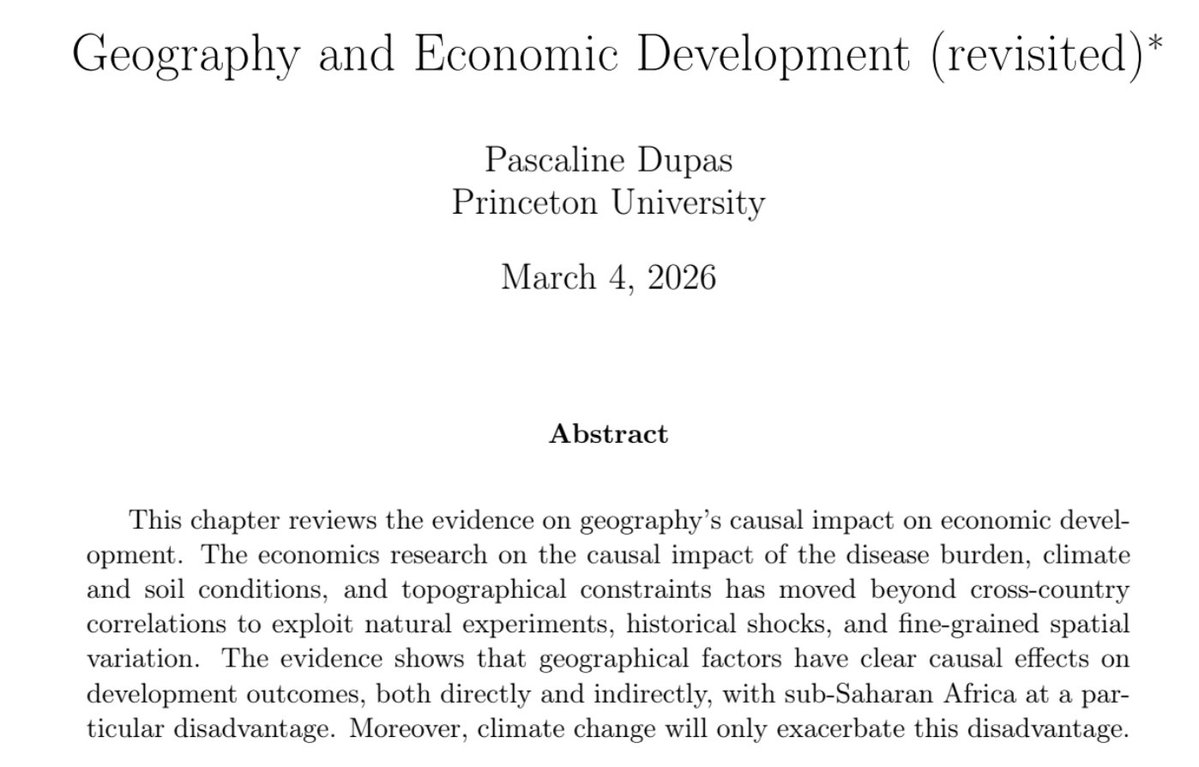
Great new review article from Pascaline Dupas, with a new take on the Jeff Sachs vs AJR debate:
20+ years of rigorous, empirical evidence point to a strong role for geography in shaping econ development outcomes
Today was the first day of the semester at Penn, and I started my course in Global Economic History!
The lecture was fun, and I tried to convey not only why economic growth is so important but also that anything we could have done to increase growth over the last 100 years would have had monumental consequences: we would have many more resources to eradicate global poverty, manage the fertility collapse and population aging, clean up the planet and decarbonize the economy, and, more generally, offer better opportunities to everyone across the globe.
Artificial intelligence, cheap energy, and modern science and technology have opened the doors to fundamental changes and opportunities, but only if we know how to take advantage of them.
The slides are here:
https://t.co/P4RykL2tTC
Nonetheless, I reminded the students of something perhaps even more fundamental. Many of the topics we will cover admit more than one interpretation of the evidence or hinge on how you weigh the outcomes. Does industrial policy work? If it does, is the cost worth paying?
I told them many times that they do not have to share my reading of the evidence or my criteria for judging outcomes. I have changed my mind about several of these questions, and experts have a poor record on economic growth over the past century.
I also told them we will grade their homework and exams based on command of the material, not on their agreement with me, and that I will try to set questions that agreement cannot answer, but understanding of the material and the arguments presented.
John Stuart Mill summarized the reason well:
He who knows only his own side of the case, knows little of that…Truth gains more even by the errors of one who, with due study and preparation, thinks for himself, than by the true opinions of those who only hold them because they do not suffer themselves to think.
Put another way: I would rather have my students reach the wrong conclusion by their own reasoning than the right one by taking my word for it. After all, independent thinking gave us modern science and technology. Let’s have more of it!
In my last two posts, I emphasized the enormous gains in material wealth and life expectancy that humanity has experienced over the past couple of centuries.
But those improvements are nothing compared with the monumental gains in what I call moral autonomy and self-determination. Two centuries ago, in 1826, the vast majority of people were far less free and far less able to shape their own futures or their communities’ futures.
Let me start with labor. One striking feature of economic history is that, for most of the human past, much labor has not been free but coerced through violence, ranging from the worst forms of chattel slavery to serfdom, peonage, and feudal tenancy. In 1826, for example, around 30% of workers worldwide were subject to some form of violent coercion and to legal limits on the work they may do (this is different from, and more restrictive than, economic limits, such as being a landless laborer with little choice of employer). If you are born in 1826, you stand a strong chance of being born to an enslaved mother in the Americas or to a serf in Russia. Today, the ILO computes that fewer than 1% of workers are coerced in this way.
Let me continue with gender. If you are a woman in 1826, your freedom to choose a husband, an education, an occupation, how many children to have, and to own property is severely limited nearly everywhere. If you are an enslaved or coerced woman, you face a very high chance of sexual assault during your lifetime. Free women suffer these attacks too, with next to no recourse.
Let me move to religion and ideology. If you belong to the “wrong” religion, denomination, or ideology, or if you simply love someone you “should not love,” you risk severe punishment. Even in the U.S., Massachusetts still has an established church and will keep it until 1833 (the First Amendment applied only to the federal government until Everson v. Board of Education, 330 U.S. 1 (1947)). In the U.K., we are three years away from the Roman Catholic Relief Act of 1829 and forty-five years away from the abolition of religious tests at Oxford and Cambridge.
In education and culture, 88% of people are illiterate, and fewer than 2% hold the equivalent of a high school degree. For most, the great works of art and literature play no part in daily life, beyond perhaps a religious image or text seen in the local temple.
Finally, almost nobody outside a small elite participates in political life. In 1826, only the U.S. can be called a democracy, and that stretches the word. With very few exceptions, only white adult men can vote, and even among them, several states, such as Virginia, restrict the franchise to about 50% of white adult males. Some Swiss cantons (but not all!) do better, and Norway, then in union with Sweden, has a relatively broad franchise for men. The United Kingdom (before the 1832 reform), France, and the Netherlands have very restricted franchises. And that is pretty much it. Nothing resembling democracy or the rule of law exists in all of Asia and Africa, most of the Americas, and the rest of Europe. In nearly all the world, you could be arrested at the whim of your ruler, and there was little you could do about it.
I do not want to paint too rosy a picture of 2026. Workers are still coerced. Gender inequalities remain large. In many parts of the world, you still cannot think what you want to think or choose your own romantic life. Democracy has badly backslid over the last two decades. And I am increasingly forced to remind people that due process is the twin sister of liberty.
But if I ask you, behind a veil of ignorance, whether you want to live in 1826 or 2026 (that is, you do not know whether you will be born a king or an enslaved woman, only that the probabilities match the proportions in the global population), you would be crazy to pick 1826. Your life will be short. You will probably be very poor. You will be illiterate, told what to do for a living, who to pray to, and whom to marry, and no one will give a penny for your input into the running of your community. And, you can be arrested at will.
And this absence of moral autonomy and self-determination is worth ten, one hundred, or even one thousand times more than all the extra income that modern economic growth has given you.
My post on life spans:
https://t.co/YyUEQyI7QV
My post on prosperity:
https://t.co/fMk9kLWOqi
has anyone done or thought of doing anything like
take the very best frontier LLM. put it in a radiation tolerant computer in high earth or lunar orbit powered by solar arrays. give it a simple persistent beacon so it pings earth for the next thousand years. how to rebuild civilization in a box.
Everyone from Weber to Mokyr puts culture at the center of the rise of the West. But nobody has had a long-run cultural series you could drop into a growth model.
So I built one: LLMs read 23,000 books from the Western canon, scoring what each endorses.
Year 0–1920, one chart:
Fun chart: LLM study of how western values have changed in the last 2,000 years, based on an analysis of 23,000 books.
It's striking that while some values rise and fall over the millennia, "Indulgence"— defined as freedom from rigid social control and a preference for fun and gratification against restraint and asceticism—is higher than ever, having basically increased steadily since the 1500s.
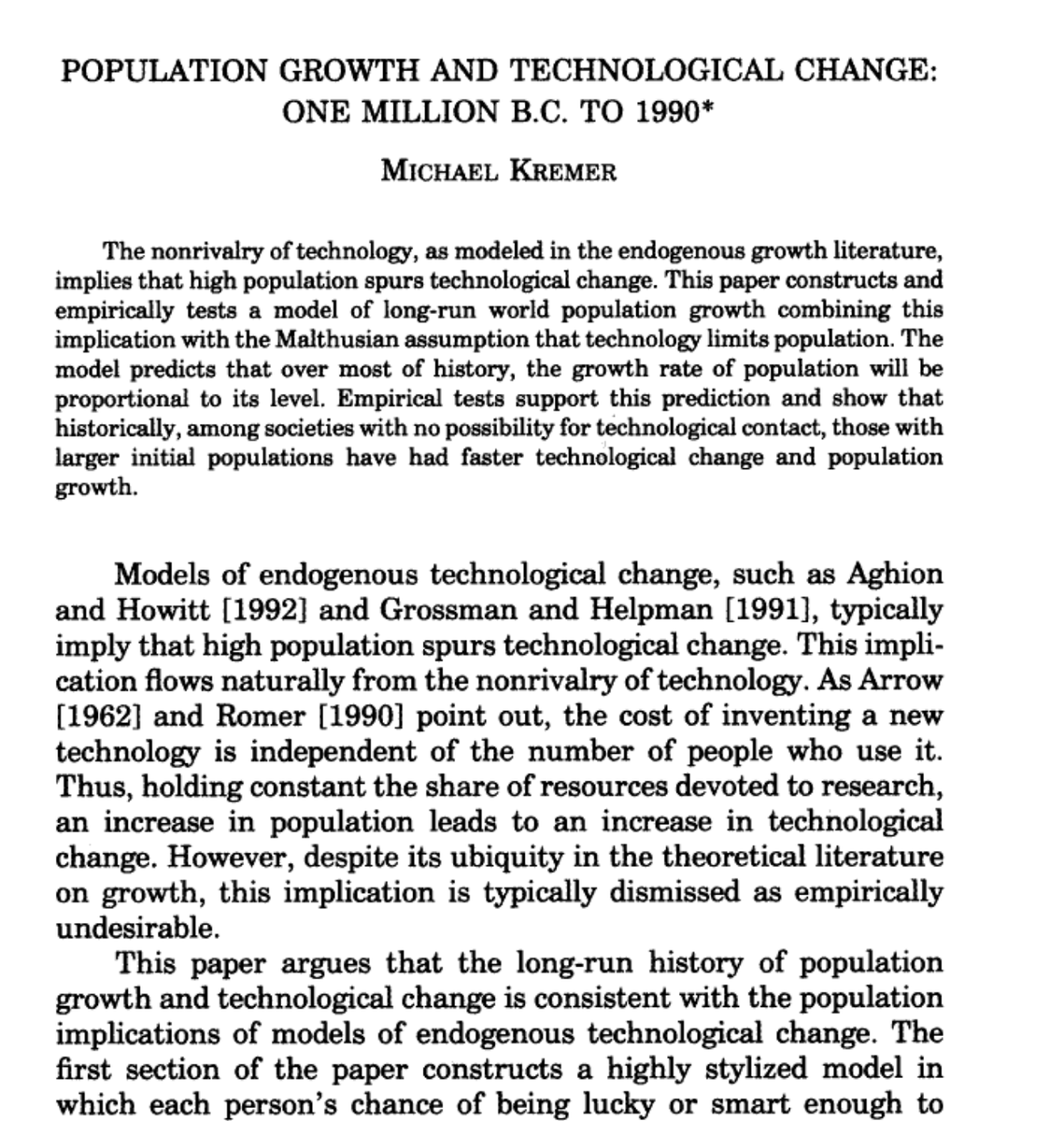
Since I am working on a new paper on demographics and growth (big surprise!), I have just reread Michael Kremer’s “Population Growth and Technological Change: One Million B.C. to 1990.”
I read it as an undergraduate. I read it again as a graduate student preparing for my growth prelim in Minnesota. And I read it years later, when I taught growth theory to undergraduates at Penn, where I even put together slides that I still use regularly for my economic history course.
And yet, however often I go back to it, I am still amazed at how elegant the paper and its argument are. As Italo Calvino once remarked:
“Every rereading of a classic is as much a voyage of discovery as the first reading.”
(Perché leggere i classici, 1981)
Kremer’s paper is exactly that. Oh, how I wish I could write papers like it!
By the way, read Calvino’s essay as well. In English here:
https://t.co/PlcWsl3kAy
1/ What moved people before states, markets, or borders? We turn ancient DNA into a direct measure of prehistoric migration. When two ancient individuals share a long segment of inherited DNA (identity-by-descent, IBD), they share a recent ancestor, so someone in that lineage moved between their burial sites. Counting these links between places, and dating them, gives a directional map of migration across 10,000 years of western Eurasia.
@cremieuxrecueil According to the CGD website "Thankfully, by the end of the fiscal year, reported PEPFAR-supported coverage had rebounded almost everywhere. Out of 53 countries, 36 reported Q4 2025 coverage above Q1 levels, and 12 more were within 5 percent of their Q1 levels."
The entire modern world, including capitalism and industrialisation, happened because we beat NIMBYism and vetocracy in 18th-century England.
Today, the vetocracy, the stakeholder state, the NIMBYs stop us building the nuclear power plants, railways, houses, towers, bridges, roads, gas turbines, solar panels, and powerlines that we need for growth.
Then, they stopped people from consolidating their land, transporting goods freely, investing in irrigation, and mortgaging their property to invest. The events that led to their downfall are called the Glorious Revolution. I think we can repeat what they did and have another Glorious Revolution of our own.
https://t.co/5PrKLK1nah
Early modern Europe was sclerotic, stifled by NIMBYs of its own: the aristocrats, guilds, and clergy who stood against the reforms that were necessary for 18th-century progress. Everyone knew that inheritance rules split land up too much, everyone knew that common land was overgrazed, everyone knew that property rights restricted making best use of land, labour, and capital.
Each one of them decided the answer was consolidating power in an absolute monarch. Each one of them failed completely. They didn't crush the NIMBYs: the NIMBYs crushed them.
One country launched itself into rapid growth, creating the industrial modernity we live under today: England. It did this, as everyone agreed was necessary, by overriding the tangle of landowner property rights that prevented best use of land. But it tried something almost unbelievable: to get the landowner NIMBYs to crush themselves.
England did not attempt to set up an absolutist state: quite the opposite. It gave landowners supreme power, and they used it to crush their fellows: the minority of landowners who were opposed to progress.
There are lessons for today. Many modern reformers think that the answer to NIMBYs is demonising them, trying to build an angry coalition of forces who hate homeowners or boomers or Republicans or environmentalists. But many of the most successful reform schemes operating around the world today try a different tack: bring a majority of homeowners onside, and it is much, much easier to crush the remaining NIMBYs.
We can still learn from England's Glorious Revolution.
Read my latest article, with historian Kara Dimitruk, in @WorksInProgMag.
How has the Spanish economy performed over the very long run?
To answer, I use Leandro Prados de la Escosura’s (@LdelaEscosura) data on real GDP per capita from 1277 to 2024. I express Spain’s figure as a ratio to Britain’s, since Britain was the first economy to achieve modern economic growth, from around 1660, and has been the leader, or close to it, ever since.
Spain, within its present borders, was prosperous in the Late Middle Ages, well ahead of Britain, then a peripheral corner of Europe. The Black Death and its aftermath hit Spain harder, and by 1360, the two economies had converged.
That parity held until 1600, when Spain began a long decline, in absolute terms (on the eve of the French Revolution, it was barely above its 1600 level, after a deep slump in between) and in relative terms (Britain pulled steadily away). The standard explanations, the Habsburg wars, and the serial bankruptcies run into one problem. They can account for the poor performance between 1550 and 1650, but not for the stagnation between 1650 and 1789. 140 years of stagnation is far more than wars and debt under the Habsburgs can explain.
The series also shows that Spain did not benefit from its empire. That is a problem for every theory tying colonies to modern growth. At most, one can argue that colonies were a necessary condition for takeoff (I do not believe even that, but leave it for another day). One cannot argue that they were sufficient.
The period from 1789 to 1936 was no kinder. The economy grew a little, and Spain built a modern but unfinished liberal state. Yet it never closed the distance to Britain. It is hard not to read the period from 1789 to 1936 as a national failure and the Civil War as its final consequence.
The recent efforts of some historians to paint those years in brighter colors strike me as unfounded. Spain did not fail at modernization as badly as China, but it did not succeed. A deeply corrupt dynasty, closed and incompetent elites in Madrid, Barcelona, and Bilbao, and an economic policy built on intervention and protection (by 1920, Spain was the most protectionist economy in the Western world, so much for the friends of protection) together made the country a basket case.
A cruel civil war left Spain at its historical low, with just 31% of the British GDP per capita. The foreign visitors who arrived in the early 1950s found a poor, backward country.
Policy in the first twenty years of the dictatorship was awful. Autarky was not so much imposed by the Allies as chosen. Spain’s rulers, using their quasi-fascist Weltanschauung, believed growth would come from state intervention, closed markets, and unorthodox fiscal and monetary policy.
Then, in 1959, policy changed. Spain adopted a more orthodox fiscal and monetary policy and opened to foreign investment and trade. The results were spectacular. For forty years, Spain grew briskly and became the modern country it is today. By 2001, it had reached 77% of British GDP per head.
But the internal contradictions of two things eventually became binding: the growth model launched in 1959, and the political regime created by the 1978 constitution. By 2024, Spain had slipped back to 74% of British GDP per head. This is worse than it looks. Britain itself has done poorly over the past twenty years, and losing ground to a weak performer is a bad sign.
Spain stands at a crossroads, economic and political. The country’s foundations no longer work, but its political and business elites have failed to understand this fundamental reality. A good grasp of its economic history helps make sense of its present predicament.
The reason economists stopped doing research into macro-development, i.e., stopped making inquiries into the nature and causes of the wealth of nations, is because we know the answers.
And the answers are a mixture of the obvious and the morally wrong.
I'm honored that @JoinColossus wrote a profile on how we're building Esmeralda from the ground up!
The piece covers everything from our 5 design principles to why we spend so much time in spreadsheets & talking to civil engineers
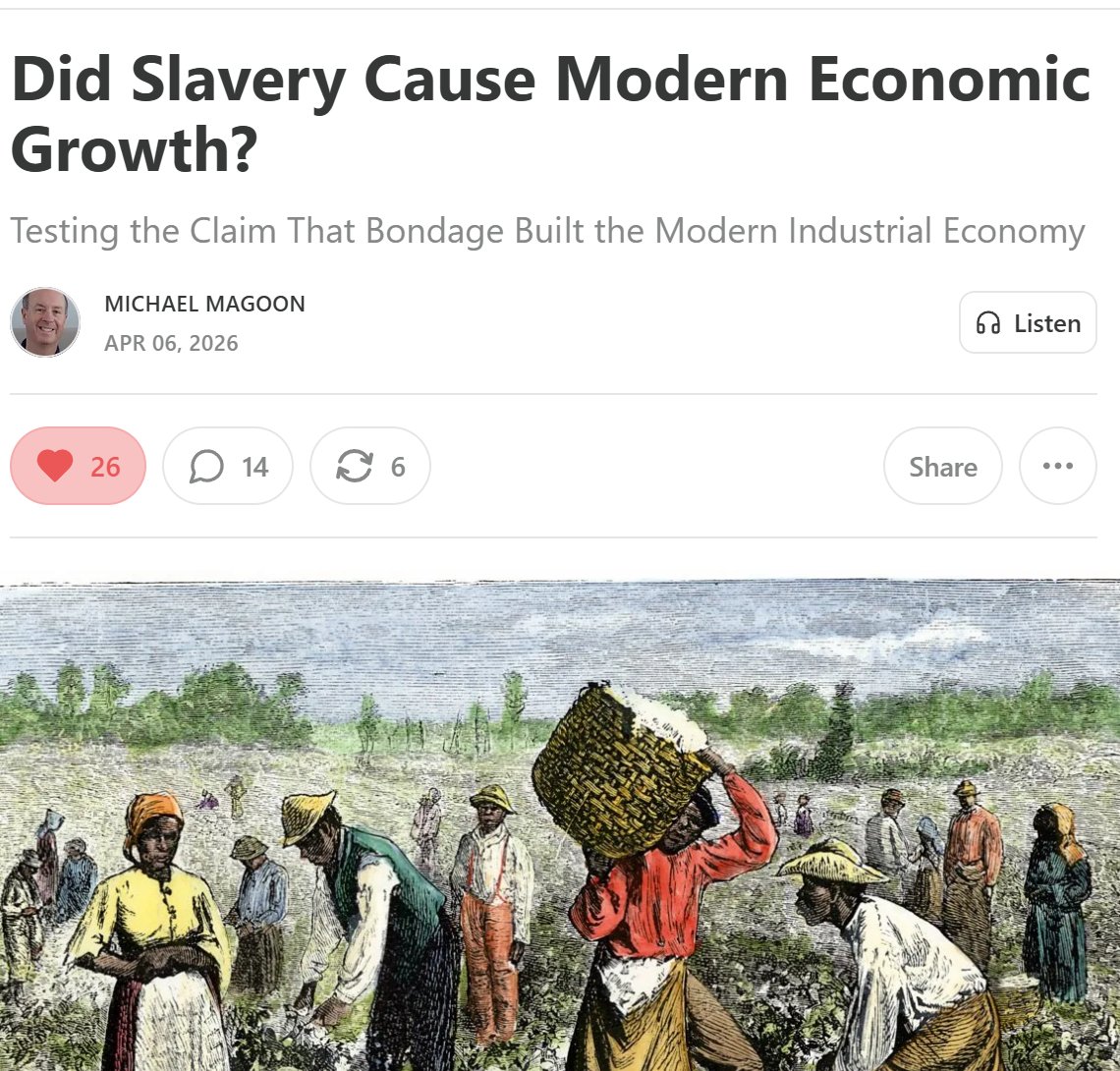
Slavery didn't cause the industrial revolution. It's the other way around: the industrial revolution enabled the end of slavery. Insightful analysis by @MichaelLMagoon. https://t.co/CN8Gn7ahMC