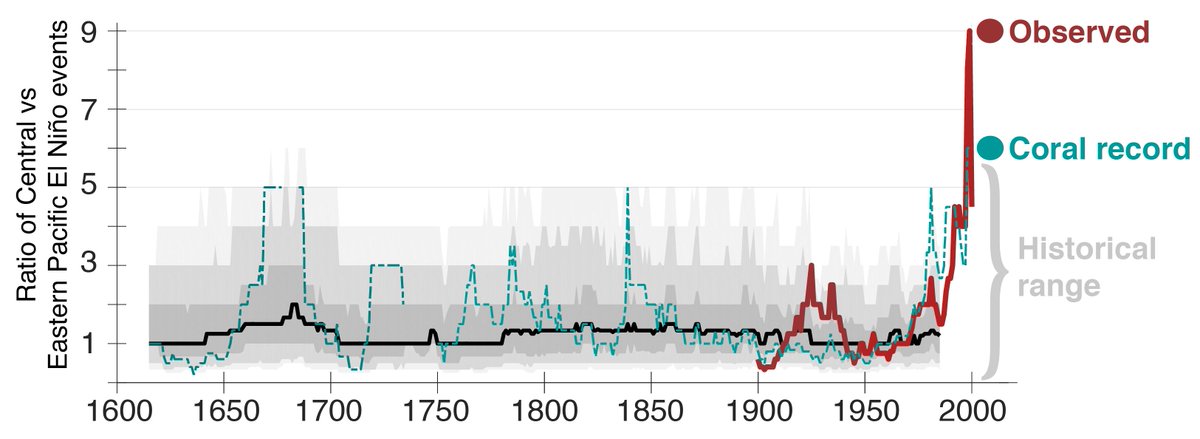
La Niña seems still possible but not very likely. We looked at year to year transitions from El Niño and historically only 16.7% of all cases resulted into a La Niña the next year https://t.co/om5ihHhJWF
A new study by Ruby Lieber, Dr. Josephine Brown, Dr. Andrew King and Dr. Mandy Freund reveals that ENSO teleconnections may amplify with climate change, leading to more severe temperature and precipitation extremes globally.
https://t.co/jd1YB1M2zC
La Niña seems still possible but not very likely. We looked at year to year transitions from El Niño and historically only 16.7% of all cases resulted into a La Niña the next year https://t.co/om5ihHhJWF
Make up your mind! The ECMWF seasonal model has lost La Niña again - it's back to a cool/neutral ENSO forecast for early N Hemisphere winter.
However, N Pacific warmth is escalating, i.e. negative PDO, and potentially a return of Hartmann's North Pacific Mode, aka "the Blob"...
Reaching Net Zero is critical and our pathway towards Net Zero is also critical as it affects how our climate will look after we cease emitting Greenhouse gases. Go check out a new Briefing note by @ClimateExtremes to learn more about it.
#NetZero
I am excited to see this study published @CommsEarth! It uses a deep learning model to infer summertime atmospheric blocking frequencies from seasonally averaged surface temperature reconstructions over the Last Millennium. 1/n https://t.co/2nTwDmpmsD
Signs of this potential La Niña are emerging fairly late. But new research may help make predictions earlier writes @ClimateFreund@unimelb https://t.co/sUwLSu96IZ
The precipitation stacked up along the strong thermal boundary, held in place by important areas of high pressure and enhanced by the orography.
The rain is still falling but we already know Austria rainfall records are being pulverised (more on that when the dust settles).
New paper led by Ruby Lieber and with @JosephineRBrown@ClimateFreund studies ENSO teleconnections with extremes. Ruby found amplification of teleconnections in many regions with global warming and this effect is stronger in models with strengthening ENSO https://t.co/jeMOK2U2se
Excited to share our new paper on two multi century seasonal streamflow reconstructions for western Tasmania! We show streamflow has been declining in the last 100 years but the 15th century was much drier. Awesome team of co-authors👇https://t.co/DfFirr1RGp
The Bureau of Meteorology has declared that El Niño and a positive Indian Ocean Dipole (IOD) are underway. Warmer and drier conditions have already been forecast for spring and summer for parts of Australia. Details: https://t.co/j4kNt3qLSZ
Europe's summer #droughts since 2015 have been the most severe for centuries - but not the only multi-year droughts. This is shown by #isotope analyses of #tree rings across Europe, which thus prove to be a unique tool for #climate research.
Full story👉https://t.co/gEso6lIwtF
Three babies (two bubs & one PhD) and seven years later, I am delighted to share our research on unusual European hydroclimate using tree-ring isotopes. (https://t.co/DWtDTM8QQq). @GFZ_Potsdam@FU_Berlin@AWI_de@ClimateCollege@CSIROnews 1/n
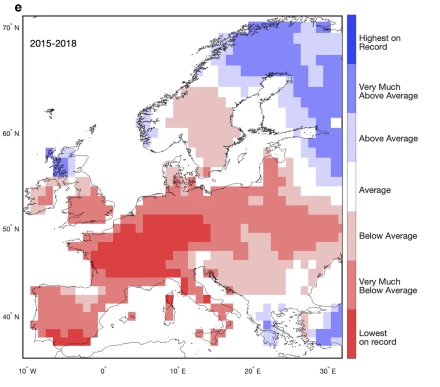
The 2015-2018 summer drought event was unprecedented in Western and Central Europe over the last 400 years, though multi-year droughts were more frequent during the Maunder Minimum.
@ClimateFreund
https://t.co/X68RRz5mJJ
This study was only possible with the support of my co-authors & many amazing people along the way. A big thank you to everyone involved in the ISONET project, the tree-ring community & numerous remarkable individuals throughout the process. 10/n #DFG@dfg_public@CopernicusEU