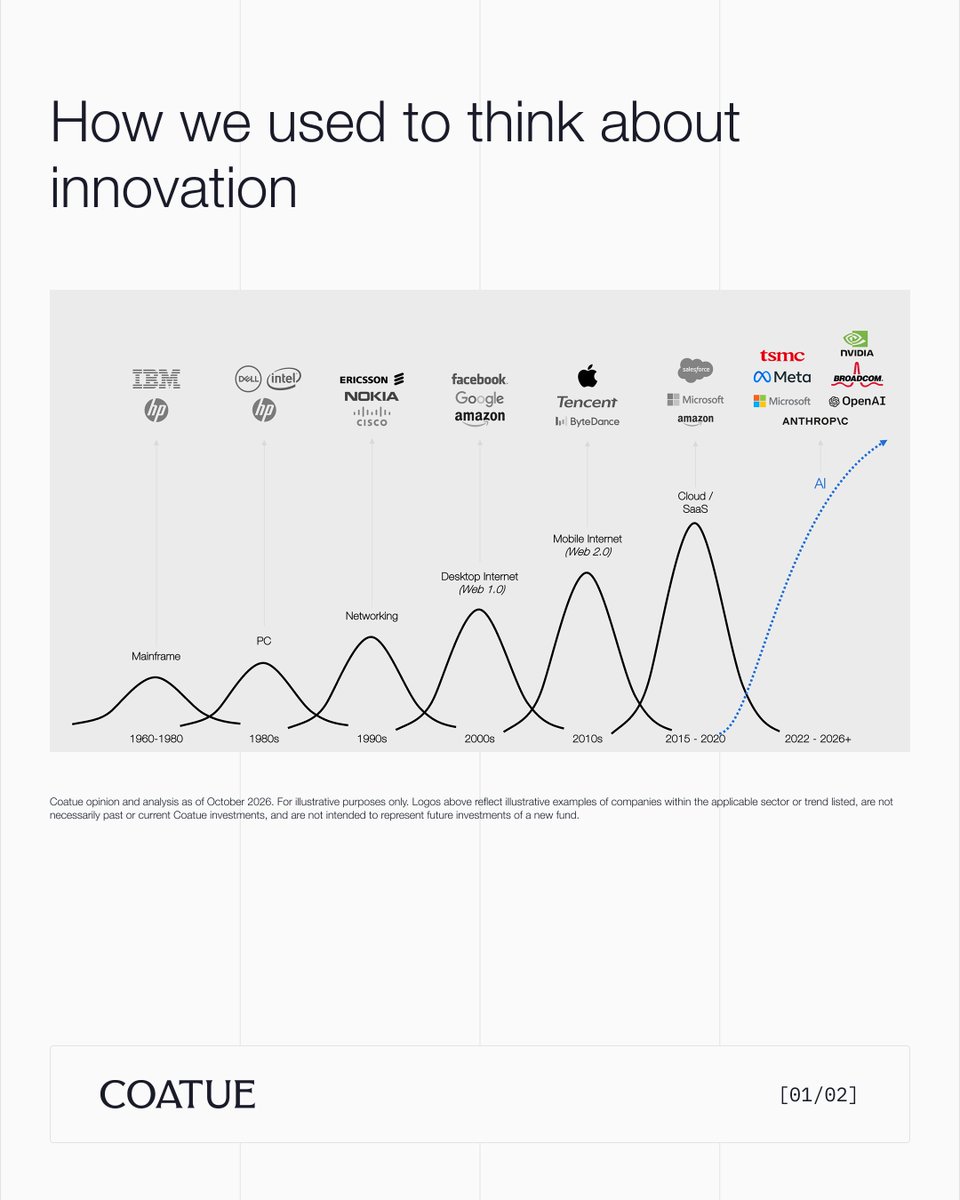
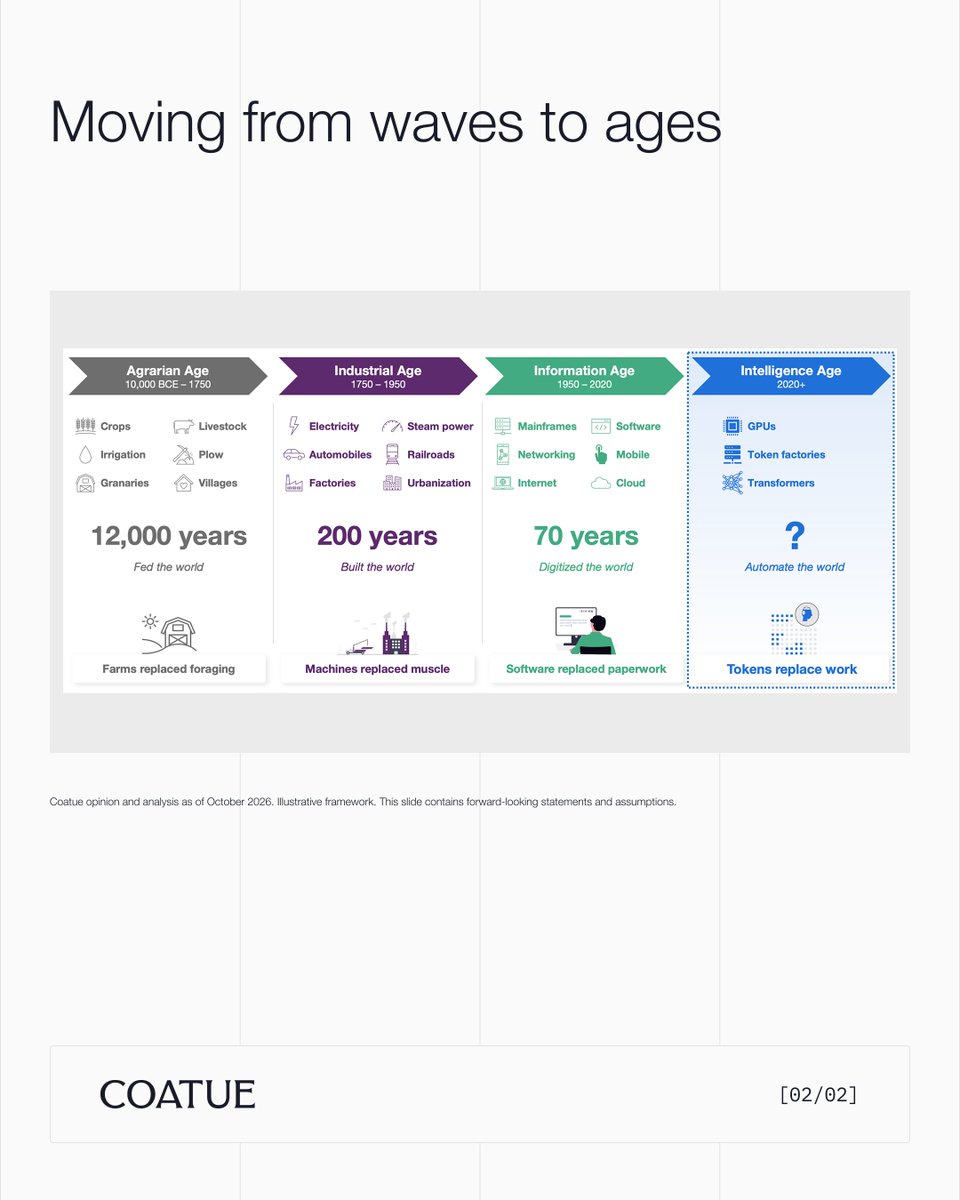
Charts of the day:
We are moving from "waves" to "ages." Our latest public markets update deck is here.
Subscribe to C:\Takes to receive updates when the video replay is available.
Links below ⬇️
Mustafa is the statesman AI needs. We all need to take the “hyperbole” way down.
The doomerism is just the mirror image of the positive hyperbole. They go hand in hand. “We are going to cure cancer in three years!” No you won’t. Wish you were. But no.
The @BostonCollege Investment Committee (an LP and my beloved alma mater) asked for a few thoughts on what's happening in AI. I recorded a test run yesterday morning and then shared it with my partners, who encouraged me to share it more broadly... so here you go!
This is not a sales pitch, it's just a reflection on what we're seeing. And it wasn't intended to be shared, so please pardon the rough edges.
https://t.co/AuZqHMSSxD
The World is Changing: AI For Creativity
By Jeffrey Katzenberg
A few months ago, I sat in my office in Silicon Valley and watched as a tech founder showed me something extraordinary. On the screen was a fully realized, beautifully lit, well-composed animated scene. It was stunning and it made me feel exactly what I felt in 1986 watching Luxo Jr. That was the first time I watched a computer-animated 3D character take a breath and seem, against all reason, to have life. It left me in awe.
Later that day, I received a text from an artist I've known for thirty years, 350 miles to the south, in the city where I spent most of my career. After seeing a similar video, she texted: "Is this the end of us?" My answer was, "Certainly not.”
I have spent the better part of the last decade in Silicon Valley, but the heart of my career has been in Hollywood. Being deeply connected to both worlds means I have deep loyalties to each and a responsibility to speak honestly to both.
In 2023, I said that these new AI tools would cut the time and cost of producing world-class animation by as much as ninety percent within three years. Some colleagues were alarmed, many were furious.
There is growing fear and resistance surrounding AI within the creative community. I deeply understand it, because I've spent countless hours walking through animation studios watching gifted artists bent over their desks, rebuilding a single second of film for the tenth time because the ninth version wasn't quite right. I've sat in screening rooms where four years of people's labor played out in minutes, and I knew the name of every person that had spent countless hours bringing those images to life. The creative process is a calling, there's really no other way to describe it. From the outside some see resistance. From the inside, it is love.
People do not fight this hard for things they don't care about. The pushback coming out of Hollywood represents the collective effort of people who are deeply passionate about their craft.
Is History Repeating Itself?
The history here is more complicated than either side may realize. In 1906, the most famous composer in America, John Philip Sousa, published an essay titled “The Menace of Mechanical Music." He warned that the phonograph would become "a substitute for human skill, intelligence and soul."
Sousa's fight was not really about the machine, it was about money. The machines were playing his compositions, and the men who built them weren't paying him a cent. His campaign helped create the Copyright Act of 1909. He did not stop the technology. He changed the terms under which it could use his work.
A hundred years ago, sound came to the movies. We remember it now as a miracle, and it was. What we forget is who paid for it. Before sound, tens of thousands of musicians made their living in the orchestra pits of movie houses, scoring every film live, every night, in towns all over the world. When the soundtrack arrived, the work of one composer and one orchestra was recorded for a film that went into thousands of theaters. The union fought back with everything it had, taking out newspaper ads across the country warning against the menace of "canned music," one of them showing a mechanical man tearing the strings out of a harp while an angel wept.
They were not fools, and they were not Luddites. They were right. Those pit jobs did not come back. And yet (this is the part we have to be brave enough to admit), sound gave us the movie musical, the modern score, sfx, sound design, audio engineering, and an art form vastly larger than the one it disrupted. And it helped keep Hollywood in the forefront of world entertainment for the rest of the century and into the next. The loss was real. And yet the art form expanded.
This is a story that has been told over and over again. To resist technology is to risk irrelevance. Just look at Kodak or Blockbuster. To embrace technology is to open doors of new possibility. Just consider Apple and Netflix.
What I Learned From Walt Disney
In the mid-1980s, I was tapped to lead Disney's animation division at a moment when the studio was at an inflection point. Animation wasn't just another business unit. It was the soul of the company, a medium revered because of Walt's genius and his passion. But the production system was cumbersome and unforgiving. A single movie was 125,000 individual hand-drawn and painted cels, photographed one frame at a time. Every revision carried a cost measured in months. These degrees of difficulty shaped the kinds of stories we could tell.
We found our way forward in an unexpected place: Walt himself. The Disney archives held astonishing recordings of Walt explaining his creative process. His own writings. His notes and storyboards. Work product captured at every stage of his process. This was truly a gift. Listening, reading, sitting with the work itself, we heard him talk about character, about emotion, about how an audience feels when a character truly comes alive. He talked about making bold choices and refining a scene until it genuinely moved people. We didn't hear a word about pencils or paintbrushes. In fact, Walt was famous for being a technologist, forever hunting for state-of-the-art tools, often inventing them himself to achieve the images he saw in his head. But he never defined animation by the tools. He defined it by whether the audience believed the character. His principles were timeless. The tools were not.
That realization changed everything. We co-developed the Computer Animation Production System (CAPS) with a young Northern California company called Pixar, replacing hand-painted cels with CGI. In The Little Mermaid, the final scene shimmered with a dimensionality and light that the old process simply couldn't achieve. In Beauty and the Beast, the ballroom sequence moved with a cinematic sweep that placed the audience inside the emotion of the moment. In Aladdin, the Cave of Wonders felt vast and alive, and the Magic Carpet became an intricate, compelling character all its own. In The Lion King, the stampede carried a scale and intensity that raised the emotional stakes beyond anything we'd done before. Technology didn't diminish the craft, it expanded the canvas. It gave artists more room to create.
A decade later, the canvas expanded again. When Disney released Pixar's Toy Story, it wasn't simply a technical milestone. It was proof that a fully computer-animated film could carry real emotional weight, that it could make audiences laugh, cry, and believe. At DreamWorks, we made the difficult decision to sunset hand-drawn animation and become a fully computer-animated studio. It was the right thing to do, but it was not without pain. It cost talented people their place in an industry where they had worked their whole lives. Some made the leap to the new tools and did the finest work of their careers. Some never did.
Tools are never the point. The instruments change with every generation. What endures is taste and imagination. The magical ability to make an audience feel. One of the greatest storytellers of our generation, George Lucas, succinctly captured the eternal essence of this issue: “It’s not the how, it’s the why.”
A Distinction With a Difference
I asked one of the leading AI models a question that has been challenging me for months. What is the difference between reasoning and creating? Its answer changed how I think about almost everything happening in this industry. It said . . .
Reasoning and creating are two distinct cognitive modes, though they also work together. Reasoning is fundamentally evaluative and analytical. It operates on what already exists: facts, premises, evidence. It moves toward a conclusion that was in a sense already implied by the input. Reasoning is constrained by logic and truth. Its goal is to arrive somewhere correct, not to invent somewhere new.
Creating is fundamentally generative. It produces something that didn't exist before. And crucially, there's no single right answer waiting to be found. A blank page has infinite valid responses. Creation involves choices that can't be fully justified by logic alone. Taste, intuition and vision fill the gap where deduction runs out.
Reasoning is what Silicon Valley has been perfecting. Creating is what Hollywood has been practicing for more than a century. AI today operates almost entirely on the reasoning side of the line. It can deduce, evaluate, optimize, and pattern-match brilliantly. And while it can create, there is a real distinction to being creative. What it doesn’t yet have is those things that make us human: empathy, devotion, serendipity, the kind of creativity that comes from a person trying to say something only they could say. When the bot generates a piece of art, it is not trying to communicate anything. It is statistics, not soul; it is emulating things that have been done. By contrast, human creativity isn’t about repeating patterns of zeros and ones; it is about doing something new.
One day, AI may close this gap. Three years ago, the leaders building AI would have called what they are achieving today, improbable, if not impossible. Impossible is no longer improbable.
Today, the line between reasoning and creating is real. Even the leading technologists acknowledge we are not there yet. There is no scientific path to crossing this divide that anyone in the field can articulate today. Understanding that gap is where we will find common ground.
A Path Forward
In 2016, I closed one chapter in Hollywood with the sale of DreamWorks and opened another in Northern California, co-founding WndrCo. We’ve backed more than 50 founders building the next generation of technology and watched how breakthroughs in Silicon Valley emerge, first as experiments, then as platforms, and finally as infrastructure that reshapes entire industries. It's worth remembering that the last great revolution in animation also came from the north. Pixar was a Northern California company, forged not in the conventions of the Hollywood studio system, but in the technological breakthroughs of Silicon Valley. I've spent years on both sides of this bridge. For sure, I don’t have all the answers (take Quibi, for one!). But, from my past and present vantage points of my long career, here is what I see . . .
Brilliant people in Northern California building this technology have made something extraordinary. They have earned the right for the rest of us to be, if not believers, at least optimistic that what comes next will be remarkable. But they have not made an artist. The tools are powerful, but they are not what makes a story matter. That knowledge lives 350 miles to the south, inside people whose life's work has informed the very models you are building. The right path forward includes them by design, with credit, with consent, and with compensation. Build this with the storytellers. Not on top of them. Taste is not something that can be synthesized, it is uniquely human.
At the same time, Hollywood needs to accept that AI is not going away. The energy they are spending trying to make it disappear is energy they are not spending deciding the terms on which it will exist. And the terms are everything. The north needs something from it that they cannot build and cannot buy: creativity. The kind that takes a blank page and conjures a single right answer where there was none and has held audiences for a century. Without it, the most powerful reasoning engine ever invented will still be missing the only thing that makes a story worth telling.
The artists who learn to wield these new instruments will do things the engineers never dreamed of. They always have. Edison invented the motion picture but made terrible movies. It took Chaplin, Lloyd, Keaton and so many others to make movies emotional. Now, the canvas is about to expand yet again. We should decide now that we intend to paint on it.
There are so many valuable lessons in history. This has happened many times before, and it was never settled by the technology. It was settled by the terms. Sousa did not stop the phonograph; he helped write the law that made sure composers got paid. And two years ago, when the writers and the actors walked out, they were fighting for the very things Sousa was fighting for in 1906. Consent, compensation, the basic recognition that human creative work has a price that must be paid. The terms of that fight are still being negotiated, but the principle is older than any of us.
The tools-versus-no-tools argument is a trap. First, we must all agree that there should be terms. Then we can have the crucial debate about what fairness requires.
What I Learned From Steve Jobs
Years ago, Steve Jobs said, "It's in Apple's DNA that technology alone is not enough. It's technology married with the liberal arts, married with the humanities, that yields us the result that makes our hearts sing." He was describing a device. But he could just as easily have been describing this tale of two cities.
What I See Coming Soon
As the barriers and the costs come down, more films will get made, not fewer. Studios will get to take more risks. There will be more seats at the table, and very soon entirely new forms of storytelling. In the 1980s, animation was dismissed as a niche corner of the business. Today it is one of the most beloved and profitable forms of storytelling in the world. In live action, filmmakers like Steven Spielberg, James Cameron and Peter Jackson embraced new visual tools not as shortcuts, but as instruments, and expanded cinema in the process. Every time storytelling has met a genuine technological shift, from synchronized sound to color to computer animation, it has redefined the boundaries of the medium and grown larger in the process.
Assuredly, I don’t have all the answers, but I am confident that the creative opportunities will expand yet again. How we come through this is a choice. The north has the new tools. The south has the creative soul. The best future will draw on the best of both worlds.
Wild 24 hours for AI and lots of different proposals have been made.
TLDR; the only *tangible* new fact is that OpenAI and Anthropic are going to have embedded 3rd party evaluators from unknown organizations with Dario floating METR as a possibility. Having 3rd party evaluators is smart as there is no Section 230 style liability shield for model outputs and showing a “duty of care” will be important in future litigation. Several internet companies might have gone bankrupt without Section 230 so limiting liability really matters.
There are minimal investment implications from this single new fact, but I do think that for anyone who wants a “smoother for longer” cycle then most constraints are good: wafers, watts, real rates and spreads. Excessive regulation is a different matter but I don’t think we are anywhere close to this even if the vector changed over the last 24 hours.
To summarize the events:
Dario made the most maximalist proposal of the weekend: embedded 3rd party evaluators, a national regulatory regime for models beyond a certain capability/ingredient threshold, a broad international regulatory pact between democracies, stricter limits on compute/distillation for China and then a different international regulatory regime that encompasses China. Before there is a national regulatory regime, he wants a Sherman act waiver so that Anthropic can safely coordinate with OpenAI and other frontier labs without antitrust fears. TBF, this latest proposal is much less maximalist than some of his prior proposals like “Policy on the AI Exponential,” where he advocated for an FAA for AI. I believe he is sincere in his beliefs. And despite all the protestations, all of this would also probably be good for his business over the long-term.
Sam agreed that embedded 3rd party evaluators were a good idea and stated they would implement them. Again, this is smart as should help limit future liability.
Elon said “Dario is right” and later specified that “Dario is right that there should be some oversight. Peer review of AI by competitors is the right way to start this off.” This would be a MPAA like self-regulatory structure for AI with regular calls between the labs plus a process where each new model is evaluated for safety by competitors for a 1-2 week period before being released. That is *wildly* different from Dario’s proposal and in-line with what David Sacks has been proposing. Elon also stated that nothing was going to slow down open-weight models.
Demis said that Dario’s essay was a “step in the right direction.” Dario also said that he was also open to Demis’ idea of a FINRA like self-regulatory structure as part of his proposal.
David Sacks had a thoughtful post where he said that Dario and Sam should pace unilaterally, called the antitrust waiver a cartel request and denied that METR was truly independent given their ties to Anthropic.
Sriram Krishnan, former White House AI advisor, noted that it would be important to have the 3rd party evaluators come from independent organizations that are not affiliated with any lab, which is basically an indirect statement about the relationship between METR and Anthropic which Sacks was explicit about.
Clem from Hugging Face said they were open to being a neutral 3rd party evaluator, which is interesting especially if Jensen was consulted before that post.
Alexander Wang from Meta noted that alignment would be an increasing focus going forward.
An executive order seems likely after all this and the language in this EO is going to be really important. It is possible to democratize and distribute AI broadly and safely without centralizing it in the hands of a few corporations who might each become more powerful than any single government.
I do not want a few humans in control of intelligence.
I want us all to have our own intelligences that reflect our own values and human variation in all of its richness.
Intelligence distribution over intelligence centralization FTW.
Almost exactly 2 years ago @bgurley & I bet as to when a consumer AI would be able to seamlessly book a hotel room. @noahrshinn & Instinct have made this a seamless reality. Receipt attached. Every person is about to have a world class assistant. Did I win the bet? 🧐💰
Everyone knows Doug is the GOAT. Internally though, he still calls himself the new associate. It's always Day 1 for him. Great interview with David on many of the lessons he's learned through his storied career.
Thrive Capital’s 2022 early-stage venture capital fund, a $516 million investment vehicle that made early bets on OpenAI, SpaceX and Anduril Industries, has grown to be worth more than $3.7 billion as of the end of June https://t.co/SmaxCiWs7k
Retail, Substack, Reddit and most of all @X accounts are increasingly the most important forces in the stock market and yet there is no way for them to connect directly with the management teams of the companies they are writing about and investing in. And they have almost no visibility into the late-stage private companies that are ever more important.
The @TomorrowXSummit aims to change this. Hosted by @antoniogracias and Valor Equity Partners, @iconnections_io and @rbiscardi and @atreidesmgmt, we are going to have our own version of the superb Morgan Stanley or Goldman Sachs TMT conference with an epic line-up of both public and private companies. Instead of having sell-side analysts interview management teams, we are going to have X accounts like @citrini and buysiders do the fireside chats. We expect thousands of attendees at the Moody Center in Austin, November 17-18 and please note that security will be extremely tight given some of the CEOs that are going to speak.
Attendance will be free for X accounts that contribute positively to the discourse and affordable for retail accounts. Happy that this means friends like @DanielSLoeb1 , @altcap , @plaffont , @patrick_oshag and the @theallinpod crew will be able to afford the price of admittance should their schedules permit. And perhaps we can even get them on a panel or have them interview some management teams. I am sad to say there will be a different price for institutional investors who are not on X unless they are willing to reveal their anonymous handle, but I think this is going to be awesome for all. And everything will eventually be posted here on X for all to see. Open source for the win.
Link to the website to sign up in the next post:
NEW: Brian Singerman, fmr Founders Fund, now GPx, on why he only invests in *people*
SpaceX is the reason he joined Founders Fund in 2008
"If SpaceX didn't work, Founders Fund would not exist."
From Elon & SpaceX to Karp & Palantir, to Anduril, Airbnb, Stripe, & Stemcentrx, @briansin's whole framework is one question:
Is this the best founder in the world at their particular thing?
We get into:
- What makes Founders Fund unique: a team of strong-willed, genuinely authentic individuals
- Why a 3x fund loses to the S&P
- How a lifetime of strategy gaming shapes how he reads founders & now GPs
- Why he bets against the end of the world every time
- Why he's bullish on N-of-1 human cultural artifacts in an AI world
- Why Cyan Banister & Palmer Luckey are genuinely N-of-1 people
Thank you to @mlevchin, @traestephens & @ScottNolan for great questions
𝐓𝐈𝐌𝐄𝐒𝐓𝐀𝐌𝐏𝐒
(00:00) Brian Singerman, Co-Founder of GPx, Former Partner at Founders Fund
(00:42) Founders Fund
(02:09) Max Levchin's unfiltered questions
(05:25) How gaming shaped his investing
(06:11) Joining Founders Fund in 2008
(07:34) Silicon Valley's most fascinating characters
(09:29) Lessons from Peter Thiel
(11:26) Building a culture of conviction
(11:59) The art of spotting A+ founders
(13:55) Trae's biggest lesson from Peter Thiel
(14:41) Is socialism a threat to America?
(15:58) Why capital is leaving California
(17:03) The obsession with Hawaii
(20:59) The Founders Fund playbook
(24:51) "If SpaceX didn't work, Founders Fund would not exist"
(26:03) Why Elon is one of one
(27:30) Why everyone knew Starlink would win
(28:42) Inside Founders Fund's biggest bets
(31:06) The Founders Fund founder archetype
(33:25) Backing fund managers instead of startups
(35:22) The new generation of GPs
(36:34) The most authentic people in tech
(41:38) Why other VCs aren't the audience
(44:05) Music, Memorabilia & N-of-1 Artifacts
(46:25) The story behind Brian's music studio
(49:22) What's next for Brian?
Sat down with @shaunmmaguire recently to talk through where Neuralink is and where it's going.
A few things that came up:
- over 20 participants now, more than 45,000 hours of BCI use — people controlling computers and speaking again with their thoughts, still hits me every time
- the implant with tiny flexible threads is impressive, but so are the surgical robots, microfab, and assembly lines needed to deliver BCI at scale (arguably harder to build)
- our current focus is restoration of function
- but the brain doesn't think in keystrokes, what we're really after is direct transfer of concepts, no compression, no language bottleneck
- most timelines are just friction people have accepted as normal, and we often ask: if every light were green, how fast could you physically build this?
- the caregivers and families of our participants don't get enough credit — their stories of love, sacrifice, and resilience keep us showing up the way we do
https://t.co/GyTe5XxfiY
This is my sixth conversation with @GavinSBaker.
As always with Gavin, the conversation covers a lot of ground, but we spend the most time on watts and wafers.
We discuss:
- Why the wafer shortage may prevent an AI bubble
- Data centers in space (reframed)
- Elon's Terafab and the new chip companies challenging Nvidia
- Usage-based pricing
- The disaggregation of GPUs
- DRAM, frontier tokens, and open source
Enjoy!
Timestamps:
0:00 Intro
7:55 Anthropic and OpenAI Valuations
12:58 Watts, Wafers, and Infrastructure
14:39 Orbital Compute and Data Centers in Space
22:49 Avoiding the AI Bubble
28:26 Terafab and the Future of US Manufacturing
32:16 Returns to the Frontier
37:23 Continual Learning
42:03 New Chip Companies
48:52 Extending GPU Lifespans and Private Credit
51:22 The Application Layer
57:32 The Token Path and Open-Source Dynamics
1:01:37 Cybersecurity
1:05:46 Diversity Breakdown
1:11:59 Assessing the Big Tech Players in AI
1:19:02 Geopolitics, Personal Safety, and the AI Horizon