The college GPA is dead.
My eyes have been opened to how AI is reshaping college learning. Based on a conversation today with 5 Deepwater interns (all rising juniors), here are 7 takeaways.
Bottom line: Employers hiring college grads should flat out ignore the GPA. Actually, they should hire the low GPA student because they likely invested more into strengthening their critical thinking.
1. College isn’t really about learning anymore. AI frees up time for life experiences, friends, working out, the pool, partying, and extracurriculars. It’s about the fun and the experience.
2. The prevailing mindset is simple: You need a degree to get the job, so the goal is getting the degree as easy as possible, maximize the fun, and figure out the rest later.
3. The entire system is built around grades. GPA is everything, and students will do whatever it takes to protect it.
4. Even students who were initially morally opposed to using AI eventually give in, they have to stay competitive with everyone else who is.
5. It doesn’t seem to bother them that most are completely indistinguishable from one another. No one stands out. The reason is grades matter.
6. The majority of their homework, all writing, math, accounting, reading reflections, and summaries, is completed with AI.
7. Cheating on tests in class room is widespread. While most tests are still in-class, on paper, and multiple choice, students in bigger lecture halls (50+ people) quietly pull up an LLM on their phone and snap a photo of the question whenever the professor isn’t looking.
Very constructive look in the NQ futures, and by extension the Nasdaq. The last 1-2 days have represented a character shift in the feel and tempo of the overall market, and a return of some of the April/May leadership. One strong day and we could be at new highs. Then what does everyone do with their current narrative?
There is such a profound shift occurring in the way that Agents alter our infrastructure requirements.
We are entering a networking supercycle. It’s not because humans are consuming more content. It’s because machines are beginning to think, act, and transact continuously.
Cisco's latest research on AI traffic patterns points to something much bigger than incremental bandwidth growth. Enterprise WAN traffic without agentic AI was projected to grow roughly 2.5x over the next
decade. With agentic AI, that projection jumps to ~9x.
And here’s the craziest part! After following this data closely, I believe even those numbers may prove to be wildly conservative. This is the first time when we have published a study like this where I feel that the projections might be off significantly and what we might think takes a decade happens in 3 years.
Why?
Because most people are still modeling AI like software. It is not. AI behaves more like a new species of digital labor. A SaaS app waits for humans. Agents do not. Agents continuously reason, retrieve, coordinate, negotiate, execute, and loop. At software
speed. Without pause. 7x24. They never get sick. Don’t need a vacation. Dont get tired. Don’t need sleep.
That creates a fundamentally different traffic architecture. The industry spent decades optimizing networks for bursty downloads, video streaming, and
human-paced interactions, almost all of it flowing downstream to a person on the other end.
AI traffic inverts that. A single agentic task can generate 450% more traffic than a human doing the same work.
Roughly 70% of that is inference. And nearly 10% of AI flows now carry more upstream than downstream data, versus 0.5% for typical web traffic, because context continuously moves back into models. Network traffic is not just increasing in bandwidth. It is fundamentally getting reshaped.
This last point matters most. The internet was built as a distribution system for content. AI is turning it into an active system for cognition. The path between agents and models is becoming the spinal cord of intelligence itself. When that path degrades, the agent degrades.
Networking stops being a passive transport layer and
becomes part of the intelligence stack. That changes everything about how we think about resiliency, observability, security, and capacity at the edge. We may be grossly underestimating what is coming. The future will not simply have more users online. It will have trillions of digital coworkers operating continuously on behalf of humans, enterprises, applications, and eventually physical systems.
Humans click.
Agents swarm.
That difference is what creates a supercycle. This supercycle of inference infrastructure will not just be compute bound, but also memory and network bound.
Take a look at the report here: https://t.co/4MCTDiDvC5
1. Bullish for the NPO supply chain.
2. The spec downgrade of NVIDIA Rubin Ultra signals the erosion of NVIDIA’s performance moat.
3. Bearish for the CPO supply chain.
4. Big winners: AMD and the TPU ecosystem?
The market zeroed in on one word: "Excess". They tied it back to Zuck's earlier comments at the 2026 shareholder meeting where he said they could end up selling surplus capacity if they overbuild.
What this really is: immediate, high-margin cash generation that helps them fund the buildout.
Several people (that missed the ai trade) are trying to call the top in ai stocks… which honestly makes me laugh… IMO, we’re still in the second inning of ai, maybe the first inning when you stop to think about what the world and tech ecosystem could look like in 10-20 years.
Most industries and companies have barely started to incorporate / integrate ai into their businesses, workflows, products, etc. which is even more evident with SMBs.
We still don’t have humanoids deployed at scale. We still don’t robotaxis deployed at scale. We still don’t have AGI. Most consumers are still using LLMs as a glorified search engine.
Will the memory companies continue to grow EPS at 900% YoY… probably not, but if this is the only justification for being bearish then you’re doing yourself a disservice. BTW, those memory companies are trading at 8x NTM EPS with prices still growing 20% QoQ.
Hyperscaler capex will be $750+ billion in 2026 and likely going to $1+ trillion in 2027.
I still think the best ai stocks to own are the ai capex beneficiaries… chips, memory, opticals, connectivity, data centers and power.
Lots of people misinterpreting the $META news from last week as bearish for the ai trade… it’s actually the exact opposite because compute is the bottleneck and $META is just trying to capitalize on that until they need all that capacity for themselves which is coming sooner than many realize. Same reason why $SPCX is leasing out their excess compute to Gemini and Anthropic at crazy prices with the option to take to back when needed.
Thanks for the dips last week… excited for the bounces this week.
Don’t get shaken out of this generational decade long opportunity because some clown with a substack is talking nonsense in your inbox.
See you tomorrow 🔥
We’ve received notice that the Department of Commerce has lifted export controls on Claude Fable 5 and Mythos 5.
We'll begin restoring access tomorrow, and will share an update soon.
We’re grateful to our users for their patience, and to everyone who worked with us on redeploying the models.
We’re planning on rolling out a verified check mark on TradeZella for all “synced” accounts only. Users will be able to share “verified sync” accounts.
TradeZella has grown massively in the past few years and with that comes responsibility.
We are not and don’t intend to be a “verifying” platform, however with all the screenshots shared with our dashboard and some bad actors, I think this is needed 🫡
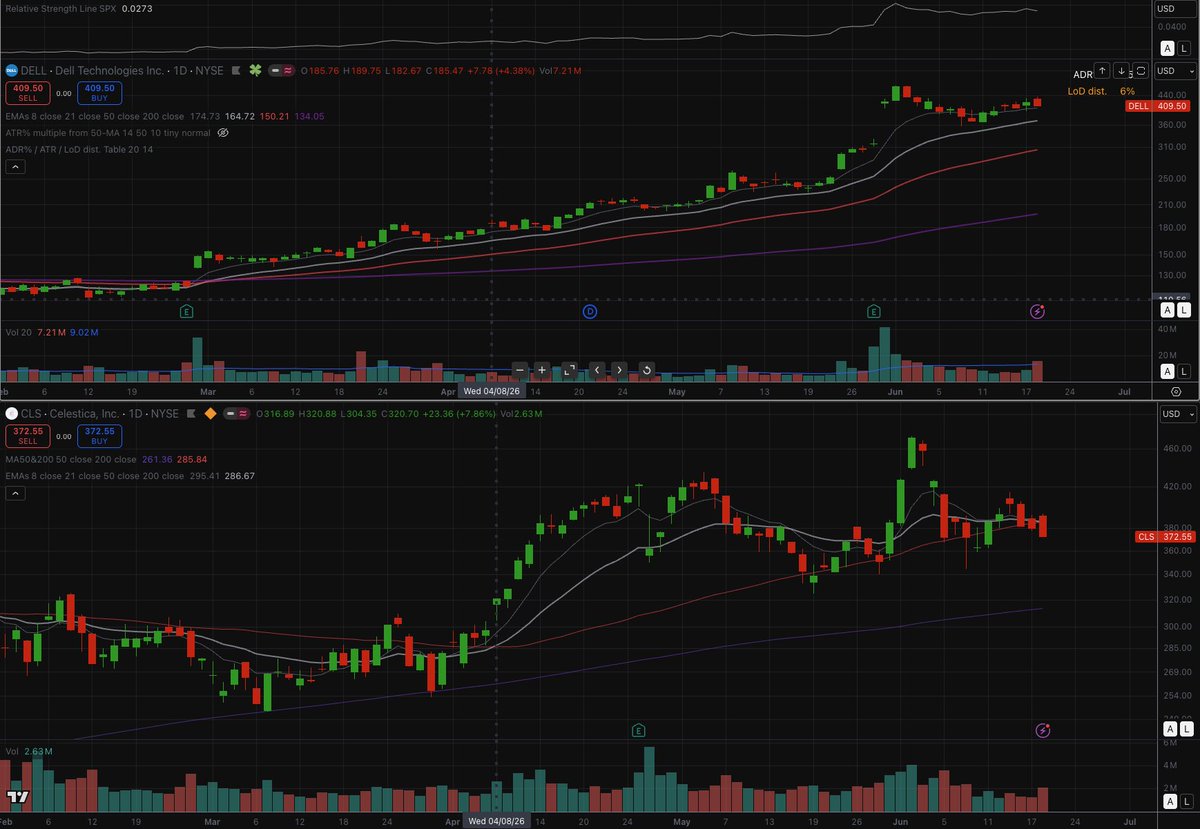
We looked at a few optics names yesterday, now some important nuances on a pair of rack-scale integrators that are serving the market from different angles - $DELL and $CLS
First off, quite the divergence in performance from the 4/8 FTD! Especially on a risk-adjusted basis. CLS is the type of chart that wears you out, and DELL is the smooth ride.
$DELL sits higher up on the AI stack compared to $CLS. Dell provides the turn-key systems, whereas Celestica works with hyperscalers to integrate their own racks, bypassing Dell.
Given the relative performance differential, the market is rewarding integration and ultimately says that new buyers are choosing turnkey systems over procuring their own. Those buyers are more likely to be the neoclouds since GOOG/META/MSFT/AMZN are more likely to design their own.
So the critical read-through is that the marginal buyer right now are those that can't do the integration themselves, such as the neoclouds like Crusoe, IREN, CRWV, NBIS and Enterprise buyers. Job postings in this area for enterprise seem to reflect that shift in trend (keep data safe in-house). Think $LLY Lillipod as an example.
Speed to deployment is also a factor. Look at $NVDA stock. It's been stuck for months. GPU allocation used to be the bottleneck, but now Blackwell is ramping strongly, so that bottleneck now becomes how fast a cluster can ramp, which favors the integrators (DELL).
The other aspect is the complexity of liquid cooling, brought on by Blackwell. $DELL provides a base 1 or 3 year limited warranty on their server racks with options for 24 hour rapid response. That's a guaranteed working factory, and less to go wrong if you want to ramp fast in 2026.
If the "integration is hard and rising fast" read is correct, that means the downstream value capture might be power and cooling at the rack level (VRT, MPWR, VICR, FLEX - via their new power shelf) and maybe networking (ANET, AVGO, MRVL), and the highest torque expressions go to the optical complex with Scale-up and Scale-out exposure (MRVL, COHR, ALAB, CRDO).
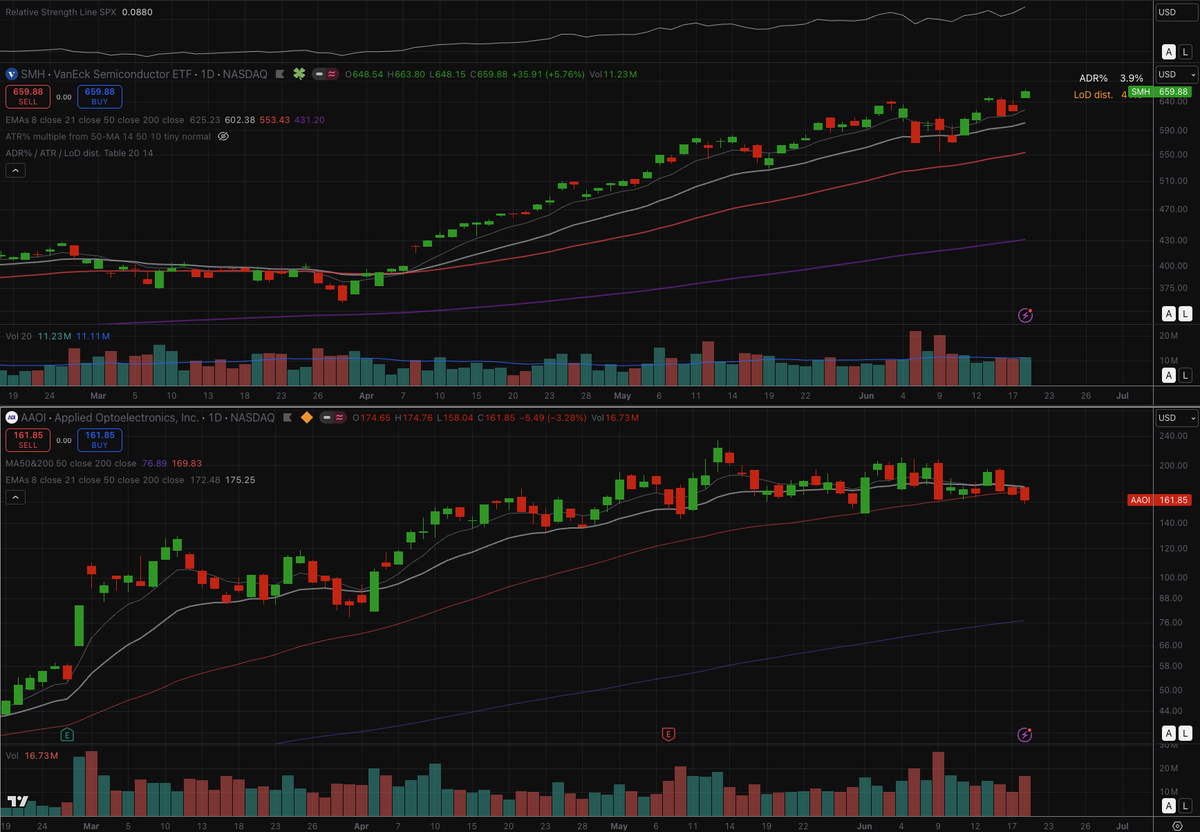
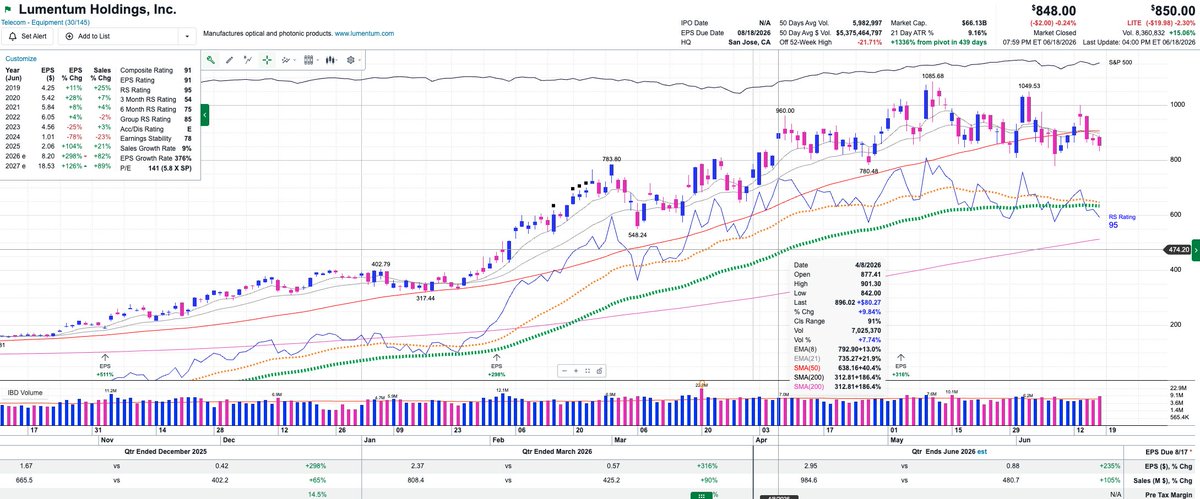
$AAOI $LITE
Sometimes Relative Strength can fool you. Take AAOI and LITE as perfect examples.
LITE is still displaying a 95RS despite being down since the Follow Through Day on April 8th. AAOI is still a 99RS despite marginal gains relative to it's average true range.
If you rewind to April 8th, both would have looked like potential TML's. Leading RS lines, huge earnings and sales growth, rising estimates, and seemingly bottleneck product lines.
So what happened? And why did both of these companies flatline right as the majority of the AI trade just got started?
The answer is that RS only tells you a stock is strong. It doesn't tell you WHY a stock is strong, and the 'why' is what mean-reverts. Relative Strength is a coincident-to-lagging read on the narrative the market already believes. In a clean trend, that is fine since RS and fundamentals point in the same direction.
The second layer is important when the sub-industry is undergoing an architectural transition that sorts winners and losers. This is where your RS line will be of no help. When the re-sort hits, the divergence begins. This is the whole pattern with $LITE and $AAOI.
GTC 2026 was held on March 16-19th. During that event, Jensen Huang released key specifications for the upcoming Vera Rubin platform. As it turned out, the shift validated science and engineering for Scale-Up ("use copper where you can, optics where you must"). At the same time, NVDA's CPO cuts per-port power to 9W from 30W.
The net result is CPO cuts out the transceiver plays for Scale-Up and only leaves them with Scale-Out (still a massive market, but already priced).
In short - copper within the rack, CPO between the racks. NVSwitch replaces pluggable transceivers used on Blackwell.
The confirmation tell - $FN. The stock has performed very poorly and missed out on the SMH rally, now well below the 50 SMA. $FN is the contract optical module assembler that physically builds the pluggable transceivers. CPO scale-up is the direct overhang on their business.
So now the question for $LITE and $AAOI is, is the scale-out market growing fast enough to offset losing scale-up to CPO? The planned 1.6T module ramp is certainly impressive, but losing scale-up is a multiple compression narrative. $AAOI at ~15.6x 2028 EPS is cheap only because the 2028 estimate is the most CPO exposed, and that cheap looking multiple is the disruption fear being quantified.
That doesn't mean buying $AAOI is wrong (although below the 50 sma is a no-go for me), but the AAOI thesis is a direct bet that CPO disruption is overpriced, in time (delays or yield issues) or reach (will Rubin ship with a non-CPO SKU). Neither of which are easy bets to make.
Kinda wild how wrong most energy experts were about the Straits of Hormuz.
What were the root causes of the error? China had more reserves than anticipated, US flexed up exports faster and more ships were actually transiting the straits via the Omani route?
Genuinely curious.
@TheOneLanceB@wguidara Enjoyed your chapter, Lance. I’ve already listened to it 3x. I definitely related to your ‘why’ and the discussion on Atomic Habits
That’s one risk to frontier models but doesn’t capture the dramatic changes happening under the surface.
broader AI adoption and infrastructure story is decoupling from the most powerful model at any given moment. Efficiency gains, distillation, open models, and the sheer economics of inference at scale provide multiple paths for accelerated deployment even under these restrictive scenarios.
The inference inflection makes the AI theme more resilient, not less, to constraints on the absolute frontier.
Very significant to see this development come out late on a Friday evening. First, Fable 5 was already a detuned/guardbanded model where Anthropic spent significant effort trying to make it safe. Given that wasn’t enough, clearly the model has impressive capabilities which means we are rapidly headed into uncharted territory of incomprehensible AI that will transform the world.
Now is a great time to set up safe words with your family and learn everything you possibly can about AI so you’re not left behind. The business and society disruption we are about to face is likely substantial.
The US government, citing national security authorities, has issued an export control directive to suspend all access to Fable 5 and Mythos 5 by any foreign national, whether inside or outside the United States, including foreign national Anthropic employees.
The net effect of this order is that we must abruptly disable Fable 5 and Mythos 5 for all our customers to ensure compliance.
Access to all other Claude models is not affected.
We apologize for this disruption to our customers. We believe this is a misunderstanding and are working to restore access as soon as possible.
Read our full statement: https://t.co/bwn0sximKZ
$ORCL $638 billion in backlog. WILD. Bullish for Chips 🔥
• Customer Prepayments and Supplied Hardware. Of the backlog $75 billion now comes from customers who prepaid for GPUs or supplied the chips themselves. This reduces Oracle’s capex burden but confirms insatiable end demand for high end semiconductors.
• Explosive Cloud Infrastructure IaaS Growth. IaaS revenue hit $5.8 billion in Q4 up 93% year over year and $18.1 billion for full FY2026 up 77% year over year. This is almost entirely driven by AI training and inferencing workloads which require massive GPU accelerator deployments.
• Record RPO Surge. Remaining Performance Obligations jumped to $638 billion up $85 billion sequentially from $553 billion and 363% year over year. Management explicitly tied most of the recent growth to large scale AI contracts involving GPUs.
• Forward Outlook. Oracle confirmed $90 billion FY2027 revenue guidance and raised non GAAP EPS. They continue emphasizing that AI infrastructure demand exceeds supply for GPUs power and networking with innovations in high performance setups positioning them as a fast growing cloud provider.
$MU $DRAM $TSM $NVDA $SNDK $ASX $AMKR
"The tech sector is coming under pressure from a combination of higher rate expectations, which lowers the current value of more distant profits, and anxiety over elevated valuations and uncertainties over the monetization of AI," wrote Mark Haefele, chief investment officer at UBS Global Wealth Management in a research note
Introducing Claude Fable 5: a Mythos-class model that we’ve made safe for general use.
Its capabilities exceed those of any model we’ve ever made generally available.
Is a a bubble? Like the Internet era? Not really. It is different this time in that actual honest, a dollar earnings are also growing as opposed to clicks and eyeballs back then. Doesn’t mean now it is not a bubble, but it is different if it is. And yes, I know the earnings are self-referential. From the FT: