Say hello to Gemini Embedding 2, our new SOTA multimodal model that lets your bring text, images, video, audio, and docs into the same embedding space! 👀
IF you are into context graphs & agentic memory, this is for you:
I've built local-first graph DB for coding agents
🔼 On-device property graph
🔼 One CLI. One Folder. No server
🔼 Schema as code: 100% typesafe
🔼 Fast: Arrow-native, built with Rust
🔼 Full time-travel: query any past state
meet: nanograph
Been using it for 4 days & it feels like magic🪄
Agents pick it up right away:
building typed graphs with clean ontology in minutes
nanogrpah has DuckDB/SQLite energy
.nano graph is a build artifact, not a service.
stored locally on device & backed-up via GitHub
100% open source.
Your agent can set it up in minutes with link↓
Try it, drop a star⭐ and DM me any feedback!
Here's RevOps system we use @CollectivelabHQ
CRM + PM + Finance + BI
Aligned with other OPS
Integrated with comms:
Email, Slack, Zoom
Built on @MongoDB
Managed by agents
[via Mongo MCP & custom tools]
→ 90% inputs are automated
→ Mirror our business ontology
→ Focused [not bloated]
→ 100% stack we like
→ Full data & code ownership
RevOps SaaS is sooo cooked
This year we've built 7 custom RevOps systems.
None of our clients want to go back to
generic bloated SaaS walled gardens
It's just a matter of time now...
CRUCIAL PATTERN for all agent builders🛠️
I'm refactoring several of my toolkits right now
to follow this paradigm
BEFORE: large tools with complex logic inside
[made sense to encapsulate logic from agent → not get it confused]
NOW [with 🆕GEN of models]: agents became way smarter:
→ can handle more tools
→ use them creatively & non-linearly
→ can handle more steps & tools calls in one go
Real example → my RAG tooling [Hyper9 System]:
BEFORE: complex agentic RAG
Separate agentic calls INSIDE the tool built around SPIKE logic:
Signals | Patterns | Insights | KnowHows | Elements
[simpler agent living inside the agentic tool]
NOW: set of small & clean composable tools for the main agent to use
Multiple agents use them independently:
Some as CLI tools [@claudeai Code, @warpdotdev]
Some via MCP [custom, @mastra based]
This automatically upgrades:
GraphRAG → AgenticRAG
Just ran my RAG evals:
the results are 🔥🔥🔥
Unix philosophy wins again💪
I turned my course into MCP server
It exposes my know-hows & methods as callable toolkit
STACK:
▲ Vercel [ecosystem]
NEXT.js [backend]
MCP‑handler [wiring]
Mongo [DB + vector index]
MUX [video & transcripts]
OpenAI [vector embeddings]
Claude [transcript cleanup]
LangChain [text splitters]
Clerk [auth]
Plug it to your favourite AGENT
and now it can apply my expertise at scale🎱
Explore this 🆕 expertise distribution model
Check out the full breakdown
↓
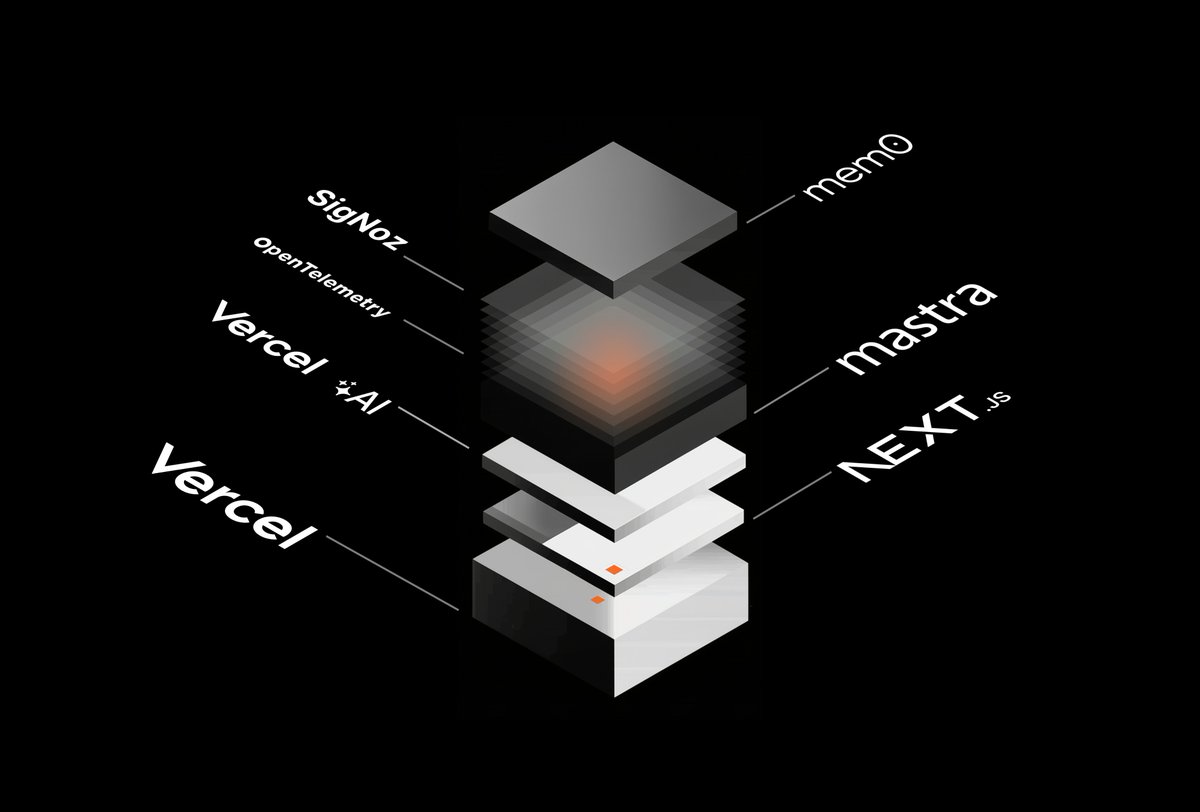
Just published the full breakdown of my AI agent stack:
🔼 @vercel AI SDK [llm wiring]
🔼 @mastra [agentic framework]
🔼 AI Elements [UI components]
🔼 @mem0ai [memory layer]
🔼 OTel & @SignozHQ [traces]
🔼 NEXT.js [runtime]
🔼 Vercel [deploy]
LINK↓
GraphRAG made knowledge graphs sexy again
Here's how to make sense of it:
✳️ Graph vs Knowledge Graph
✳️ Property Graph vs RDF
✳️ SPARQL vs Cypher
✳️ Graph DB vs Traditional DB
✳️ GraphRAG vs RAG
Full cheat sheet ↓
Memory architecture blueprint
for @mastra Slack agent
3-layer system:
✳️ Thread context
✳️ Semantic recall
✳️ Durable memories
L1: Thread context
[Mastra memory → @upstash Redis]
• Recent messages
• Convo context within threads
• Auto-generated titles
L2: Semantic recall
[Mastra memory → Upstash Vector]
• Vector embeddings
• Semantic search for older threads
• Can index shared knowledge [FAQs, SOPs]
L3: Durable memories
[Mastra tool → @mem0ai]
• Specific facts across threads
• User preferences & decisions
• Searchable & persistent long term
How it works:
✳️ Thread memory keeps conversations coherent
✳️ Vector search finds relevant past context
✳️ Mem0 remembers user preferences forever
Perfect context engineering → no agent amnesia
Slack Agent can be used to:
→ Sync the team
→ Nudge team members
→ Manage projects
→ Track decisions
→ Do follow-ups
NO memory: agent perceived as fungible & disposable
THIS architecture: agent becomes valuable part of the team
I'm building my own graph visualization library
I tried everything that's out there
And nothing hits my requirements:
✦ React-first with clean API
✦ WebGL 2D super-fast rendering
✦ Handle 5K+ nodes @ 60 FPS
✦ Web workers for algorithms
✦ Super smooth animations
✦ Nice developer experience
✦ Real data science focused
I need something optimized for heavy commercial projects, not for 3D showcases
So hyper-graph is born!
STACK:
🔼 React → Components & API
🔼 PixiJS → WebGL rendering
🔼 D3-force & ForceAtlas2 → physics
🔼 Web Workers → Algorithm runs
🔼 Graphology → Data model
🔼 Zustand → State management
Learned soooo much already!
As you see in the demo → not perfect yet, but we're getting there
Coming to npm next month🤞
Sensemaking is a process of transforming:
• scattered data
• fragmented information
• raw experience
• probabilistic cues
into
• mental models
• coherent stories
• shared understanding
And AI will change it forever real soon 🧵
1. Notes will be automatically tagged and linked, no manual work required.
2. Notes will be automatically enriched and synthesized to help you find patterns.
3. CoPilot-like functionality will resurface key information from previous notes in-context as you type.
In a knowledge economy, natural selection favors organizations that can most effectively harness and coordinate collective intellectual energy and creative capacity.
@rosenstein