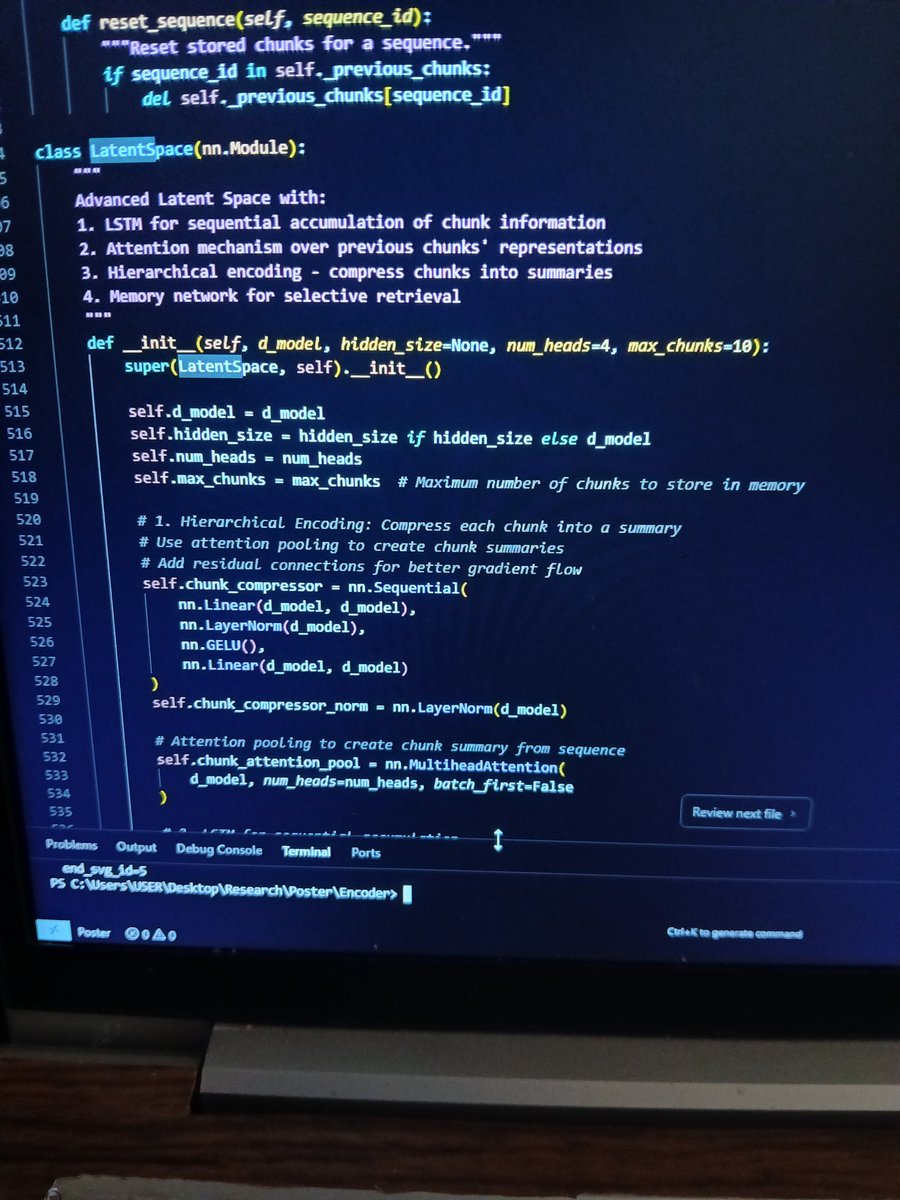
Somewhat sadly, I think we’re seeing the end of Python as a programming language. When agents write the code, the language designed to be the most readable just isn’t as useful.
You were fun, Python.
Been experimenting with different model Architectures trying to squeeze performence on low resource environ. - edge AI. So far Funnel CNN has been the most promising on translation task BLEU score !
To be honest, my personal opinion is that the models will converge on human intelligence because there's nothing in the pretraining data smarter than humans. I think once we get near human intelligence, we will struggle to make progress.
The first proof for 1+1=2 was given by the well-known mathematicians Bertrand Russel and Alfred North in their book "Principia Mathematica".
It was 360 pages long!
"Java is pass-by-value."
"But when I pass an object, it modifies the original object!"
"Yes, because the value being passed is the pointer to the object."
"So it's pass-by-reference?"
"No, the pointer is passed by value."
[C programmer laughing in the distance]
Engineers spent decades shrinking semiconductor process nodes from around 1,000nm to today’s 2nm class so you could carry absurd amounts of computing power in your pocket.
Software developers responded with megabytes of JavaScript, telemetry trackers, six frameworks, and a loading animation for the login page.
Hardware gives. Software takes away.
the golden age of hackathons was fucking amazing. it was the easiest way to build a network, make friends and find a job in tech.
2021 to 2023 was incredible. I knew a ton of people that did hackathons full time. making thousands of dollars and flying around the world. the professional adderall hackathon class.
I knew a ton of startups that raised substantial amounts of money that started as a hackathon project. it also was my number one recommendation to find a job. you learned a ton, interacted with great companies and just built cool shit in a short amount of time.
for young engineers it was the best way to show "proof of skill". to skip leetcode and all that bs and to add something cool to your github. obviously AI nuked the whole concept. building is easy now especially if you don't care about code quality.
the idea guys took over and I'm not sure what the point is anymore. the industry was basically paying people to learn, travel and make friends. looking back, that was a pretty insane deal. I don’t know what the equivalent is for someone starting out today.
GPS was designed exclusively for US military navigation until September 1983, when President Reagan announced that civilian aircraft would be given access to the system after Korean Air Lines Flight 007 - a Boeing 747 carrying 269 people - was shot down by Soviet fighters after its navigation system failed and it strayed into prohibited airspace.
The technology that now guides every phone, car, and aircraft was opened to the public because a navigation failure killed 269 people.
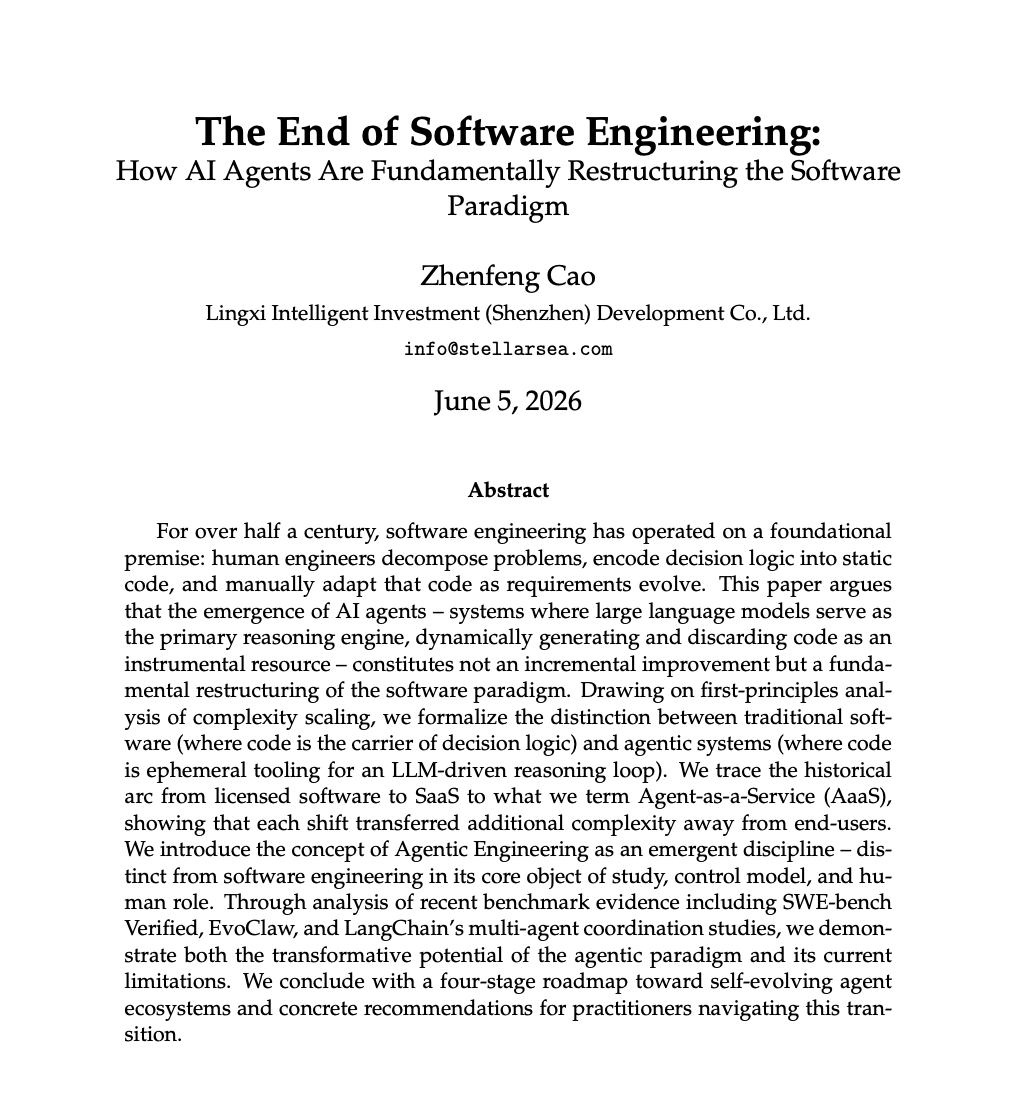
Chinese researchers published a paper with a devastating title: "The End of Software Engineering”
it argues software engineering is finished.
In traditional software, code is the carrier of pre-written human logic.
In agentic software, the AI agent is the software.
Code is no longer a permanent monument built by human hands. It is completely ephemeral, dynamically generated, executed, and discarded on the fly by an LLM-driven reasoning loop.
Think about how software delivery has evolved:
• Era 1: On-premise licensed software (you installed it locally)
• Era 2: SaaS (hosted in the cloud, managed by vendors)
• Era 3: Agent-as-a-Service (AaaS)
Each historical shift transferred complexity away from the user. But this latest shift transfers something entirely different.
It transfers decision-making complexity itself.
The paper argues that traditional engineering is hitting a hard complexity wall. Human brains can only hold so much state, manage so many dependencies, and debug so many lines at once.
LLM-based agents scale non-linearly.
They don't just write functions faster. They navigate architectural complexity by outsourcing reasoning to models that improve every single month.
Which means the role of the developer is permanently changing.
You are no longer a code author typing syntax line by line.
You are an intent architect.
Your job is no longer writing the implementation. It is specifying goals, designing multi-agent coordination loops, and auditing outcomes.