Good old electrophysiology still has tricks up its sleeve. We teamed up with the Vida lab to extend the dynamic clamp from artificial conductances to artificial capacitance in biological neurons. Read about the capacitance clamp and why you should study C: https://t.co/QuOOoYzGRg
Excited to announce our workshop @ CNS*2023 Leipzig (@CNSorg) on "Optimality, Evolutionary Trade-offs, Pareto Theory and Degeneracy in Neuronal Modeling" w/ @jedlickap, @AlexNeurosci July 18 & 19, Leibniz Room. Talks by Astrid Prinz, Tim O'Leary, Anna Levina et al. CU there! 1/2
🪰 How to flap one's wings? 🌟 Our new paper with the Duch lab shows that the right combination of action-potential type and electrical coupling enables the desynchronised neural network activity that stabilises Drosophila flight.
@silvanhuerkey https://t.co/VYEOKcX94N
Wie erzeugen Millionen von Nervenzellen unsere Gedanken? Einblicke in aktuelle Hirnforschung geben drei spannende Sprecher:innen am 11.09. in der @bbaw_de in Kooperation mit @BernsteinNeuro und @BMBF_Bund. Kostenlose Anmeldung für die Veranstaltung unter https://t.co/1fyoMyKAzi
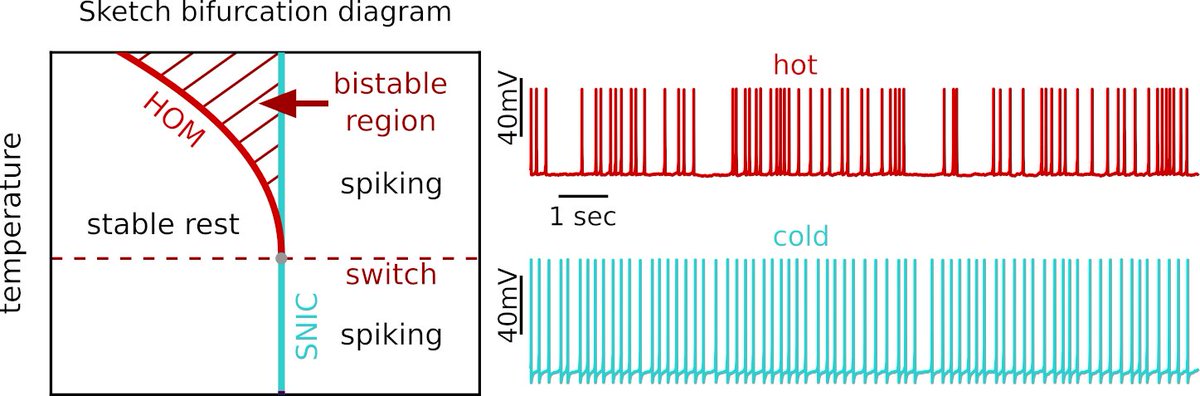
@TMoldwin That depends on how close a cell (i.e., its dynamics) is to the transition point. Depends on the intrinsic properties (channels etc.). For some models/cells its indeed too hot not to degrade proteins. For others it's within the physiological range (or fever 2°C above normal).
Three dynamic classes of APs in regularly firing cells are known. Using temperature to switch spiking, our results suggest the neglected third type, homoclinic spiking with its intriguing coding and synchronisation properties, is relevant in the brain. https://t.co/s9reLe02CV
From schizophrenia to epilepsy, what can mathematical modeling teach us about neurological disorders?
Tomorrow 16:20 GMT+2 at the #ICMNS session "Dynamical systems for neurological disorders" organized by Louisiane Lemaire from our lab and @cgAlexandersen
https://t.co/jWemYt05sP
This Friday Fabian @DiesPallas will present our work on understanding trade-offs in neural optimization using Pareto Theory at the #FENS satellite symposium "Understanding Neural CircuitEvolution" (@SPP2205). Also check out the corresponding paper https://t.co/jh8FRdShs8
Good old electrophysiology still has tricks up its sleeve. We teamed up with the Vida lab to extend the dynamic clamp from artificial conductances to artificial capacitance in biological neurons. Read about the capacitance clamp and why you should study C: https://t.co/QuOOoYzGRg
Zebra finches take turns to avoid tweeting at the same time. @LabVallentin & the Schreiber lab described the underlying neuronal circuit. It’s based in a brain area called HVC, integrates auditory inputs & precisely times vocal output: https://t.co/qGkEBWrnl7
🖌️ by Matt Zaharchuk