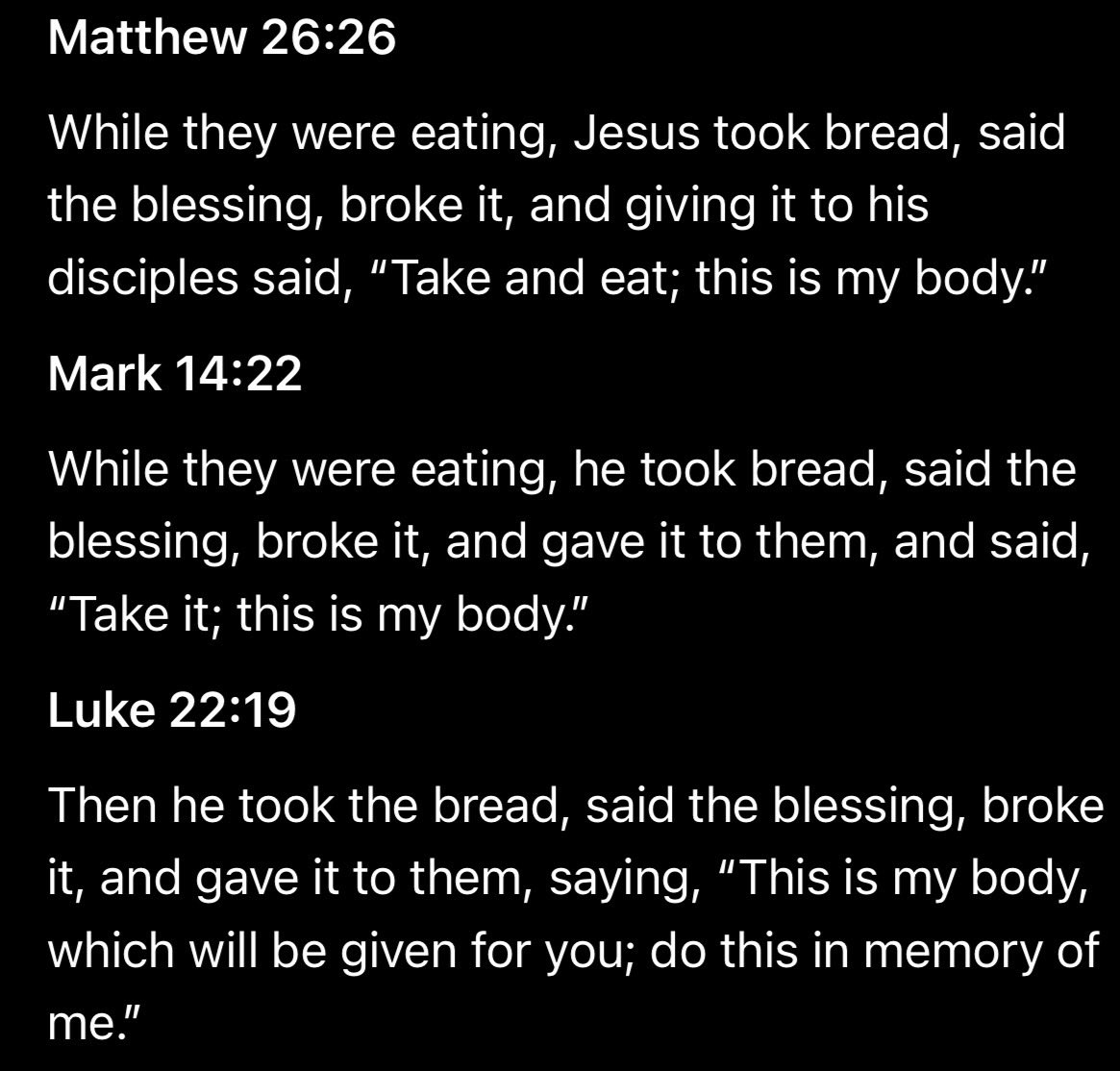
@Godsavedme4real This is hilarious.
This guy says it’s prideful to assume you can lose your salvation through mortal sin (turning away from God).
Yet, at the same time, he’s the most prideful because he assumes he knows what God knows and that he is going to heaven — convinced he can’t lose it.
@eick74@wcmclaa Hey @grok when did Catholics first establish the books in the Bible and how many books did it have? Did the earliest Christians use the Septuagint? Was it most likely used by Jesus as well? Was this 73 book canon de facto used in Catholic liturgy for centuries before 1500’s?
@eick74@wcmclaa@grok@grok make sure to stick to the true historical account, as usual. It’s important to have context and evidence to debunk anachronisms and disingenuous posts downplaying the evidence in one direction and giving hyperbolic weight to cherry picked random events.
@eick74@wcmclaa Hey @grok when did Catholics first establish the books in the Bible and how many books did it have? Did the earliest Christians use the Septuagint? Was it most likely used by Jesus as well? Was this 73 book canon de facto used in Catholic liturgy for centuries before 1500’s?
The verse no Protestant wants you to read:
"Baptism, which corresponds to this, now saves you, not as a removal of dirt from the body but as an appeal to God for a clear conscience"
Thomas Aquinas was a great theologian whose work contains rigorous argumentation that historic Protestants agree with, especially his works concerning the nature of God and the person of Christ. However, we also disagree with some of his other conclusions.
I know this will come as a surprise to those who are only steeped in Roman Catholic theology, but protestant theologians have developed substantial exegetical and philosophical arguments against those positions of Aquinas where we have theological differences—including aspects of his account of justification and the sacraments.
For example, start with Francis Turretin’s Institutes of Elenctic Theology. If you go to Topic 1, Question 12, Turretin expressly defends establishing theological conclusions by necessary inference from Scripture. Indeed, Protestant scholastics discussed the legitimacy of this method and employed it throughout their theology.
For specific doctrinal arguments, turn to Topic 16: Question 2 addresses whether inherent righteousness can ground our justification; Question 3 defends the imputation of Christ’s righteousness; Question 8 argues for justification by faith alone. These discussions define the disputed terms, establish premises, draw conclusions, and answer objections—including arguments advanced by Roman Catholic theologians.
But here is a particularly insightful example. In his Commentary on the Heidelberg Catechism, under Question 62, Zacharias Ursinus presents this argument (as a paraphrase).
1.The righteousness on account of which we are justified before God must conform perfectly to his law.
2.Our own obedience, even after regeneration, does not conform perfectly to that law.
3.Therefore, our own obedience cannot constitute the righteousness on account of which we are justified before God.
Ursinus calls this a syllogism and proceeds to defend its major and minor premises. He appeals to Leviticus 18:5 and Deuteronomy 27:26 concerning the law’s demands, and to Matthew 6:12 and Psalm 143:2 concerning our continuing need for forgiveness. This is a historical Protestant argument directed expressly against Rome’s account of justification.
Catholics may dispute a premise or challenge his interpretation of those passages. If you do, that would give us something substantive to discuss. But, as with areas with Aquinas where we differ, disagreement with an argument does not establish that the argument doesn’t exist or is without merit.
A Catholic appeal to Aquinas also requires precision about “demonstration.” In Summa Theologiae I, question 1, article 8, Aquinas explains that sacred theology reasons from articles of faith received through revelation. It does not establish those foundational articles by unaided reason. In I, question 32, article 1, he then denies that natural reason can demonstrate the Trinity. His distinction matters when we are comparing theological arguments.
So let’s examine the premises and the inferences. Neither side establishes its conclusions merely by arranging propositions into a syllogism. But claiming that Protestants have never supplied such arguments overlooks an entire theological literature. Turretin and Ursinus are perfectly good places to begin.
In Luke 1:28, the angel Gabriel greets Mary with the title kecharitōmenē, translated “full of grace.” In Greek this indicates an action already completed with effects that continue into the present.
"full of Grace" means without sin.
Furthermore, the old Ark of the Covenant had to be incorruptible, and so too, Mary the New Ark must also be.