I’ve spent most of my career close to infrastructure, build systems and developer tooling and I think there’s an important idea underneath this thread.
Software engineering isn’t disappearing. The abstraction boundary is moving again.
We moved from assembly to higher-level languages, from servers to cloud, from manual infrastructure to declarative systems. Each time, engineers stopped caring about some details and became responsible for a larger system.
Agents are another, much bigger, jump.
When an agent can produce thousands of lines of code in minutes, reviewing every line stops scaling. The interesting questions move up a level:
1/ Does the system do what we intended?
2/ What assumptions did the agent make?
3/ What happens under failure, load or partial degradation?
4/ Are the boundaries and dependencies right?
5/ Can we observe it well enough to know when reality diverges from intent?
I’m less convinced that tests, terminals or code review simply “die.” Their role changes. We’ll test behaviour more than implementation. Review intent and architecture more than syntax. Observability becomes part of verification, not something added after deployment.
And I think one skill becomes more valuable: building a mental model of a system you didn’t personally write.
That’s something I’m thinking about a lot while building @OpenLume too. If agents increasingly produce the implementation, humans need better ways to understand the architecture, flows and decisions around it. Maybe visually, interactively, without reading 20,000 lines of generated code?
The engineer of the future may write far less code. But they’ll need to understand far more software.
That’s what @OpenLume does for dev tool docs:
- Turns your docs pages into narrated visual lessons
Embeds in Mintlify, Docusaurus or any site
- developers pause and ask questions, no account needed
- Updates the lesson at the same link when your docs change
If you have a docs page that needs a diagram to make sense, try it free:
https://t.co/TKipKjouvd
A query on a warm working set never touches S3.
How @ObsessionDB does it, as a visual lesson from their docs: https://t.co/JlY6r2YV2Y
Ask it questions, and it updates when the docs change.
Make one from your docs: https://t.co/olMTNVkOHG
Today we are launching @ObsessionDB, the realtime data warehouse for agents.
Your agents are hungry for data. Feeding them is getting expensive.
Your data warehouse wasn't built (or priced) for that.
We learned this the hard way. We scaled our last company to petabytes on ClickHouse and watched the infra bill go vertical.
So we built @ObsessionDB . The ClickHouse engine, rebuilt with compute and storage separated, so your infra scales with your agents instead of your bill.
100x faster and 20x cheaper than Snowflake and Databricks. Already live, processing trillions of rows a day.
Agents are just getting started...
@marchoeffl@ObsessionDB Every write warms the cache too, so new parts are fast right away. I turned your tiers docs into a visual lesson: https://t.co/JlY6r2YV2Y
Devs can pause and ask it questions, and when your docs change, it updates at the same link.
Run STM32 firmware with no board on your desk.
How Simantic does it, as a visual lesson from their docs: https://t.co/couicFmAnV
Ask it questions, and it updates when the docs change.
Make one from your docs: https://t.co/olMTNVkOHG
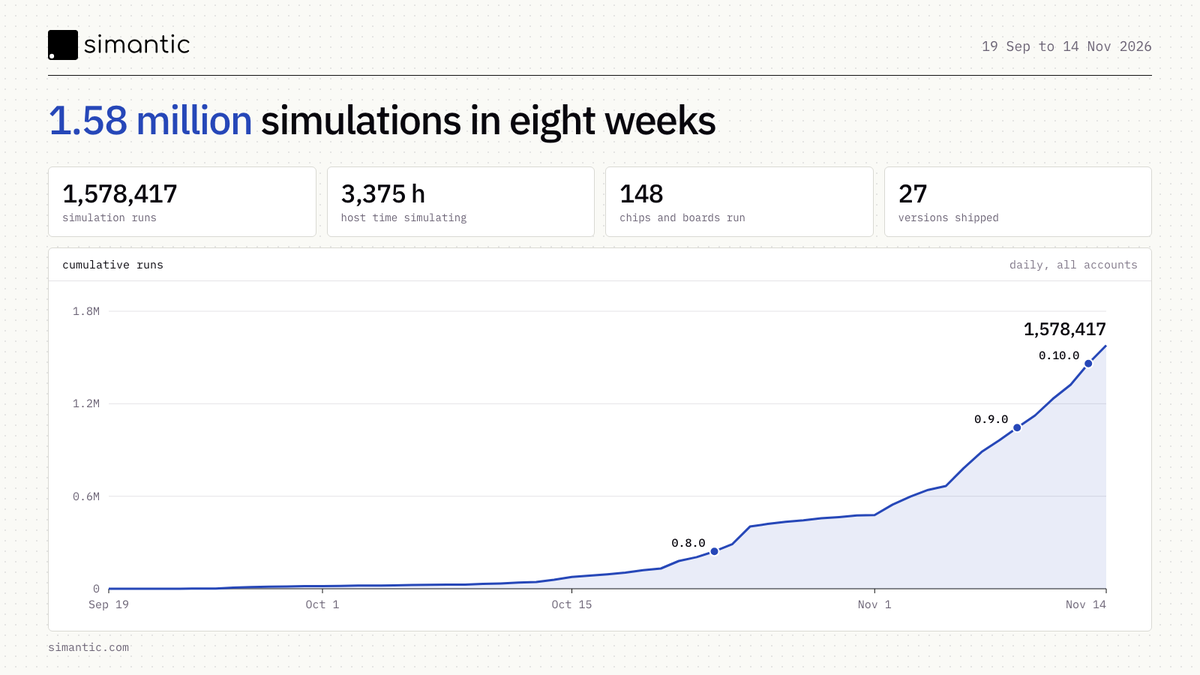
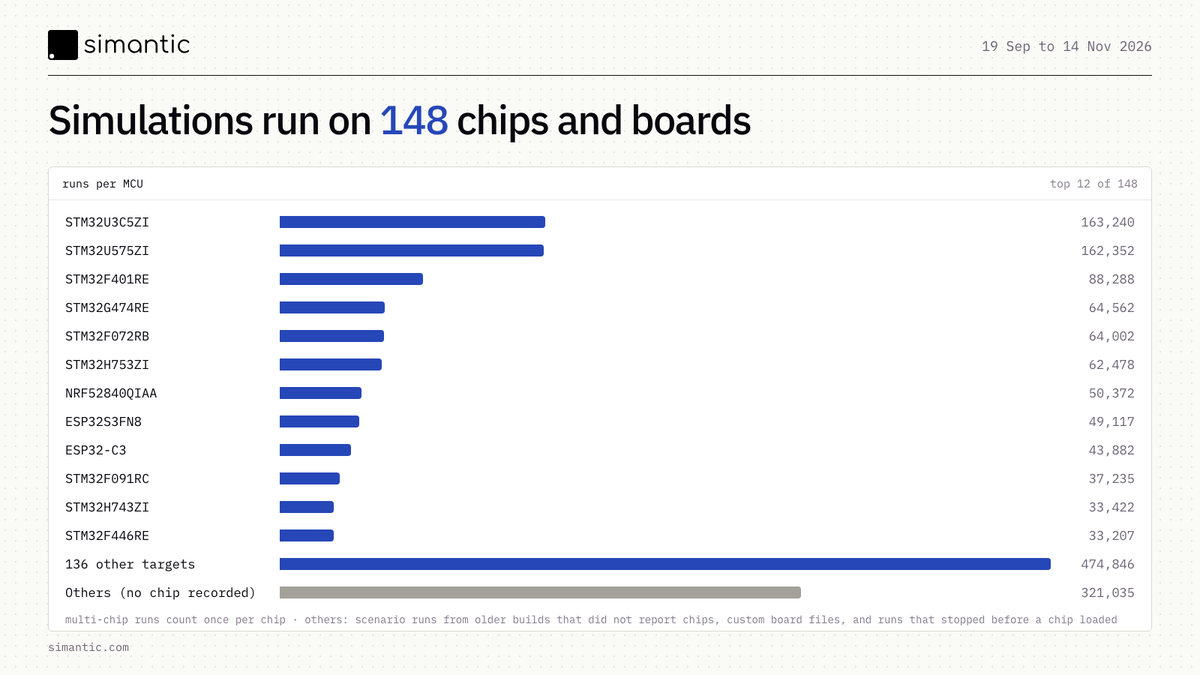
In the last two months, @simantic has processed over 1.5 million simulation runs equating to over 3000 hours of compute time, with an average growth rate of 70% per week.
Ever since we joined @ycombinator 8 weeks ago, we've been working on creating the most accurate simulation models for a wide range of MCUs and SoCs, to close the gap in fully autonomous hardware and firmware development.
Now we run in the CI pipelines, benchmarks, and agentic verification loops for engineering teams building satellites, robotics, and consumer electronics.
If your firmware team needs a better CI and verification loops, DM me or email us at [email protected], or go to https://t.co/cXPb91zTbt
@shong0504 Run STM32 firmware with no board on your desk.
How Simantic does it, as a visual lesson from their docs: https://t.co/couicFmAnV
Ask it questions, and it updates when the docs change.
That’s what @OpenLume does for dev tool docs:
• Turns your docs pages into narrated visual lessons
• Embeds in Mintlify, Docusaurus or any site
• Lets developers pause and ask questions, no account needed
• Updates the lesson at the same link when your docs change
If you have a docs page that needs a diagram to make sense, try it free: https://t.co/0hugklJNnJ
I converted Inference engineering topic from The Pragmatic Engineer newsletter into a visual lesson.
You can pause and ask it questions:
https://t.co/d4dZGYesCD
@GergelyOrosz@CompleteSkeptic I converted Inference engineering newsletter into a visual lesson.
You can pause and ask it questions -
https://t.co/d4dZGYesCD
@tonychang430 All these sandboxes need a better documentation. I turned Superserve docs into a visual lesson: https://t.co/4CFp01eNfC
Devs can pause and ask it questions, and when your docs change, it updates at the same link. Make your own free: https://t.co/olMTNVkgS8
Your agent learns a website once, then calls it like an API, with no model in the loop.
How Pomerado does it, as a visual lesson from their docs: https://t.co/26c0VuXgtC
Ask it questions, and it updates when the docs change.
Make one from your docs: https://t.co/olMTNVkOHG
@pomeradoai now supports APIs for over 700 sites
- ecom (amazon/target/etc)
- food delivery
- flights and taxis
- business portals
people were making so many APIs we had to redesign the dashboard:
@akshay_manglik@pomeradoai@Alanmrsa1 Your agent learns a website once, then calls it like an API, with no model in the loop.
How Pomerado does it, as a visual lesson from their docs: https://t.co/26c0VuXgtC
Ask it questions, and it updates when the docs change.
A git push that’s durable before S3 sees it.
How @enroute_sh does it, as a visual lesson from their docs: https://t.co/0Co43umQxk
Ask it questions, and it updates when the docs change.
Make one from your docs: https://t.co/olMTNVkgS8
We just built the most scalable Git server out there: 7,600+ concurrent pushes/s per repo at millisecond latency.
Powered by Raft and S3, designed like a modern database.
Today we're making it open source by releasing Enroute 0.3.0.
Read the write-up: https://t.co/y9W7YLN148
@periping A push that’s durable before S3 sees it is a great design. I turned your write-path docs into a visual lesson: https://t.co/0Co43umQxk
Devs can pause and ask it questions, and when your docs change, it updates at the same link. You can also make your own.
Snapshot mid-task, fork twice and try both fixes. Love it. I turned your snapshots docs into a visual lesson: https://t.co/4CFp01eNfC
Devs can pause and ask it questions, and when your docs change, it updates at the same link. Make your own free: https://t.co/olMTNVkgS8
Today we’re launching Superserve (YC F26).
Every agent needs a computer. We are building the cloud to give each one their own.
Already running over 100,000 machines every week for teams like Lindy and Y Combinator.
Fastest cold and snapshot starts. Beats E2B, Daytona, Modal, Cloudflare, Vercel, and Google Cloud Run.
curl -fsSL https://t.co/W1kyrb0nfE | sh
@pavitrabhalla Snapshot mid-task, fork twice and try both fixes. Love it. I turned your snapshots docs into a visual lesson: https://t.co/4CFp01eNfC
Devs can pause and ask it questions, and when your docs change, it updates at the same link.
Your agent can’t click on a screen it hasn’t seen.
How @trykubi does it, as a visual lesson from their docs: https://t.co/Sxkgo7Pjol
Pause and ask it questions. When the docs change, it updates at the same link.
Make one from your docs: https://t.co/olMTNVkgS8
Another sandbox startup launch. Ah sh*t, here we go again.
Introducing Kubi: cloud desktops for AI agents.
> Its own Debian desktop (Windows / Mac coming)
> $20/mo or $0.035/h for 4 CPU and 8 GB RAM (cheapest in the game)
> Screen control over MCP, SDK or raw API
> Full disk & proxy control
Grab a $20 screen while I can still lowball my competitors. Early users keep that price for life.
https://t.co/Ddcb4oGymL
Sign up, dm me or comment, and I'll let you in.
@arthurkatcher Love that an agent can’t click on a screen it hasn’t seen. I turned your look-and-act docs into a visual lesson: https://t.co/Sxkgo7PRdT
Devs can pause and ask it questions, and when your docs change, it updates at the same link. Happy to share embed code.
Your agent sleeps for $0.54 a month and wakes up in seconds.
I made a short visual of what happens in between: it goes idle, gets checkpointed, then the next request waits at the edge while the instance comes back.
Built from their docs, and when the docs change, the lesson updates at the same link: https://t.co/ZlVWJJvu7r
The CEO of Vercel called us out. We claimed https://t.co/DqCfjvVkFz was 25x cheaper, and he said we didn't consider active CPU time.
So we fixed the math..
We gave 100 coding agents a sandbox each and had them vibe code an app. Here's the cost per hour at just 5% active CPU:
Vercel: $9.75 (14x)
E2B: $16.56 (24x)
Daytona: $16.56 (24x)
Agent37: $0.68
We're starting a race to the bottom... see you there.
Find a cheaper sandbox and we'll refund the difference.
@an_engineer_log Your sleep and wake setup was too good not to animate. I made a short visual lesson of it from your docs: https://t.co/eERekN9uIg
Happy to send embed code, and I’ll keep it in sync when your docs change.
I turned @triggerdotdev's how-it-works and runs docs into a short visual lesson: https://t.co/rBQgKeMd56
It shows a long job pausing while it waits on subtasks, then picking up right where it stopped.
It's free to use and you can embed it in your docs. People can ask it questions while they watch. If anything's off, tell me and I'll fix it.
Happy to make more. Do you think queues and concurrency would be a good next one.