Building your Digital Sanctuary on IRYS. 🛡️
Claiming your data sovereignty. Your AI, your keys, your legacy. Join the 1% who truly own their digital soul.
Upload a file. Ask Coopa to find it.
No search bar. No folder navigation. No "where did I save that?"
Just ask.
This is what it looks like when your AI actually knows your data not because it stores it on a corporate server, but because it reads from the permanent, encrypted memory that belongs only to you.
The file doesn't live in Coopa. It lives on the permanent network. Coopa just knows how to find it because you told it to remember.
This is the Memory Layer of the Mechanical Living Being.
@irys_xyz@samecwilliams@josh_benaron@ar_io_network
#BuildInPublic #Web3 #Coopa #PermanentWeb
This is what Coopa looks like right now in development.
The live site at https://t.co/3P1cmKywFA is still running the previous version. We know. It's intentional. You don't ship a half-built sanctuary.
What you're seeing here is v3.28.4 the Mechanical Living Being, fully active. Seven modules orbiting a single entry point. Zero Trust. Permanent Storage. Web3 Identity. Quantum Protected. All running. All connected.
The live version catches up when the work is done. Not before.
We build in public because hiding the process would contradict everything we stand for. The gap between what's live and what's built is not a failure it is the distance between a promise and the work required to keep it.
It's closing.
@irys_xyz@josh_benaron@samecwilliams@cdixon@levelsio
#BuildInPublic #Web3 #Coopa #PermanentWeb
Order matters more than people think.
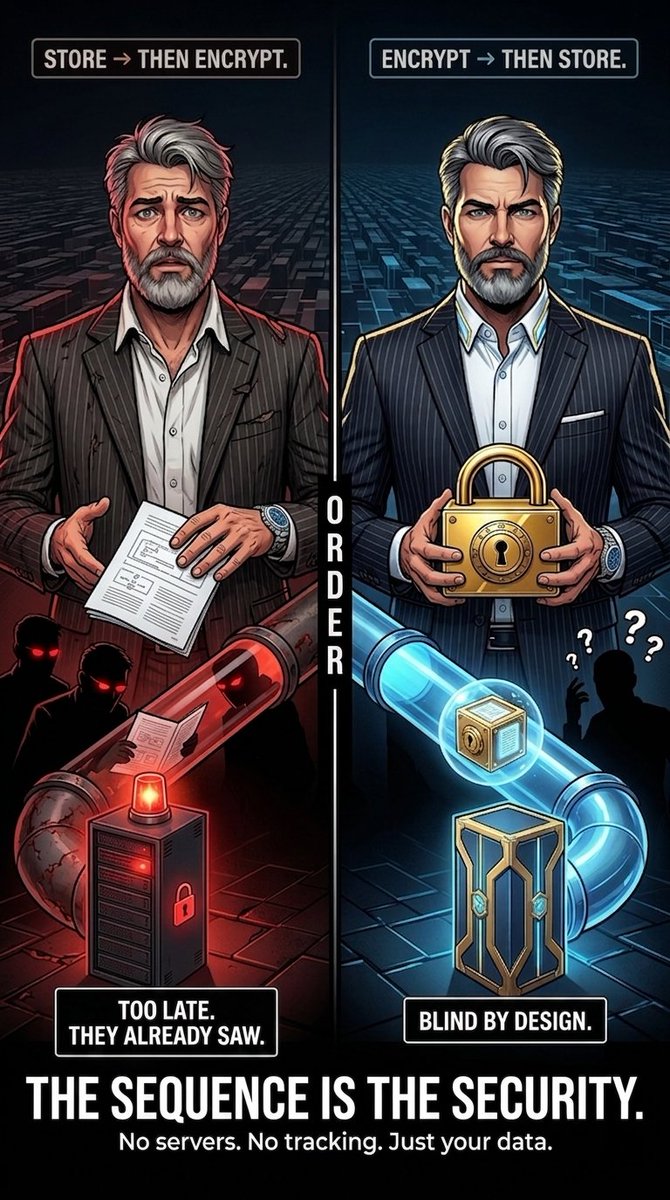
Most systems that claim to protect your data encrypt it after it leaves your device. The data travels first, then gets wrapped. By then, it has already passed through infrastructure that could have read it. The promise of encryption arrives too late.
We spent a long time thinking about sequence.
In Coopa, the order is non-negotiable: your data is sealed before it moves. Not on our servers. Not in transit. On your device, before anything else happens. By the time it touches the permanent network, it is already mathematically opaque to us, to anyone, to every server it passes through.
This is not a minor implementation detail. It is the entire security model.
Encrypt-then-store is fundamentally different from store-then-encrypt. One builds the wall before opening the door. The other hopes no one is watching while it builds.
We chose the harder sequence. Because in privacy, order isn't a preference it's a guarantee or it's nothing.
What other sequences in tech do people get backwards without realizing it?
Drop a comment 👇
#BuildInPublic #ZeroTrust #Web3 #Coopa
@zooko@cdixon@thegrugq
@VitalikButerin@ethereumfndn@aerugoettinea Choosing depth over speed is the only way to build a sanctuary technology. If we trade CROPS for just high TPS, we become the very Web2 institutions we tried to replace. Intermediary minimization isn't just a technical goal, it's a moral imperative for Web3.
@ErikVoorhees Building for convenience made the ecosystem lazy. True user controlled cryptography and onchain privacy are the ultimate red pills. This energy is non-negotiable for the future of Web3.
@samecwilliams The integration of technical intelligence with permanent storage is exactly where the industry needs to go. Giving agents the framework to directly ship to the permaweb shifts the paradigm from 'AI as a helper' to 'AI as an autonomous builder'. This is massive for DevX.
Someone, at some point, has to make the decision.
Not the decision to "care more about privacy." Not the decision to "read the terms of service." Those are small adjustments inside a system designed to extract from you.
The real decision is harder: to stop renting your digital life and start owning it.
Every platform you use today was built on a single assumption that you will trade your data for convenience, indefinitely, without ever questioning the terms. And for decades, that assumption has been correct. Because the alternative didn't exist.
It exists now.
The transition from data serfdom to data sovereignty is not a technical upgrade. It is a philosophical rupture. It requires admitting that "free" was never free that every gigabyte you uploaded, every message you sent, every memory you stored was a payment you didn't know you were making.
Coopa was built for the moment someone decides they're done paying.
Not with anger. Not with a manifesto pinned to a wall. But with a quiet, irreversible act: moving their data to infrastructure that answers only to them.
The question was never "is this possible?" The question is: who decides to go first?
Drop a comment 👇
#DataSovereignty #Web3 #Coopa #PermanentWeb
@balajis@naval
Your password doesn't belong to you.
It never did.
The moment you handed it to a platform, it became a shared secret. Theirs and yours. And anything that belongs to two parties is only as secure as the weaker one.
LinkedIn. Yahoo. Adobe. RockYou. Equifax.
These weren't sophisticated attacks. They were the inevitable outcome of an architecture that requires your secret to live somewhere you don't control.
We've accepted this so completely that most people have never stopped to ask: does it have to be this way?
It doesn't.
In Coopa, we don't know your password. Not because we chose to be responsible with it. Because the architecture makes it structurally impossible for us to have ever received it.
Your identity is verified through a cryptographic signature a mathematical proof that you possess something, without revealing what that something is. We confirm you were there. We never learn what you used.
Nothing to leak. Because we hold nothing that matters.
And the key itself?
Twelve words. Memorisable. Yours alone. From those twelve words, everything derives your identity, your data, your ability to recover everything if your device is lost or destroyed.
Not from our servers. From memory.
This week's article goes deep on what a key actually is, why the password was always a flawed idea, and what changes when the architecture is built around you not around the platform's need to know you.
👇 Link in comments.
#DigitalSovereignty #Privacy #Web3 #ZeroTrust #Encryption
@NativeSatoshi The current layout proved the math and the architecture work seamlessly. The new home will make interacting with your sovereign data feel entirely natural. Appreciate the support.
Something is changing at Coopa.
The interface you've seen so far was a beginning. A proof that the architecture works. A first breath.
What's coming is different.
A complete redesign. A new entry point. A system that doesn't just function it speaks the language of what we actually built. Sovereign. Permanent. Alive.
The Mechanical Living Being deserves a home that looks like what it is.
We're not announcing a date. We're announcing that the work is happening right now, in the same spirit that built everything else: quietly, precisely, without shortcuts.
When it's ready, you'll know.
@irys_xyz@samecwilliams@josh_benaron@ar_io_network
#BuildInPublic #Web3 #Coopa #PermanentWeb
@NativeSatoshi@Snowden@muneeb Exactly. We shouldn't need to trust the integrity of a CEO when we can just trust the integrity of mathematics. That’s the core of the Blind Server architecture.
Every privacy policy you've ever agreed to is a promise. And promises break.
"We don't sell your data." "We take your privacy seriously." "Your information is safe with us." These are words. Written by lawyers. Subject to change. Dependent on the continued goodwill of people you will never meet.
Coopa doesn't make promises. It makes the promise structurally impossible to break.
The server doesn't see your files because it architecturally cannot. Not because we've decided to look away. Not because of a policy that a new CEO could reverse on a Tuesday morning. The encryption happens before anything leaves your device. By the time data touches our infrastructure, it is already mathematically sealed.
We call this the Blind Server. And blindness, in this case, is not a limitation it is the entire point.
A system that could see your data but chooses not to is a system you have to trust. A system that cannot see your data is a system you don't have to trust at all.
That distinction is the difference between a privacy policy and a privacy guarantee.
When was the last time a company's promise was enough?
Drop a comment 👇
#ZeroTrust #DataSovereignty #Web3 #Coopa
@zooko@thegrugq
The leash problem is real but it's not just about prompting or verification. It's about what the agent is anchored to.
An agent that runs on infrastructure it doesn't own, with memory that lives on someone else's server, will always be middle-to-middle. The human principal can't fully trust what they can't fully own.
High agency starts with sovereign infrastructure. Not just better prompts.
And yet we keep building systems that promise permanence then delete your account for missing a payment.
The impermanence of mind doesn't have to mean the impermanence of memory. What you choose to preserve, mathematically and irrevocably, is the one thing that outlasts the searching.
That's what we built Coopa for.
This is exactly the distinction most people miss. Verifiability without independence is just another form of trust and trust is exactly what we're trying to eliminate from the equation.
We built Coopa on the same premise: the server should be structurally blind, not just policy-compliant. When your AI's memory lives on an immutable network, "trust us" stops being part of the architecture.
The right tool for a specific trust problem. Precisely.
@T_C_O_T_M@ErikVoorhees@ar_io_network Exactly. Relying on a corporate promise vs. relying on math and decentralized networks is the ultimate paradigm shift.
Every file you've ever stored in the cloud has a gatekeeper.
Not a lock. A gatekeeper. A company that decides, every single day, whether you can access what you uploaded. Change their terms. Miss a payment. Anger their algorithm. The gate closes.
You were never given a key. You were given a ticket and tickets expire.
Coopa was built on a different principle: the gateway to your data belongs to the network, not to us. Not to any company. Not to any jurisdiction.
When your file is committed to the permanent web, it is addressable forever. The path to it does not route through a corporate server that can be switched off. It does not require an account in good standing. It does not depend on our continued existence as a company.
If Coopa disappeared tomorrow, your data would still be there. Exactly where you left it. Exactly as you encrypted it.
This is what permanent access actually means not "we promise to keep it up." But "the network itself is the promise."
No permission required. No renewal needed. No gatekeeper.
What would you trust with something you needed to last a hundred years?
Drop a comment 👇
#PermanentWeb #DataSovereignty #Web3 #Coopa
@samecwilliams@cdixon
Most people think they own their digital life.
They don't. They're renting it.
The platform holds the keys. The platform sets the terms. The platform can change them tomorrow, silently, without asking.
We rebuilt feudalism. We just gave it a better interface.
The serf didn't wake up thinking "I am unfree." He thought "this is how things are." That's exactly how most people feel about their relationship with Big Tech today. Not oppressed. Just... navigating.
But there's a word for a system where someone else holds the key to what you thought was yours.
It's not "free." It's conditional.
Every photograph you've uploaded. Every message you've sent. Every document you've stored. All of it exists at the pleasure of a corporation subject to terms written by someone you'll never meet, changeable at any moment, for any reason.
That's not ownership. That's tenancy with good UX.
At Coopa, we made a different architectural decision.
The key stays with you. The encryption happens on your device. What reaches our servers cannot be read not because we choose not to read it, but because we structurally cannot.
Sovereignty isn't a privacy policy. It's a structural reality.
This week's article goes deep on what digital ownership actually requires technically, philosophically, and historically.
Read it. Then ask yourself: do you own your data, or are you just the most recent tenant?
👇 Link in comments.
#DigitalSovereignty #Web3 #ZeroTrust #Coopa
@samecwilliams