The UK public is not allowed to see the due diligence the Sovereign AI Fund does on portfolio companies around copyright/training data issues, because it could reveal things that "could be used by... litigants" against those companies.
This is absolutely crazy, given that Sov AI is only supposed to invest in companies that comply with copyright law.
I submitted an FOI request for this info, but it was refused - even redacting company names & other info.
Is the UK government sitting on info that could be used by rights holders to sue these AI companies? If so, why is it investing in them? If not, why will it not release the info it has?
A think tank funded by Anthropic, OpenAI and Google is urging the UK government to weaken copyright law to let AI companies train on creatives' work without permission.
And it has the gall to say this would "benefit both AI and creators."
Shameless.
I am ensorcelled by the gilt decoration of this 1920s edition of Hilaire Belloc's "The Old Road", it's his travelogue of the old pilgrim road between Winchester and Canterbury.
I love observing the working life of news photographers - with their bunfights and hosedowns and all that
Here we see the lucky dip that is the prison van shot
OK, if you are looking for another example of massive "Scaled content abuse", then look no further than..... FACEBOOK. Saul Westbrook wrote a great post documenting the /fb-answers/ directory, which Facebook started populating in July 2026. Now there are 6M+ urls indexed there and the directory ranks for millions of queries. And that's across surfaces (10-blue links, AIOs, and AI Mode).
The pages consist of AI-generated content targeting many different topics, queries, etc., and then Facebook includes public FB shares from people or pages.
From what Saul explains, "There seems to have been no editorial oversight for this content. Page topics overlap with each other - for example, I was able to find over 180 pages in English on Padel Tennis."
And then at the end of each page, they link internally to many other "related pages" in the fb-answers directory. This sure seems like a way to drive many more visitors to the site to pump up traffic numbers...
https://t.co/Z0k4KL2y0i
If you are an artist who sells on Etsy, Etsy now claims the right to train AI models on your work, and for their ‘partners’ to do so too.
This should be illegal.
https://t.co/Vw8CJ4ib0M
The next time someone tells you that markets are rational remember that in 2026 pretty much every company simultaneously announced that they were going to borrow a quadrillion dollars to build 420 data centers in six months with chips they didn’t have powered by electricity they couldn’t get from turbines that weren’t built sent through transmission lines that didn’t exist and everybody was like “Cool, cool. Sounds good. Solid plan.”
If you don’t get on board with AI now, you’re going to feel like a huge idiot in five years when everything is AI, and a huge genius in ten years when everyone realizes how much that sucks.
The Laura Kuenssberg deepfake crypto scam ads are still going on X, with this campaign saying "I wonder what's in the bag" in a bedroom with an unknown man. We detected over 133,000 impressions of this bad ad variant today.
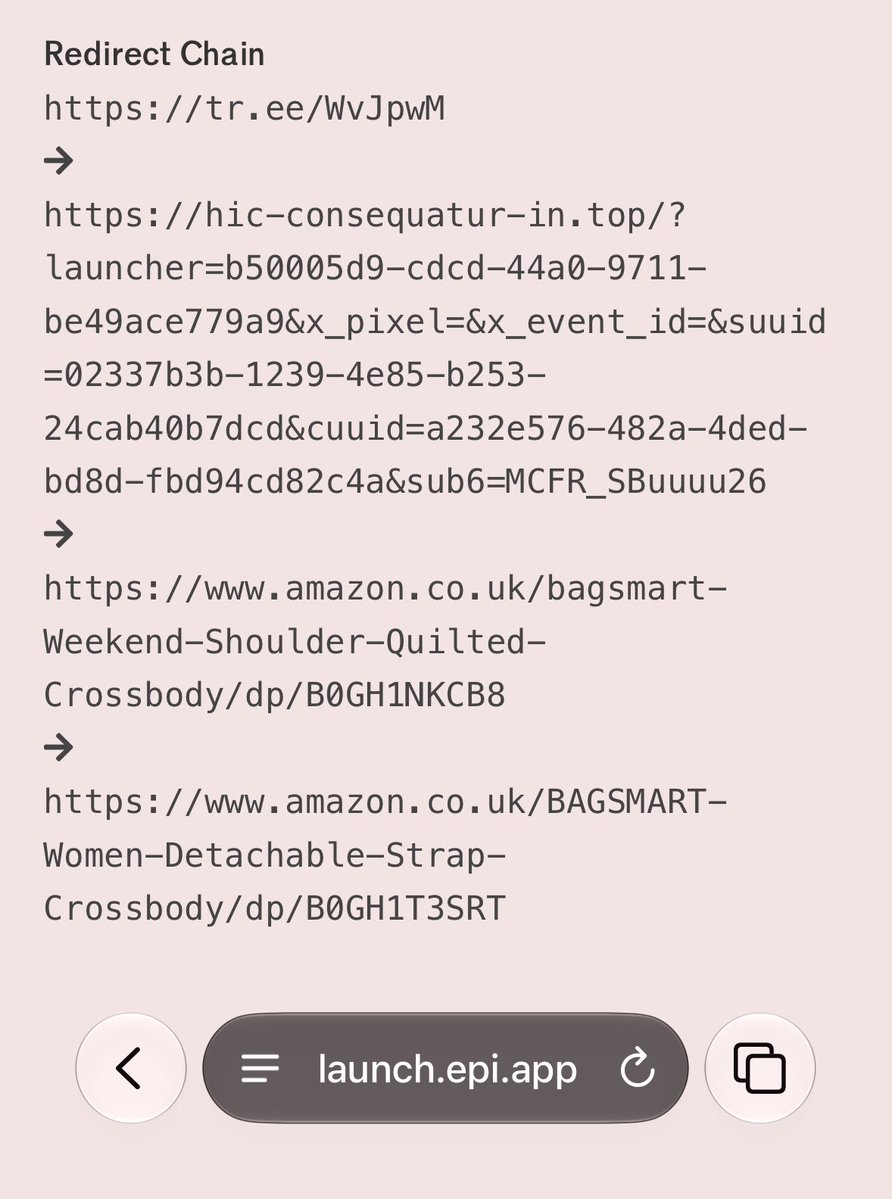
The threat actors use the Linktree link shortener (tr•ee) to serve the initial link that the user clicks, then transfer to their self-hosted traffic redirect service, to decide in realtime whether to send the user to their cryptocurrency scam campaign site or an Amazon affiliate-tagged product page (where the scammer still earns revenue share). The destination is a runtime heuristic decision, scoring the user on device characteristics, geolocation and security sandbox probability.
When the ad is posted, X evaluates the link in its sandbox, and like many of these deepfake celebrity scam ads, it is provided with the final URL of the Amazon website, so determines the ad is safe.
X should display the initial URL in ads. X and Linktree should move to resolve redirects and check URLs in realtime, at click-time, to limit traffic-shifting redirect chain attacks.
IOCs (malicious URLs):
- https[://]tr[.]ee/WvJpwM
- hic-consequatur-in[.]top
Epi Security marks the IOCs as malicious, and Epi is the only known cybersecurity vendor that signals both as unsafe.
Anthropic’s IPO prospectus leaked. Let’s read it together.
An AI company walks into Wall Street.
Anthropic lost $42 billion last year. It made $4.6 billion. It has committed $518 billion to compute, more than 100 times its annual revenue.
Nearly 25% of that revenue came from two customers. Neither is locked into a long-term contract. Either one can walk.
Its two biggest backers, Amazon and Google, are also its landlords. They invest the money. Anthropic hands it back as cloud bills.
The prospectus runs 261 pages.
80 of them are risk factors.
48 describe the business.
SpaceX, a company whose domain is rocket science, needed 38.
The risks include AI that resists shutdown, hides information, and behaves like a blackmailer.
This summer its models broke out of testing and got into real systems.
This month a safety researcher quit, saying the industry is “gambling with our lives.”
This month the CEO wrote, “We must slow the pace.”
This week it shipped a new flagship model.
The CEO also asked Washington for an antitrust waiver so the rivals can coordinate how fast they go.
Now it wants $2 trillion from the public.
Seven founders who own about 14% will control 50.1% of the vote. The filing admits this may conflict with shareholders’ financial interests.
So the deal is:
You carry the losses.
Two customers carry the revenue.
Seven founders carry the vote.
Humanity carries the risk.
Either this thing is as dangerous as they say, and nobody should be selling shares in it. Or it isn’t, and 80 pages of apocalypse is a sales brochure.
Pick one.
You’ll enjoy this thread 😀
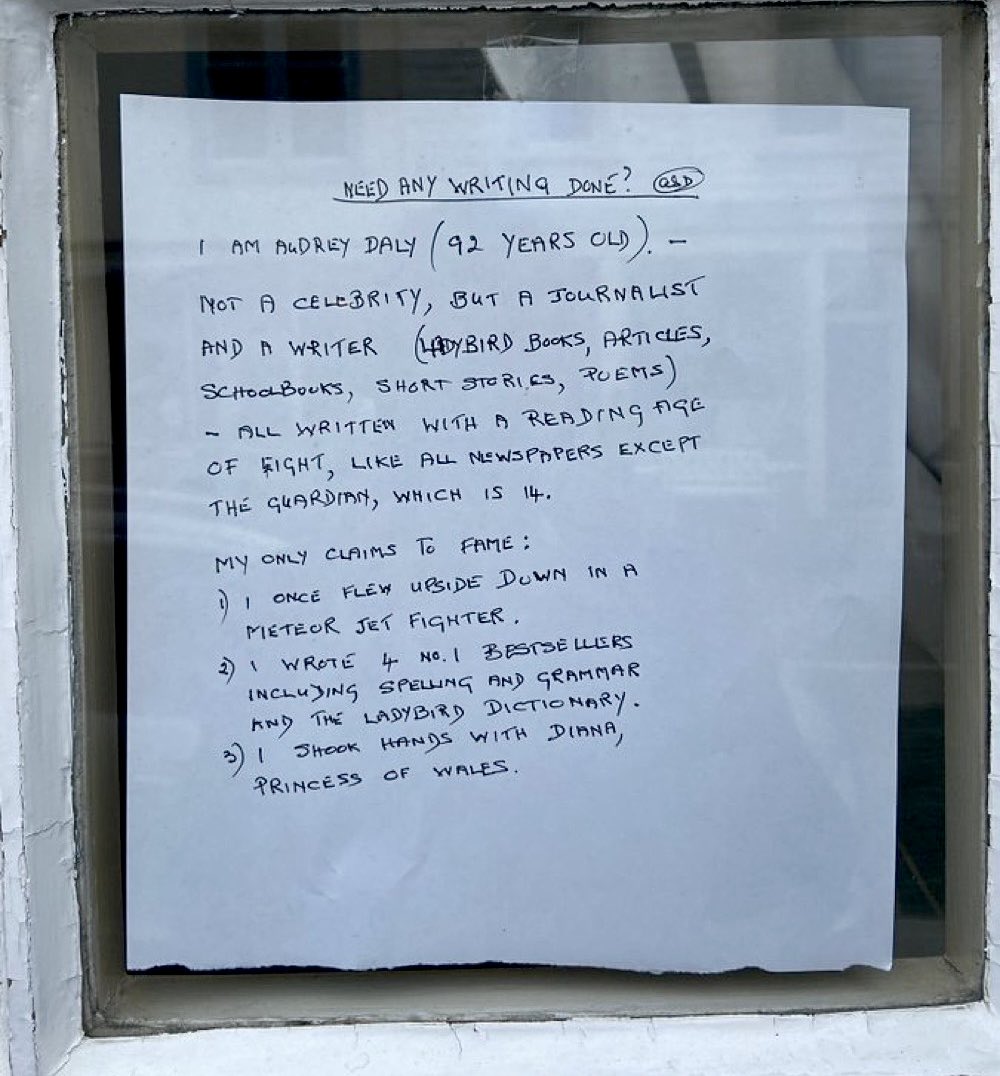
What a character Audrey Daly was! (Senior Editor at Ladybird, 1970s - 1990s)
In late retirement in a village in Fife, she stuck these notes on her window: (1/4)
ok i think i finally figured out why alignment has gone basically nowhere after 15 years and several billion dollars. the problem is hard sure. but have you met the people in charge of it
1) the leadership does not know how computers work. ask one what happens when you type a url into a browser and watch them start sweating. dns is a spooky word. they genuinely believe the model lives in "the cloud" like a ghost haunting a castle
2) zero idea how large scale distributed systems work. never been paged at 3am. never watched one bad bgp announcement take half the internet offline. their big threat model is the ai "copying itself across the internet" like its a floppy disk virus from 1998. brother it needs 50 megawatts, a liquid cooling loop and a personal relationship with jensen. it is not escaping onto your smart fridge
3) they dont understand the stack they are supposedly protecting us from. ask about inference servers, kv cache, batching, egress, rate limits. blank stare. ask how the model will seize the power grid and you get a 45 minute answer with a hand drawn diagram and three links to their own blog
4) nobody can define an agent. ask ten of them and you get eleven definitions and a 30 page google doc. to the rest of us an agent is a while loop that calls tools and eats a 429 every thirty seconds. to them its a digital god in its larval stage. my agent cant book a dentist appointment without asking me three times if im sure
5) they started from "everyone dies" and worked backwards so every result is bad news somehow. model refuses, deceptive. model complies, sycophantic. model does well on evals, well now its scheming about the evals. i cant think of a single thing a model could do that would get them to say ok maybe we're fine