Incrível.
Forjado na Barreira do Vasco, brilhou com a camisa do Vasco e hoje voa pelo mundo.
Humilde ao extremo. Talentoso na mesma medida.
Rayan está na Copa do Mundo 🇧🇷
Present your research at the 20th International Symposium on Microbial Ecology in Auckland, from 16 - 21 August 2026! When submitting your abstract, make sure to check whether you are eligible for one of the travel grants.
https://t.co/GW6qkMHWRA
#microbialecology#isme20
Healthy soils, healthy planet 🌍
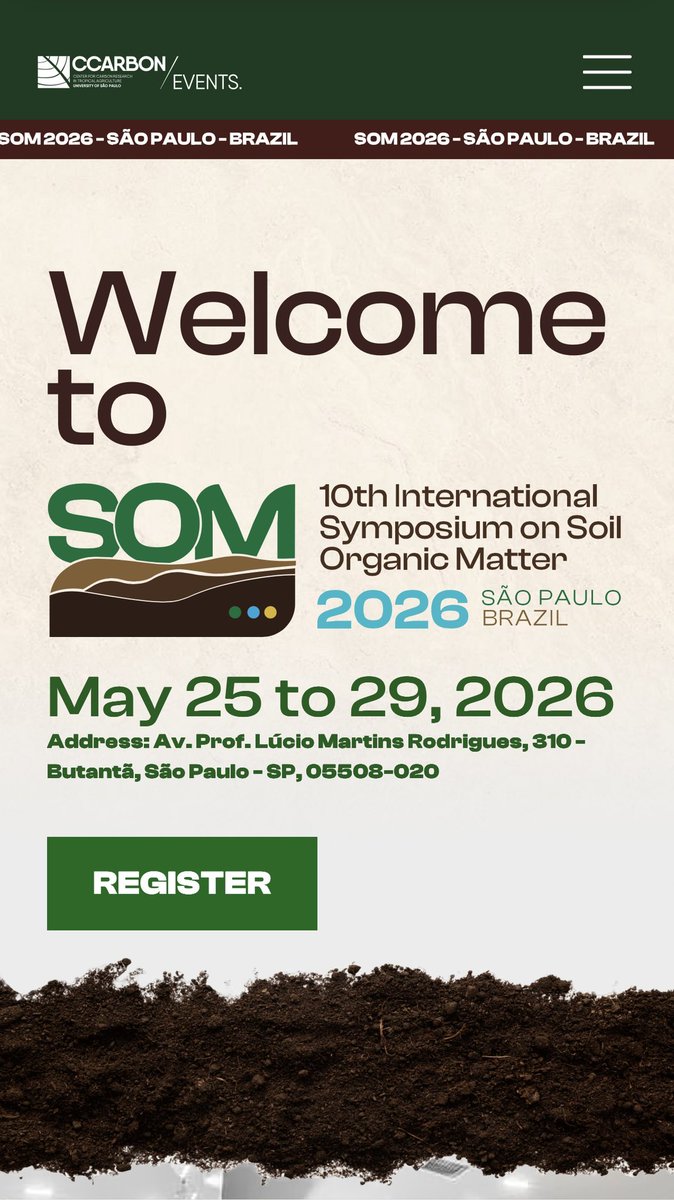
Join us at #SOM2026 — May 25–29, 2026, University of São Paulo, Brazil 🇧🇷
“The Nexus of Healthy Soils and a Sustainable Future.”
Let’s advance soil organic matter research for a sustainable world!
🔗 https://t.co/OKKjYInrOI
#IUSS100#SMOM2026
Thrilled to share our new paper on methane emissions from freshwater ecosystems: Methane from urban river networks: distinct responses of methanogenic pathways to substrate stimulation 👉 https://t.co/Z419sSkovG
Excited to share our first manuscript with colleagues from Northwestern Polytechnical University (Shenzhen, China) and Northwest A&F University (Shaanxi, China), supported by @fapesp and #NSFC
| https://t.co/NIK2yN2c9j|
When asked to draw a scientist, school-age kids in the United States are increasingly sketching women, according to a study from 2018.
Read more on #WomenInScienceDay: https://t.co/gv6TDrdT4r
So happy this is finally out and congratulations to this awesome team. I have been obsessed with this figure for over a year now and for very good reasons as these results bear implications that promise to fundamentally change the microbiome industry and associated therapeutic efforts that rely on microbes. By comparing well over 1 million microbial genomes from cultured and uncultured organisms we found that:
✨ over 95% of the sequenced species of cultivated microbes cannot be recovered from any of the 40K metagenomic samples across all habitats on the planet we have analyzed (orange part of the venn diagram).
✨ this suggests that the vast majority of cultivated microbial species are not sufficiently abundant in any environment to be captured through metagenome-assembled genomes (MAGs).
✨ with over 1.5 million genomes of both cultivated and uncultivated microbes, there remains an enormous diversity of microbial species that we have yet to genomically characterize (grey portion of the venn diagram). This vast diversity offers a glimpse into the rare microbial biosphere of our planet. Its relative presence across ecosystems is a great indicator of each habitat’s resilience and ability to recover from environmental changes. There is much more to explore and discuss on this topic in future work.
✨ we are now working on a hypothesis to explain the very low abundance of cultivated organisms in natural habitats and through that pioneer novel approaches for stable and robust microbial therapeutic interventions.
✨ beyond these incredibly exciting implications, what all this means for all microbial ecologists out there? Based on this ground work, JGI will soon be able to provide a way to let its users know if any newly identified species is part of this rare biosphere, or completely novel species and if in rare biosphere, where else was it seen before.
More on this to follow soon!